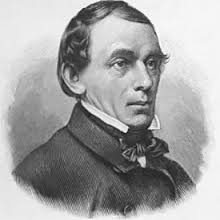
Hermann Lotze (1817 - 1881)
Open Lotze's interactive page (graphs of influences, similar and opposing positions, and quotes)
Background
Hermann Lotze
Born: 21 May 1817 in Bautzen, Saxony
Died: 1 July 1881 (aged 64) in Berlin, Prussia
Alma mater : Leipzig University
Schools: German idealism, Neo-Kantianism
Main interests: Philosophical logic, metaphysics,
biology, psychology, language, morality, religion
Influences: Johann Gottlieb Fichte, F. W. J.
Schelling, G. W. F. Hegel, Johann Friedrich
Herbart, Jakob Friedrich Fries, Gustav Theodor
Fechner, Christian Hermann Weisse, E. H.
Weber, Alfred Wilhelm Volkmann, Leibniz
Influenced: Russell, T. H. Green, Royce, William
James, George Trumbull Ladd, Borden Parker
Bowne, Georg Elias Müller, Carl Stumpf, John
Dewey, Wilhelm Windelband, Frege, Husserl,
Rudolf Christoph Eucken, Santayana, G. E.
Moore, W. E. B. Du Bois, Bernard Bosanquet
From Wikipedia
Lotze was a German philosopher and logician. He also had a medical degree and was well versed in biology. He argued that if the physical world is governed by mechanical laws and relations, then developments in the universe could be explained as the functioning of a world mind. His medical studies were pioneering works in scientific psy- chology…. Lotze denied that he belonged to the school of Herbart. However, he admitted that the monadology of Leibniz could be considered the forerunner of Herbart's teachings and also of his.
Introductory Comments
Do mind and body interact? Surely they do. Stub a toe on a curb and pain arrives, unbidden and unmistakable. Reverse the causal arrow: decide to kick the curb, and - voilà - the curb gets kicked (and the toe, alas, gets stubbed again). Lotze, trained as both a physician and a philosopher, never doubted that such traffic occurs, and he freely admitted that nobody knows how. Then he made a surprising move. The mystery, he argued, is not peculiar to mind and body. Nobody knows how a hammer drives a nail, either. If things were truly separate and self-contained, nothing could act on anything. That things do act on one another shows that they are not separate at all.
Clever. But what good does it do us? At most, the argument shows that interaction is possible, not how it happens. From where we stand, the world still comes in pieces. There are souls and bodies, and, on Lotze's larger map, three distinct realms of facts, laws, and values. Lotze insists these realms are separate only in our thinking and that in reality they form one whole, grounded in God as the highest good. The first step, from interaction to a single reality, is a genuine argument. The last step, from a single reality to a personal God, leans more heavily on what Lotze believed the heart demands. And even if both steps hold, the toe still hurts, and nobody can say how. Having made every cause as puzzling as the mind-body one, Lotze may not have solved the old mystery so much as spread it evenly across the universe.
Some of Lotze's Key Positions
Mechanism is universal in extent but subordinate in significance. Natural science must explain every physical event, living bodies included, by mechanical law, with no appeal to mysterious "vital forces." Yet a purely mechanical account tells us only how things happen, never why they matter, and it has nothing to say about human purposes and ideals.
Soul and body are genuinely distinct. The unity of consciousness, a single self that remembers, compares, and judges, cannot be assembled from scattered material parts. Yet soul and body plainly interact. How can something immaterial act on something material?
The puzzle is not peculiar to mind and body. We cannot explain how any one thing acts on another, not even how a flame melts max, so long as things are treated as wholly independent. Interaction becomes intelligible only if all things are, at bottom, states of one all-embracing reality, so that a change in one part is a change in the whole. That reality is ultimately a personal God.
Besides facts and the laws that govern them, there is a third realm: values, the standards of the good and the beautiful. Values are not an afterthought. They give facts and laws their point. And the three realms of facts, laws, and values are separate only in our thinking. In reality they form one whole, grounded in the highest good.
Place in the History of Ideas
Lotze's Place in History of Ideas
Rubin Gotesky: Like many thinkers born in the first two decades of the nineteenth century, Lotze faced three great schisms: the schism between science and Christianity, which was known at that time as the conflict between science and religion; the schism between reason and feeling; and the schism between knowledge and value. To Lotze, these schisms had to be rationally harmonized in some manner. It seemed impossible to him for any rational man to reject any one of the trinity that composes the total culture of man: science, art, and value. Each has its place in the life of man and the universe, and none can be eliminated without distorting and destroying that life.
Nikolay Milkov: The priority of orderly relations in Lotze’s ontology entailed that nature is a cosmos, not chaos. Furthermore, since the activity that is typical for humans - thinking - is an activity of relating, man is a microcosm This point convinced Lotze to jointly study microcosm and macrocosm....The distinction between the universe as macrocosm and humanity as microcosm gave rise to another central component of Lotze’s philosophy: his anthropological stance. According to Lotze, the fundamental metaphysical and logical problems of philosophy are to be discussed and answered through the lens of the microcosm, that is, in terms of the specific perceptual and rational characteristics of human beings.
Random Thoughts on Lotze
Lotze's attempt to dissolve the mind-body problem is only one of many. Some philosophers escape by declaring that one half of the problem isn't what it seems. Berkeley took the idealist exit. Material objects, he argued, exist only as ideas in minds, so there is nothing alien for the mind to push against. Dennett takes the same exit in the opposite direction. Consciousness as we picture it, a private inner theater, is a kind of illusion. Explain what the brain actually does, he says, and nothing mysterious remains. (Critics grumbled that Dennett's book Consciousness Explained should have been titled Consciousness Explained Away.)
Others insist the problem is real. Thomas Nagel asked what it is like to be a bat, and he observed that no amount of physical detail about echolocation could tell us. Science describes the world from the outside, while experience exists only from within. Colin McGinn goes further. Evolution built our minds to find food, not to fathom themselves, and the answer may lie forever beyond our reach. Navel-gazing won't put dinner on the table, but it might put someone on a tiger's. How, then, does a decision raise an arm? We haven't the foggiest. Lotze would have nodded along. He simply insisted that the fog covers every cause in nature, not just this one. And to add a label: David Chalmers calls explaining why brain activity feels like anything the "hard problem." After several centuries of philosophical guesswork, the adjective seems admirably restrained.
Influences
Lotze was influenced by: Fechner, G., Fichte, Fries, Hegel, Herbart, Leibniz, Schelling, Volkmann, A., Weber, E.H., Weisse, C.H.
Lotze influenced: Bosanquet, Bowne, B.P., Dewey, Du Bois, Frege, Green, Husserl, James, Ladd, G.T., Moore, Muller, G.E., Royce, Russell, Santayana, Stumpf, Windelband
Similar and opposing positions
Thinkers with similar positions:
- Chalmers (Like time & space, consciousness may be a basic property of reality.)
- Chalmers (There's an explanatory gap between physical & phenomenal realms)
- Coleridge (No radical metaphysical split exists between realms of mind & matter)
- Cousin ("Absolute" systems based on deductive abstractions are illegitimate.)
- Goethe (Science & philosophy need to ponder the dynamic character of nature.)
- Humboldt, W. (Mind and body form a vital unity as seen in man's sensuality.)
- McGinn (Our minds may not be equipped to grasp the causes of mind.)
- Whitehead (The world is a process and can't be reduced to mere matter.)
Thinkers with opposing positions:
- Ayer (Metaphysics should play no role in responsible human discourse.)
- Berkeley (Essentially the world does not consist of things, but of mental events.)
- Dennett (Consciousness can be explained with empirical methods.)
- Diderot (The universe is simply matter in motion, bound by laws of nature.)
- Fichte (The world is essentially ideal - just mental images produced by our ego)
- Royce (The Absolute is temporal, personal & the source of community & love)
- Schelling (Properties only belong to the perceived appearance of the objects.)
- Skinner (Our behavior can be reduced to matters of stimulus and response.)
What others said about Lotze
- James: [Lotze has] the most exquisite of contemporary minds.
- R. Collins: Lotze found the properly metaphysical territory not in ontology but in the distinction between a realm of value and the value-indifferent: the task of philosophy is to confer meaning on the meaningless material world.
- Rubin Gotesky: [For Lotze the] urge to be metaphysical is not to be found in metaphysics itself but in ethics, in the desire to know and attain some ultimate good. Thus, metaphysics involves speculating beyond what is scientifically warrantable in order to include that which drives men to write metaphysics: the experience of ultimate goodness.
- C. E. Schutzinger: Body and soul he conceived to be in constant reciprocal relationship: the body affects the soul (e.g, in perception and feeling), while the soul acts upon the body (e.g., in acts of freel will).
- W. Turner: [A connection seems to exists] between Lotze's treatment of the problem of values and [the] pragmatic notion of philosophical method....
- W. Windelband: His own attitude is best characterised by its conception of knowledge as a vital and purposive interaction between the soul and the other "substances."
- Nikolay Milkov: Closely following Trendelenburg, Lotze advanced an objectivist philosophy that did not start from the subject-object opposition in epistemology. He insisted that this opposition is based on a metaphysical relation that is more fundamental. In this way, the very possibility for philosophical subjectivism was suspended.
- Rubin Gotesky: Lotze was essentially an idealist, but his idealism was tempered by his respect for science and his emphasis upon feeling as the dominant element guaranteeing meaning to the life of man.
Schools: Neo-Kantianism, Personalism, Transcendental Idealism
Main interests: Biology, Ethics, Language, Logic, Metaphysics, Psychology, Religion
Lotze's answers to philosophical questions
Art and Aesthetics
The primary way we transmit wisdom and and guidance in human culture is through poetry and religion.
Epistemology
The soul combines the complex and manifold phenomena of our senses into the unity of conscious experience.
Language
Language doesn't picture reality. Rather, it transforms our various sensations into a meaningful, mental phenomena.
Metaphysics
Nature is spiritual in part: A completely mechanical view of nature can't explain human purposes and ideals.
Soul and body clearly interact, but how this occurs we do not know.
Pluralism and monism are reconciled in the soul, which converts a pluralistic world into unified consciousness.
Religion and Theology
The insights of the soul don't contradict the physical laws of nature. Rather, they unite these laws with our mental experience.
Though everything is the personal creation of God, God achieves his ends through the mechanisms we discover in science.