Bernard Bolzano (1781 - 1848)
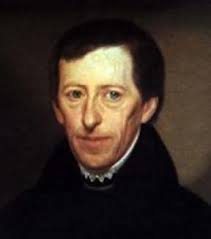
Open Bolzano's interactive page (graphs of influences, similar and opposing positions, and quotes)
Background
Bernard Bolzano
Born: 5 October 1781 in Prague, Kingdom of
Bohemia (now Czech Republic)
Died: 18 December 1848 (aged 67) in Prague,
Kingdom of Bohemia (now Czech Republic)
Alma mater: University of Prague (PhD, 1804)
Schools: Logical objectivism, Utilitarianism
Main interests: Logic, epistemology, theology,
religion, ethics, political philosophy, aesthetics,
metaphysics, ontology, history of philosophy,
mathematics, semantics
Influences: Leibniz, Kant, Abraham Gotthelf
Kästner
Influenced: Carl Stumpf, Husserl, Frege, Kevin
Mulligan, Kazimierz Twardowski, Heinrich
Scholz, Benno Kerry, Georg Cantor, Brentano,
Ryle, Jean Cavaillès, C. S. Peirce, Russell, Jan
Evangelista Purkynû, Karel Rokitansk, Karel
Postl, Frantiek Tkadlík, Jan Łukasiewicz
From Wikipedia
Bolzano was a Bohemian mathematician, logician, philosopher, theologian and Catholic priest of Italian extraction, also known for his liberal views.... For the most part, his work came to prominence posthumously…. Bolzano alienated many faculty and church leaders with his teachings of the social waste of militarism and the needlessness of war. He urged a total reform of the educational, social and economic systems that would direct the nation's interests toward peace rather than… armed conflict….
Introductory Comments
Bolzano was one of history's great polymaths: mathematician, logician, philosopher, theologian, scientist, political theorist, social and educational reformer, professor, and priest - he was all of these things. Yet one idea threads through everything he wrote: truths (or what he called "truths in themselves") exist independently of any mind at all, human or otherwise. This simple conviction - that truth is objective, eternal, and yet accessible to reason - captivated Bolzano. It played a particularly important role in his works on logic, mathematics, and, surprisingly enough, theology.
As a Catholic priest, Bolzano saw no conflict between this austere logical doctrine and his faith. God, as the source of all being, is also the ultimate ground of all truth. This is not to say that God creates all true propositions, nor that all true propositions somehow exist in God, but rather that God knows them all. For Bolzano, truth remains independent of any thinker, divine or human. This is why he insisted that revelation could never contradict what reason discovers: both answer to the same unyielding, mind-independent truth.
That same faith in truth's absolute objectivity animated his ethics and politics, and it fed the courage behind his blunt critiques of militarism and imperialism. To defend the truth, for Bolzano, was to defend something sacred - no matter the subject, no matter the cost. In his world, even a math proof could be a quiet hymn to God.
Some of Bolzano's Key Positions
Human knowledge captures only a sliver of the truths that could be stated. Truths do not wait on anyone to notice them; they hold whether or not a mind ever grasps them, and there are infinitely many. Yet even the sliver we have collected outruns what any single person could master. So knowledge gets parceled out into portions small enough to be learned.
Those portions are the sciences. Deciding where to draw the lines between them is itself a discipline - the theory of science. It asks which truths genuinely belong together, but it is not a purely logical exercise.
Propositions and truths "in themselves" occupy no place in the causal order. A truth about lightning is no more located in space and time than a truth about syllogisms; neither one strikes anything or is struck. What exists in time are the thinkings and utterings of propositions, not the propositions thought or uttered.
Nor are propositions linguistic. A sentence expresses a proposition; it is not identical with it. The same proposition survives translation into German or English, and a proposition no one has ever voiced is a proposition still. Words are the handle, not the tool. A proposition's truth depends on how its parts are put together and on whether the objects its parts pick out really have the properties ascribed to them.
Place in the History of Ideas
Bolzano's Place in History of Ideas
Edgar Morscher: [Bolzano was] an outstanding mathematician and one of the greatest logi- cians or even (as some would have it) the greatest logician who lived in the long stretch of time between Leibniz and Frege. As far as logic is concerned, Bolzano anticipated almost exactly 100 years before Tarski and Carnap their semantic definitions of logical truth and logical consequence; and in mathematics he is not only known for his famous Paradoxes of the Infinite, but also for certain results that have become... standard in textbooks of mathematics such as the Bolzano-Weierstrass theorem.
J. Alberto Coffa: While the idealists were removing every trace of objectivity from Kant's semantics, there was in a corner of the Austro-Hungarian empire, ignored by the leaders of German philosophy, a Czech priest by the name of Bernard Bolzano, who was engaged in the most far-reaching and successful effort to date to take semantics out of the swamp into which it had been sinking since the days of Descartes. Bolzano was the first to recognize that tran- scendental philosophy and its idealistic sequel were a reductio ad absurdum of the semantics of modem philosophy. He was also the first to see that the proper prolegomena to any future metaphysics was a study not of transcendental considerations but of what we say and its laws and that consequently the prima philosophia was not metaphysics or ontology but semantics.
Random Thoughts on Bolzano
Bolzano was a Catholic priest who spent his life on logic and mathematics. This odd combination of interests is less odd than it looks. The pattern is crowded: Pythagoras and his number-worshipping brotherhood, then Anselm, Aquinas, Duns Scotus, Descartes, Pascal, Leibniz, Boole, Dummett. Some of this is institutional history - for centuries the monastery and the university were much the same building. But that explains the overlap, not the enthusiasm. The enthusiasm came in varieties. Descartes put God underneath the arithmetic: our clearest and most distinct ideas can be trusted only because a God would not us. Pascal ran reason to the end of its tether and then let go, leaving room for a heart with reasons of its own. Others took logic up as a tool in theology's service, as seen in Anselm's ontological argument - a proof of God's existence via a definition and a few quick moves.
Bolzano belongs to a stranger group: those who found a mysticism inside mathematics. Not in the way one might expect. He did not hold that truths live in the mind of God; his achievement was to pry truth loose from every mind, God's included. God knows all truths, but knowing them is not what makes them true. Yet notice what follows. If a truth depends on no mind at all, the theorem a student finally grasps at two in the morning is no human copy of a divine original. It is the same truth, entire - the one God contemplates. Every valid proof therefore marks a point at which finite human reason touches infinite understanding.
Influences
Bolzano was influenced by: Kant, Kastner, A.G., Leibniz
Bolzano influenced: Brentano, Cantor, Cavailles, J., Frege, Husserl, Kerry, Benno, Lukasiewicz, Mulligan, K., Peirce, Postl, Karel, Purkynu, J.E., Rokitansk, K., Russell, Ryle, Scholz, H., Stumpf, Tkaklik, F., Twardowski, K.
Similar and opposing positions
Thinkers with similar positions:
- Carnap (Meaning of a sentence is equivalent to stating its truth conditions.)
- Frege (Logic is the appropriate measure of what can or cannot be.)
- Husserl (Thought is intentional. It is by nature about or directed toward objects)
- Kant (What is good must be regarded as such without adding qualification.)
- Mill (Our guiding moral principle must be to advance the general welfare.)
- Plato (The soul, being the very likeness of the divine, is pure and immortal.)
- Santayana (The nature and meaning of truth is complex and multifaceted.)
Thinkers with opposing positions:
- Bergson (Intuition gives our minds direct access to the nature of reality.)
- Goodman (Philosophy, logic, and math should dispense with set theory.)
- Hamann (I trust the power of passion and symbol over abstraction and logic.)
- James (Logic is not an adequate measure of what can or cannot be.)
- Kant (Moral judgments must be unconditional and universally applicable.)
- Leibniz (Simple substances are "windowless": they do not interact.)
- Lewis, C.I. (First principles in logic must be based on pragmatic considerations.)
- Marx (The comfort of religion is illusory & keeps the masses quietly enchained.)
- Williams, B. (We can't reduce moral decisions to a few utilitarian algorithms.)
What others said about Bolzano
- P. Simons: Bolzano's... reliance on [logic]..., his [monadology] and his many-sidedness helped to earn him his sobriquet of "the Bohemian Leibniz."
- Sandra LaPointe: The importance of Bolzano’s contribution to semantics can hardly be overestimated. The same holds for his contribution to the theoretical basis of mathematical practice.
- Husserl: Bolzano did not, of course, expressly discuss or support any independent demarcation of pure logic in our sense, but he provided one de facto...; he did so with such purity and scientific strictness, and with such a rich store of original, scientifically confirmed and fruitful thoughts, that we must count him as one of the greatest logicians of all time.
- Dorothy Maud Wrinch: He possessed not only the sympathy for the poor necessary for a social reformer, but the ability to develop his ideas of social reconstruction on practical lines.
- Wolfgang Künne: Bernard Bolzano was a lone forerunner both of analytical philosophy and phenomenology.
- Sandra LaPointe: As a mathematician, Bolzano was attuned to philosophical concerns that escaped the attention of most of his contemporaries and many of his successors.
- Edgar Morscher: The presentation of Bolzano’s personality... would still be incomplete unless it were added that Bolzano was also a great philanthropist. This becomes evident not only by Bolzano’s writings in ethics and political philosophy, but it also manifests itself in practice by his activities for the benefit of the poor, subjugated [and] discriminated... people.
- Helena Lorenzová: Bolzano believed that the highest moral law of the individual is to contribute one's bit to the public welfare, family, nation, state and all human beings as much as he is able to.
Schools: Consequentialism, Rationalism, Transcendental Idealism, Utilitarianism
Main interests: Art and Aesthetics, Epistemology, Ethics, History of Philosophy, Logic, Mathematics, Metaphysics, Political Philosophy, Religion, Semantics, Theology
Bolzano's answers to philosophical questions
Epistemology
Logic is essential to our understanding & arranging of truths - not only in philosophy, but also in all intellectual disciplines.
"Even in the realm of things which do not claim actuality [nor even] possibility, there exist... sets which are infinite."
Ethics
Personal happiness should never be one's primary aim in life. Instead, we should contribute to the welfare of others.
The highest good is to help or somehow contribute to others - be they family, friends, neighbors, or society in general.
Language
Like logic, language is an essential component of our reasoning, but its nature & its limitations should always be kept in mind.
If we don't keep in mind the nature & limitations of language, we can't reliably determine the truth of our own propositions.
Philosophy
Logic is needed not only to determine the truth of propositions, but also to see the connection between true propositions.