Proclus (412 - 485)
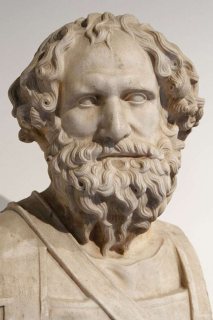
Open Proclus's interactive page (graphs of influences, similar and opposing positions, and quotes)
Background
Proclus Lycaeus
Born: 8 February 412 in Constantinople,
Byzantium
Died: 17 April 485 (aged 73) in Athens, Greece
Other names: "The Successor"
Era: Ancient philosophy
Region: Western philosophy
School: Neoplatonism
Main interests: Mathematics, religion,
metaphysics, astronomy, ethics
Influences: Plotinus, Aristotle, Plato, Plutarch of
Athens, Syrianus, Iamblichus, Hipparchus,
Ptolemy, Euclid
Influenced: Damascius, Pseudo-Dionysius,
Ammonius Hermiae, Marinus, Marsilio Ficino,
St. Thomas Aquinas, Nicholas of Cusa, Boethius,
Meister Eckhart, Mirandola, Gemistus Pletho,
Johannes Kepler, Thomas Taylor, Ralph Waldo
Emerson
From Wikipedia
Proclus was a Greek Neoplatonist philosopher, one of the last major classical philosophers of late antiquity. He set forth one of the most elaborate and fully developed systems of Neoplatonism and, through later interpreters and translators, exerted an influence on Byzantine philosophy, Early Islamic philosophy, Scholastic philosophy, and German Idealism, especially G.W.F. Hegel, who called Proclus's Platonic Theology "the true turning point or transition from ancient to modern times, from ancient philosophy to Christianity."
Introductory Comments
When we think about the early Christians in the Roman Empire, we picture persecution first (all those hungry lions), then revelation (Constantine bearing the sign of the cross into battle), then vindication (the Edict of Thessalonica, which in 380 made Christianity the state church). What we forget is the epilogue. Once that edict took hold, pagan temples were shuttered and pagan practices banned. The persecuted had become the persecutors, and the pagans were now the ones in the crosshairs.
Among them was Proclus. He accepted the old gods, but he understood them through the lens of his Neoplatonism - not as the quarrelsome deities but as aspects of the One. And within the relative safety of the Academy in Athens (the very school Plato founded some eight centuries earlier), he practiced pagan rituals recast as preparations for the soul's ascent toward that same One.
But as persecution of the pagans grew, Proclus had to slip out of Athens for a year. And the ironies keep coming. Before long the triumphant Christians began to absorb the very Neoplatonism they had pushed to the margins. You can see it plainly in Pseudo-Dionysius, deeply indebted to his older contemporary Proclus, who in turn steered Christian theology toward a distinctly Proclian mysticism. Which yields one last irony: echoes of Proclus can still be heard today - but chiefly in a religion he himself rejected.
Some of Proclus's Key Positions
That the One - divine unity itself - exists can be proven by reason alone. And what reason establishes does not stop there: from the One follow, by strict logical descent, all the things we encounter, including the material world and the immaterial souls that move within it.
Plotinus never adequately explained how the One gives rise to the teeming multiplicity we see around us. That multiplicity forms a hierarchy. At its summit stands the One. But the One is a power and principle rather than a being, for a being has some particular nature, and anything with a particular nature is no longer universal.
Even so, we can say this much: the One is unified and Good - and thus the wellspring of every good thing in the world. Highest among these are the henads. Overflowing from the abundance of the One, they are identified with the Greek gods. Like the One, they lie beyond being; yet represent distinct ways of being, channels through which the One's goodness pours downward.
Beneath the henads comes Nous or Divine Intellect. From Intellect proceeds Soul, and from Soul the material cosmos itself. Individual souls participate in the universal Soul, but in their embodied state they are easily seduced by the physical world and its distractions. Here philosophy earns its keep, for it alone can rescue the soul and turn it back toward its source.
Place in the History of Ideas
Proclus's Place in History of Ideas
William Turner: Proclus endeavored by means of Aristotelian dialectic to synthesize and systematize the Neo-Platonic doctrines. He retained the essential elements of Neo-Platonism - monism, doctrine of the Nous, emanation, antithesis of matter and spirit, mysticism, belief in demons, magic, etc. The principle on which he endeavored to unify all these was that of triadic development. That which is produced is similar to that which produces it; at the same time it differs from it, as the derivative differs from the original. By reason of its difference from the original, the derivative differentiates or produces; while by reason of its identity with the original, it tends to return to it. Thus we have the original, the emergence from the original, and the return (in a lower form) to the original - the three stages of the triadic development.
Anthony Gottlieb: [Proclus's] universe is an arcane zoo in which pagan deities rub shoulders with barely comprehensible platoons of abstractions. In an attempt to insulate the divine and perfect One from contamination by the lower orders of existence, Proclus added many new intermediate levels of reality to a picture that was complicated enough already. Many of his innovations came grouped as triads, which sometimes gave Christians the impression that what he was really talking about was the Holy Trinity.
Random Thoughts on Proclus
Proclus taught that we need physical rituals - chants, symbols, sacred objects - to remind us of our spiritual origin. This seemingly paradoxical claim points to a problem baked into spirituality itself. How can bodily creatures, marinating in a material world, ever conceive of a realm that is neither bodily nor material? Plato had it easy. In the Allegory of the Cave, he simply drags his prisoner out into the blinding light above, but such dragging is not possible for us non-allegorical beings. (Even Star Trek's transporter is no help here - it only beams you from one material place to another.) So how are we to picture a realm that is the opposite of everything we've ever known: nonspatial, nonphysical, nontemporal? Many mystics go further still, claiming that in this realm even personal identity dissolves into the Oneness of Being. But that only makes the problem worse: how can you imagine yourself in a realm where there's no longer a "self" left to do the imagining, nor a "you" to be imagined?
Seen this way, Proclus's ritual prescription looks less like a contradiction than a quiet confession: we can't actually imagine the spiritual realm, so we gesture toward it with candles and chants instead. Some mystics claim that drugs or prolonged meditation can occasionally deliver the real thing - a fleeting blissful taste of the self dissolving into the One. Fair enough. But that only sharpens the puzzle: if the self has truly dissolved, who, exactly, is left standing there to feel the bliss?
Influences
Proclus was influenced by: Aristotle, Euclid, Hipparchus, Iamblichus, Plato, Plotinus, Plutarch of A., Ptolemy, Syrianus, Thales
Proclus influenced: Al-Kindi, Ammonius, Aquinas, Boethius, Damascius, Eckhart, Emerson, Ficino, Kepler, Marinus, Nicholas of C., Pico, Pletho, G., Pseudo-Denys, Taylor, Thomas
Similar and opposing positions
Thinkers with similar positions:
- Boethius (Things are known according to the character of the knowing subject.)
- Bradley (Reality is ideal, whole and one. There are no real separate things.)
- Eriugena (God has created the world out of his own being.)
- Ficino (A hierarchy of substances descends from God down to lowly matter.)
- Heraclitus (There's a certain unity of opposites at work in our changing world.)
- Iamblichus (The purely contemplative part of the Soul is its higher & eternal part.)
- Ibn Tufail (Preoccupation with the physical world can never lead to happiness.)
- Nicholas of C. (We gain a mystic unity with God thru intellectual intuition.)
- Plotinus (The One, being perfect & eternal, is stable, uniform and unchanging.)
- Pseudo-Denys (God is beyond reason. We know what He isn't, not what He is.)
Thinkers with opposing positions:
- Averroes (The individual's soul ends when he or she dies. It is not eternal.)
- Bacon, Francis (All real knowledge rests upon observed facts & scientific method)
- Deleuze (There is no one substance, only an always-differentiating process.)
- Democritus (Everything is the result of natural laws related to matter & motion)
- Feyerabend (The mind/body distinction is confused. The mind is a physical thing)
- Holbach (The universe is simply matter in motion, bound by laws of nature.)
What others said about Proclus
- E. R. Dodds: [Through his influence on Pseudo-Dionysius] Proclus was... conquering [medieval] Europe in the guise of an early Christian.
- William Turner: Proclus maintained that the duty of man is to rise from the sensuous to the supersensuous, in the hope of reaching the mystical union with God which constitutes supreme happiness.
- Hegel: In Proclus we have the culminating point of the Neo-Platonic philosophy; this method in philosophy is carried into later times, continuing even through the whole of the Middle Ages. … Although the Neo-Platonic school ceased to exist outwardly, ideas of the Neo-Platonists, and specially the philosophy of Proclus, were long maintained and preserved in the Church.
- Anthony Gottlieb: [Proclus'] aim was to build a bridge between the gods who look down on the world and the souls who look up from it, a task best achieved by magic and religion.
- William Turner: It was Proclus who gave to Neo-Platonism its final and most complete form.
- Wilhelm Windelband: Personally, Proclus is characterised by the mingling of a superabundant credulous piety with a logical formalism carried even to pedantry, a combination which is highly interesting psychologically.
- Victor Cousin: [In Proclus] are combined, and from whom shine forth, in no irregular or uncertain rays, Orpheus, Pythagoras, Plato, Aristotle, Zeno, Plotinus, Porphyry, and Iamblichus.... [Proclus] had so comprehended all religions in his mind, and paid them such equal reverence, that he was, as it were, the priest of the whole universe!
- Emerson: [In reading Proclus] I am filled with hilarity and spring, my heart dances, my sight is quickened, I behold shining relations between all beings, and am impelled to write and almost to sing.
Schools: Emanationism, Mysticism, Neoplatonism
Main interests: Astronomy, Chain of Being, Ethics, Free/Unfree Will, Immortality, Mathematics, Metaphysics, Religion, Spirituality, Universals
Proclus's answers to philosophical questions
Art and Aesthetics
Beauty has a mathematical aspect: "Whenever there is number, there is beauty."
Epistemology
Perfect knowledge is beyond us, "for we are men, who speak according to what is likely, and whose lectures resemble fables."
Reason reveals not only the nature of the One, but also all things that follow from the One: matter, thought, soul, etc.
For all essential matters, truth is found within us. The source of fundamental knowledge is within the soul itself.
Ethics
"A true philosopher is married to wisdom; he needs no other bride."
Metaphysics
From the One springs all else: Intellect, Soul, Thought, Matter, etc. From these in turn spring individual souls & things.
"He whose intellectual eye is fixed on that which is... comprehensive, will think but little of that which is sensible and singular."
Nature
"If you could hear the sound produced by the galaxies, you would... realize that the system is based upon a basic harmony...."
Philosophy
"[Mathematics] awakens the mind and purifies the intellect; She brings light to our intrinsic ideas; She abolishes oblivion…."
As a discipline, philosophy can help prevent the soul from being overly enamored with the physical world.
Religion and Theology
The One is a transcendent principle, not a being. The One has no particular nature, yet is the source all beings & things.
Though the One and all that follows from it are completely rational, it is important to observe the rites of ancient faiths.
Sex and Gender
Being under the special guidance of female divinities, such as Athena, it is only proper that we endorse female education.