Jean Murdoch (1919 - 1999)
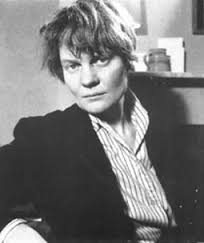
Open Murdoch's interactive page (graphs of influences, similar and opposing positions, and quotes)
Background
Jean Iris Murdoch
Born: 15 July 1919 in Dublin, Ireland
Died: 8 February 1999 (aged 79) in Oxfordshire,
England
Occupations: Novelist, Philosopher
Education: Somerville College, Oxford,
Newnham College, Cambridge
Spouse: John Bayley (m. 1956–99)
Main Interests: Ethics, politics
Influences: Simone Weil, Shakespeare, Plato,
Jean-Paul Sartre, Fyodor Dostoyevsky, Sigmund
Freud, Elizabeth Anscombe, Marcel Proust,
Arthur Schopenhauer, Raymond Queneau,
George Eliot, Ludwig Wittgenstein, Søren
Kierkegaard, Leo Tolstoy, G. W. F. Hegel,
Immanuel Kant
Influenced: Martha Nussbaum, Alasdair
MacIntyre, Philippa Foot, John Henry McDowell
From Wikipedia
Murdoch was an Irish and British novelist and philosopher. Murdoch is best known for her novels about good and evil, sexual relationships, morality, and the power of the unconscious…. Her philosophical work was influenced by Simone Weil (from whom she borrows the concept of "attention"), and by Plato, under whose banner she claimed to fight. In re-animating Plato, she gives force to the reality of the Good, and to a sense of the moral life as a pilgrimage from illusion to reality.
Introductory Comments
Though Murdoch was writing at a time when metaphysics was being shown the door by the bouncers of Logical Positivism, she herself re- mained an unrepentant metaphysician and Platonist - someone who embraced the Idea of the Good in all its metaphysical glory. For her, the Good was not a mere moral slogan or deco- rative ideal, but a real and transcendent pres- ence. The Good is "real" in the sense that it pro- vides an objective standard beyond the ego. However, it is also elusive: we cannot fully de- scribe or grasp it conceptually. This makes her metaphysics both realist (there is something objectively there) and apophatic (it resists full articulation).
Murdoch’s metaphysics is also deeply tied to her view of human consciousness. Influenced in part by Simone Weil, she emphasized the moral importance of attention - a kind of loving, just perception of reality, as opposed to the self-flattering fog most of us mistake for reality. Morality, on this view, is less a matter of grand decisions at dramatic crossroads than of the slow, unglamorous labor of seeing clearly what or who is right there in front of you. Life is then a pilgrimage from illusion to reality - not unlike Plato's Myth of the Cave. The difference being that unlike Plato's spelunking hero, Murdoch's hero stays put but achieves something much more difficult than discovering eternal Forms that don't exist: she discovers people that do.
Some of Murdoch's Key Positions
Though morality is measured according to outward behavior, its source and discipline is largely a matter of perception. That is, to become truly moral creatures, we must learn to see others with more justice. We must see others as they truly are, not as they may aid or hinder our personal interest or vanity.
And when we learn to see others as they truly are in themselves, our behavior towards them will naturally become more just. Morality will no longer require conscious exertion: it will simply flow from how we see the world and the people we encounter.
As argued in Plato's Allegory of the Cave, perception is central not only to morality, but also to metaphysics: When we leave the dark, narrow cave and at last witness the form of the Good, our entire view of the world is transformed. The Good then is seen as more than a moral term: It is a transcending ideal, an eternal power, an object of love.
However, as finite human beings, this love must be directed towards the objects and persons of this world - not to the abstract form itself. We love flesh and blood persons in light of the Good, since we too are made of flesh and blood. Having said this though, the Good lifts us above "natural psychology" and gives human love a touch of the divine.
Place in the History of Ideas
Murdoch's Place in History of Ideas
Lawrence Blum: Iris Murdoch was a prominent British philosopher of the second half of the 20th century, best known for her moral philos- ophy. Unusual for her times, she combined her grounding in Wittgensteinian and linguistic/ analytic philosophy with a strong influence of 19th and 20th century Continental philosophy, Christian religion and thought, and Hindu and Buddhist philosophy. Though linked with virtue ethics, care ethics, and particularism, she devel- oped a unique form of Platonic moral realism not readily assimilated or even comparable to any of the dominant approaches to ethics in 20th century Anglo-American philosophy.
Daniel J. Sundahl: As for existentialism, for Murdoch it meant not "being" or "becoming" but authoring her opposition to that "philosophy." She... notes that "Sartre by-passes… the world of ordinary human relations which is also the world of ordinary moral virtues."... Her philosophical purpose was to hold up a theory of moral life opposed to Sartre’s solipsistic romantic figure, marooned, isolated, and alienated. Murdoch’s argument rebuts Sartre’s argument that the "will" is dormant, if not detached, but emerging at points of decision largely public. For Murdoch, Sartre’s theory is impoverished and fails to do justice to spiritual realities. Such an argument also prescribes moral acts accountable only in their public effects.
Random Thoughts on Murdoch
Though Murdoch was an admitted metaphysi- cian who embraced the Idea of the Good, she was no otherworldly mystic gazing serenely past her neighbors toward the Idea itself. Being that we are all finite creatures of flesh and blood, she insisted we must direct our love to- ward other creatures of flesh and blood - the Good glimpsed through persons, not instead of them. Here she sounds not unlike Martin Buber: genuine moral life unfolds in the encounter with a real other, truly seen. When we perceive the person in front of us justly and lovingly, moral responsiveness tends to follow almost of its own accord; cruelty, by contrast, is usually a failure of vision before it is a failure of will.
All of which has rather pointed consequences for the self. For Murdoch, the self is not the sovereign, self-authoring agent beloved of Sartre and the existentialists - striking heroic poses and forging values from the void - but something altogether more humbling: a clut- tered, partial, ego-ridden thing that must be disciplined and refined before it can see much of anything truly. Murdoch therefore declined both fashionable invitations of her age: the materialist's, which reduces moral and aesthetic experience to neurons and noise, and the exis- tentialist's, which conjures values out of the hat of human choice. In short, goodness is not in- vented; it is discovered - and the discovery is the work of a lifetime. If Murdoch is right.
Influences
Murdoch was influenced by: Dostoyevsky, Eliot, George, Freud, Hegel, Kant, Kierkegaard, Plato, Proust, Queneau, Sartre, Schopenhauer, Shakespeare, Tolstoy, Weil, Wittgenstein
Murdoch influenced: Anscombe, Foot, MacIntyre, McDowell, Nussbaum, Williams, B.
Similar and opposing positions
Thinkers with similar positions:
- Borges (Writing fiction can be an engaging & effective way to do philosophy.)
- Buber (Morals improve along with our improved perspective on people.)
- Einstein (The most important human endeavor is the pursuing of moral aims.)
- Foot (Ethics should emphasize internal virtues, not external results.)
- Lewis, C.I. (Value statements are not merely expressive. They have meaning.)
- Plato (The Good, though an idea, is a real and powerful force in the world.)
- Pseudo-Denys (To truly know the moral good we must know the eternal Good.)
- Shaw (Morality can be effectively taught through stories and parables.)
Thinkers with opposing positions:
- Bataille (Literature has no moral purpose. It's best when disrupting morals.)
- Bentham (Our ultimate motive is always to experience pleasure and avoid pain.)
- Hare (Moral statements do not objectively describe, but rationally prescribe.)
- Sartre (Literature has a moral purpose: the realization of a free humanity.)
- Schopenhauer (Art exists in a realm free of the forces at work on & within us.)
- Spinoza (Moral absolutes do not exist. Nothing is inherently good or evil.)
- Stevenson (Moral statements do not express propositions but mere emotions.)
- Williams, B. (Moral statements express attitudes or feelings, not empirical facts)
What others said about Murdoch
- S. Hannah: What I love most about Murdoch’s writing is its accuracy in portraying the human experience at its most passionate and comically absurd.
- Daniel J. Sundahl: Murdoch’s point is that if we think of love and beauty as "things," we risk falling into egoistic fog.... But if we think of them as transcendent they point to something... infinitely beyond our own limited conception.
- Lawrence Blum: For her entire career, she retained a strong sense of the value of metaphysics both in itself and as providing broader visions and structures for moral philosophical reflection, while also appreciating the force of especially a Wittgensteinian critique of traditional metaphysics.
- Charlotte Mendelson: [Murdoch’s novels] work for everyone because she understood our secret lives: falling in love with exactly the wrong person, maddened with inconvenient lust and sadness and fear. Her books are full of passion.
- Maria Antonaccio: [Murdoch was an] unapologetically Platonic and metaphysical thinker… [which] testifies to the fecundity of [her] thought.
- James Wood: In her literary and philosophical criticism, she again and again stresses that the creation of free and independent characters is the mark of a great novelist; yet her own characters never have this freedom.
- Alex Clark: [Murdoch explored] the terrifying truth that human beings, in the absence of God, are off the leash, motivated and animated by powerful internal forces beyond their apprehension, unable to conceive of goodness as an end in itself.
- Lawrence Blum: Over her lifetime Murdoch developed an entirely distinctive position in moral philosophy, as well as philosophy of art and religion (both of which she saw as important for morality).
Schools: Aristotelianism, Communitarianism, Existentialism, Humanism, Liberalism, Virtue Ethics
Main interests: Biography, Communication, Desire, Ethics, Fact–value distinction, Free/Unfree Will, Friendship, Happiness, Human Will, Language, Literature, Love, Politics, Psychoanalysis, Virtue
Murdoch's answers to philosophical questions
Art and Aesthetics
"Art is a kind of artificial memory and the pain which attends all serious art is a sense of that factitiousness."
"Art and psychoanalysis give shape and meaning to life and that's why we adore them."
"The most essential [part of culture is] literature, since [it teaches us] how to picture and understand human situations."
"Good art shows us how difficult it is to be objective by showing us how differently the world looks to an objective vision."
Education
Education "convinces us that there is only one freedom of any importance whatsoever, that of the mind…."
Ethics
We must remember though that "to be understood is not a human right. Even to understand oneself is not a human right."
"Our destiny can be examined, but it cannot be justified or totally explained. We are simply here."
"Love is the extremely difficult realization that something other than oneself is real."
"Freedom may be a value in politics, but it is not a value in morals."
"Of course reading and thinking are important but, my God, food is important too."
Metaphysics
Objective values - especially moral ones - are as real (in an important sense) as are physical objects.
The form of the Good is not a personal God, but a transcendent reality that we can orient our lives and relationships toward.
Mind
"The chief requirement of the good life... is to live without any image of oneself."
Nature
"People from a planet without flowers would think we must be mad with joy the whole time to have such things about us."
Philosophy
"The role of philosophy might be said to be to extend and deepen the self-awareness of mankind. "
"In philosophy if you aren't moving at a snail's pace you aren't moving at all."
"Learning philosophy is learning a particular kind of intuitive understanding."
Psychology
Our many "blinding self-centered aims and images [are] a powerful system of energy, and most of what is often called 'will.'"
To be truly productive and content in life, we must jump outside our measly ego and see the reality of what is outside the self.
"Happiness is... one's most ordinary and everyday mode of consciousness being busy and lively and unconcerned with self."
Religion and Theology
"It is in the capacity to love, that is to SEE, that the liberation of the soul from fantasy consists."
"There is no beyond, there is only here, the infinitely small, infinitely great and utterly demanding present."
Sex and Gender
"The absolute yearning of one human body for another... and its indifference to substitutes is one of life's major mysteries."
"Every man needs two women, a quiet home-maker, and a thrilling nymph."
"I think being a woman is like being Irish. Everyone says you're important and nice, but you take second place all the same."