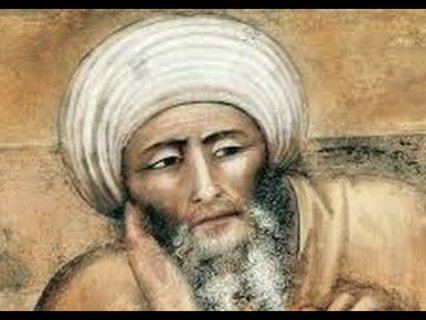
Averroes was an Andalusian polymath and jurist who wrote about many subjects, including philoso- phy, theology, medicine, astronomy, physics, psy- chology, mathematics, Islamic jurisprudence and law, and linguistics…. Averroes was a strong pro- ponent of Aristotelianism; he attempted to restore what he considered the original teachings of Ari- stotle and opposed the Neoplatonist tendencies of earlier Muslim thinkers, such as Al-Farabi and Avicenna. He also defended the pursuit of philoso- phy against criticism by... Al-Ghazali.
Introductory Comments
As most of us come to realize sooner or later, a life can turn on a lucky break or, alas, a missed opportunity. Consider a favorite tale from the dawn of the personal computer. When IBM went looking for an operating system for its first PC, it approached Gary Kildall of Digital Research, the reigning name in the field. But Kildall, so the story goes, was more interested in a planned outing in his private plane than in a meeting with a pack of IBM suits, and the two sides never came to terms. IBM, unaccustomed to being brushed off, turned instead to a young fellow named Bill Gates - who said yes. And the rest, as they say, is history.
Something similar - missed opportunity for one man, lucky break for another - happened to Averroes. When the Almohad caliph let it be known that he wanted someone to explain the difficult works of Aristotle, the philosopher Ibn Tufail begged off, pleading age and other burdens, and recommended Averroes instead. Averroes, unlike the recalcitrant Kildall, seized the opportunity with both hands. He produced not one book but a whole series of commentaries on Aristotle. Those commentaries rekindled interest in Aristotle across both the Islamic and the Christian worlds. And a turn toward Aristotle was, in effect, a turn away from Plato - away from the otherworldly and toward the this-worldly. In turn, that shift in attention, once other social forces lent their weight to it, helped set the stage for the Renaissance. Not bad for a Plan B.
Some of Averroes's Key Positions
Earlier thinkers such as Al-Farabi and Avicenna leaned too heavily on Neoplatonism. We should return to Aristotle and build on his more rigorous, empirical approach to philosophy and science.
One Neoplatonic excess that has crept into philosophy is Avicenna's claim that existence is a kind of accident, added onto an essence that somehow "waits" to receive it. This gets things backward. In reality the distinction between essence and existence is only conceptual: what exists, exists, and essence is merely an abstraction the mind draws afterward from things.
We should likewise reject Al-Ghazali's mysticism and his suspicion of worldly knowledge. This world is God's creation and therefore worthy of study - and reason is our proper guide in studying it. Where scripture seems to contradict the sure findings of reason, iy should be read allegorically.
The fruits of reason are of immense value, because the intellect is ultimately one and the same for all human beings. We are all rational creatures drawing on a single, eternal intellect that is forever engaged in thinking whatever can be thought.
By exercising our minds, then, each of us both shares in this unity and contributes to it. But we must give up the comfortable notion that our thoughts belong to us as private individuals. The intellect transcends individuality.
Place in the History of Ideas
Averroes's Place in History of Ideas
Russell: Averroes was concerned to improve the Arabic interpretation of Aristotle, which had been unduly influenced by Neoplatonism. He gave to Aristotle the sort of reverence that is given to the founder of a religion - much more than was given even by Avicenna. He holds that the existence of God can be proved by reason independently of revelation, a view also held by Thomas Aquinas. As regards immortality, he seems to have adhered closely to Aristotle, maintaining that the soul is not immortal, but intellect (nous) is. This, however, does not secure personal immortality, since intellect is one and the same when manifested in different persons. This view, naturally, was combated by Christian philosophers.
Robert Pasnau: In responding to Ghazali’s attack on philosophy, Averroes first insists that there can be no conflict between philosophy and faith: "Truth does not contradict truth." Although this is so in principle, Averroes goes on to make an interesting and subtle conces- sion - he accepts that not everyone is suited to pursue religious questions in the way that phi- losophy demands. Following Ghazali, he distin- guishes between "the people of demonstration" and "the people of rhetoric" - that is, between the few who are able to pursue philosophical reasoning, and the vast majority, who can only follow simple and superficial teachings.
Random Thoughts on Averroes
Is the human intellect a faucet or a bucket - a creative power pouring forth insights, or a receptive vessel waiting for insights to be poured into it? Most of us prefer the faucet. It makes the mind seem less passive, and it fits nicely with what William James called the stream of consciousness. Averroes, however, cast his lot with the bucket. He held that the individual human mind is merely a predisposition to receive intelligible forms - a readiness, not a source. Those forms, on his account, flow from the Active Intellect: a single, transcendent, universal Intellect that pours knowledge into the waiting human mind, which he called the Material Intellect. The faucet, in other words, is not us. We are the bucket set beneath it.
Unsurprisingly, the theory drew fire. Critics charged that it could not be squared with free will or the immortality of the individual soul, that it denied us the power to think for ourselves, that it diminished the dignity of the person. Fair enough. But one might reply that such complaints overlook the important differences among buckets - how some are leaky and others watertight, some narrow-rimmed and others wide, some tipped over and others standing ready. Buckets, it turns out, matter. And it is true that our best insights sometimes arrive like gifts descending from above. So receptivity is nothing to sneeze at, and the humble bucket has more to recommend it than one might think - though, yes, "vessel" does sound rather better.
Al-Farabi (Leadership of Islamic imam is akin to Plato’s philosopher-king.)
Al-Kindi (Muslims can learn much from studying ancient Greek Philosophers.)
Aquinas (Philosophy & revelation are different means of reaching same truth.)
Aristotle (The world was not created, but must have existed for all eternity.)
Ibn Tufail (Religion is for the masses, but philosophy is a privilege of the few.)
Ibn Tufail (Preoccupation with the physical world can never lead to happiness.)
Maimonides (One should study God's works & marvel at their order & wisdom)
Newton (Intricate design we see in nature proves existence of Great Designer)
Plato (Women should be educated & the best among them should help rule.)
Thinkers with opposing positions:
Albertus Mag. (The individual's soul doesn't die with the body. It is eternal.)
Al-Ghazali (All acts in this world spring directly from God, not laws of nature.)
Avicenna (The essence of a thing is ontologically prior to its existence.)
Darwin (Intricate design in the natural world can be explained thru science.)
Harris (It's almost certain that spirit or consciousness ends at death.)
Jefferson (There should be a wall of separation between Church and State.)
Kierkegaard (Religion must be accepted on faith alone, never on reason.)
What others said about Averroes
Copleston: [Averroes said] the intellect is one in all men and denied personal immortality whereas Christian theology maintained personal immortality.
Maimonides: I have recently received Averroes's work upon Aristotle...; and I have read enough to perceive that he has hit the truth with great precision; but I lack the leisure now to make a study of it.
Robert Pasnau: Against Averroes..., Aquinas argued that the world... was brought into existence anew by God.... Yet even while Aquinas and other Christian theologians such as Albert the Great and John Duns Scotus disagreed with Averroes on various high-profile questions, they gladly profited from [his] commentaries on countless other matters, great and small.
Duns Scotus: [We must first ask ourselves:] Is the proper subject of metaphysics being as being, as Avicenna claims, or God and the Intelligences, as the Commentator, Averroes, assumes?
Peter Adamson: [Averroes argued that] there is only one, single human capacity for human knowledge.
Anthony Kenny: Against Al-Ghazali, Averroes insisted that there is genuine causation in the created cosmos: natural causes produce their own effect, and are not mere triggers for the exercise of divine omnipotence.
Cassirer: By letting the soul re-enter completely into the sphere of objective-metaphysical forces, Averroism abandons not only the principle of subjectivity but the principle of individuality as well. The basic force of thought is placed above every form of individuation; for the intellect... is considered to be not something manifoldly divided but an absolute unity.
Russell: Averroes regards religion as containing philosophic truth in allegorical form. This applies in particular to creation, which he, in his philosophic capacity, interprets in an Aristotelian fashion.
Schools: Aristotelianism, Intellectualism, Islamic Theology, Medieval Realism, Natural Law Theory
Main interests: Astronomy, Biology, Free/Unfree Will, History of Philosophy, Human Will, Immortality, Justice, Law, Logic, Mathematics, Medicine, Physics, Psychology, Religion, Spirituality, Theology, Universals, Wisdom