Paul-Henri Holbach (1723 - 1789)
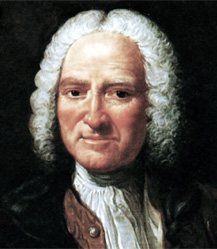
Open Holbach's interactive page (graphs of influences, similar and opposing positions, and quotes)
Background
Baron d'Holbach
Born: 1723 in Edesheim near Landau, Rhenish
Palatinate
Died: 21 January 1789 (aged 65–66) in Paris,
France
Era: 18th-century philosophy
Region: Western Philosophy
School: French materialism, Utilitarianism
(precursor to the later Utilitarians)
Main interests: Atheism, Determinism,
Materialism, Ethics, Political theory, Science,
Metaphysics
Influences: Bolingbroke, Pierre Bayle, Thomas
Hobbes, Denis Diderot, David Hume, Lucretius,
Baruch Spinoza, Isaac Newton
Influenced: Karl Marx, Michel Onfray, Adam
Weishaupt, Jean-Paul Marat, Georges Danton,
Camille Desmoulins, Joseph Priestley, William
Godwin, Percy Bysshe Shelley, Immanuel Kant
From Wikipedia
D'Holbach was a Franco-German philosopher, encyclopedist and writer, who was a prominent figure in the French Enlightenment. He was born… in the Rhenish Palatinate, but lived and worked mainly in Paris, where he kept a salon. He helped in the dissemination of "Protestant and especially German thought," particularly in the field of the sciences, but was best known for his atheism, and for his voluminous writings against religion, the most famous of them being The System of Nature (1770) and The Universal Morality (1776).
Introductory Comments
Imprisoned at Vincennes as a young man for a book that questioned the existence of God, Diderot learned caution. He kept his most incendiary manuscripts in a drawer, to be published only after his death. His friend Holbach took the opposite tack - sort of. Holbach wrote the most thoroughgoing atheist works of the century, denying God, soul, and free will with a bluntness that made even other philosophes wince. But he published them anonymously, printed them in Amsterdam, and smuggled into France in barrels. It worked: his books were burned, and he died in bed. Being a wealthy baron with useful friends - including, it seems, the chief censor - did no harm either.
That wealth had another use. Twice a week, Holbach's grand house on the rue Royale filled with philosophes, writers, scientists, and visiting foreigners, all of them fed extravagantly and encouraged to say dangerous things out loud. Modern equivalents exist - the TED talk, the podcast, the forum thread - but they rarely happen in someone's dining room, and never with that finest of wines. Are the new salons better because anyone can attend, or worse because no one is really there? The shared meal, the beautiful room, the face across the table: these must have added layers of sensory and emotional richness that a comment thread cannot touch. But let's be honest: if we'd been alive then, how likely were any of us to get the invitation?
Some of Holbach's Key Positions
Everything that exists is matter in motion. Matter is eternal and moves by its own nature, needing no divine shove to set it going, and every event - the fall of a stone, the flicker of a thought - belongs to a single unbroken chain of causes. Human beings are no exception. Thought and choice follow necessarily from bodily organization and circumstance. Free will is an illusion.
Religion, in this light, is not merely false but harmful. It began in fear - people who could not explain nature invented invisible agents behind it - and priests and princes have found the arrangement useful ever since. It obstructs knowledge by substituting supersition and mythology for honest inquiry.
As for morality, it needs no such prop. Humans are naturally self-interested, but that is where ethics begins, not where it ends. Because we are social animals who depend on the esteem and assistance of others, an enlightened self-interest must include a real concern for their happiness. No one wins the regard of his fellows by trampling them.
Virtue, then, is not a sacrifice of happiness but its condition. The same principle applies to politics. Government exists for the happiness and security of the people, not for the glory of rulers or the defense of religious authority. A government that makes its people miserable undermines its own legitimacy and, ultimately, its own stability.
Place in the History of Ideas
Holbach's Place in History of Ideas
Cassirer: [Holbach believed] man must free him- self from all idols, from all illusions concerning the original cause of things, for only by so doing can he succeed in ordering and establishing the world according to his own ideas. Hitherto theological spiritualism has prevented any truly autonomous regulation of the political-social system. It is the dragon of the sciences, ob- structing their development at every stage…. But this rule of supersition becomes even more dangerous if it is permitted to shape the moral order. For here it not only annuls human knowledge but robs human happiness of its real foundation. It frightens man with a thousand phantoms and deprives him of every uninhibit- ed joy of existence.
Robert Luehrs: In his later works... d’Holbach argued that society is a natural condition for men and the best society is one where each individual understands personal well-being is advanced only through service to everyone. This service involves a measure of sacrifice, a willingness to labor, and a consciousness of duty. A rational government directs emotions by just legislation to benefit the community. Since most people are not rational, government must be in the hands of an elite, but one restrained by law. In practice, d’Holbach favored a constitutional monarchy, where the king is limited by intermediate bodies, although not necessarily by an elected legislature.
Random Thoughts on Holbach
Holbach's metaphysics, to speak metalinguistically, is metaphysics without the "meta." That is, it's simply physics. Everything that exists is matter in motion, caught up in what Holbach called an uninterrupted succession of causes and effects - and everything means everything. No God above, no soul within, no afterlife waiting at the end, and no free will along the way. Humans are matter arranged in a particular way, doing what matter so arranged must do. Thoughts and feelings are not exempt from this; they simply are modifications of the brain, as real as any other motion in nature and just as thoroughly caused. Holbach, one begins to suspect, was a bit of a party pooper.
And yet Holbach was famous for his dinner parties. Both party pooper and party giver: how did he connect the dots? Epicurus invites the same question. How does one reduce the universe to atoms and the void, and the soul to atoms that scatter at death, while extolling a life of moderate pleasures - good food, good friends, good conversation? Both would likely answer that materialism is not a counsel of despair but a declaration of independence, above all from priests and the fears they cultivate. Remove the gods from the sky, and the dinner table looks even more appealing. If nothing lies beyond this world, its pleasures are not diminished but promoted - they are all there is, which is a reason to embrace them. Though, of course, to embrace them is impossible, since they evaporate even as one reaches.
Influences
Holbach was influenced by: Bayle, Bolingbroke, Diderot, Hobbes, Hume, Lucretius, Newton, Spinoza
Holbach influenced: Danton, G., Darwin, Desmoulins, C., Freud, Godwin, Kant, Marat, Jean-P., Marx, Nietzsche, Onfray, Priestley, Shelley, Weishaupt, A.
Similar and opposing positions
Thinkers with similar positions:
- Bayle (People’s behaviour reflects their character, not their religious beliefs.)
- Dawkins (One can be moral without having any religious beliefs.)
- Democritus (Everything is the result of natural laws related to matter & motion)
- Diderot (The universe is simply matter in motion, bound by laws of nature.)
- Harris (Religious toleration can't justify beliefs based on no evidence or reason.)
- Hobbes (All things, including humans and their minds, are entirely material.)
- Singer, Peter (There's no evidence that God exists nor that belief in Him is good)
- Smith, Adam (Govt. must be very careful when interfering with the economy.)
Thinkers with opposing positions:
- Chrysippus (Free will springs from our participation in the deterministic world.)
- Iamblichus (The universe isn't just matter in motion. It has a spiritual aspect.)
- Jacobi (The scientific understanding can lead us only to atheism and nihilism.)
- James (Tho' our bodies live in a physical world, our souls live a spiritual universe)
- Keynes (Government has an important role in maintaining a good economy.)
- Lotze (Universal mechanical laws suggests the work of a universal mind.)
- Muir (In studying nature we are also directly studying the handiwork of God.)
- Whitehead (The world is a process and can't be reduced to mere matter.)
What others said about Holbach
- Goethe: [Holbach's book] appeared to us so grey, so Cimmerian, so corpse-like that we... shuddered before it as before a spectre.
- Émile Faguet: D'Holbach, more than Voltaire, more than Diderot, is the father of all the philosophy and all the anti-religious polemics at the end of the eighteenth and the first half of the nineteenth century.
- Voltaire: What is most repellent in the "System of Nature"... is the audacity with which it decides that there is no God, without even having tried to prove the impossibility.... But all nature cries aloud that he does exist: that there is a supreme intelligence, an immense power, an admirable order, and everything teaches us our own dependence on it."
- Wallace Matson: Like Lucretius, Holbach believed that dissemination of knowledge of nature would free humanity from the prejudices and follies of religion, and thereby bring about the triumph of justice, goodwill, and peace.
- John Herman Randall, Jr.: Holbach was primarily a physicist who believed that the Newtonian science offered a complete explanation of the universe....
- Robert Luehrs: Through his wealth, his friendship with Denis Diderot, and his association with many other leading thinkers, he helped to disseminate a number of radical concepts on the eve of the French Revolution.
- Michael LeBuffe: Ethics on Holbach’s account... amounts to enlightened self-interest, vice to a failure to recognize the means to one’s interest, and moral rules to hypothetical imperatives which dictate the means to happiness or self-preservation.... [People] will as a matter of course be motivated to do what is moral, provided they know what that is.
- Edward Gibbon: [Holbach and his coterie] laughed at the skepticism of Hume, preached the tenets of atheism, and damned all believers with ridicule and contempt.
Schools: Atheism, Consequentialism, Determinism, Enlightenment, Naturalism, Physicalism, Utilitarianism
Main interests: Economics, Ethics, Free/Unfree Will, Metaphysics, Political Theory, Science
Holbach's answers to philosophical questions
Art and Aesthetics
"Art is only Nature operating with the aid of the instruments she has made."
Ethics
"Morality should be based on reason and compassion, not on religious commandments."
"True morality lies in doing good for the sake of goodness itself, not for the promise of reward or punishment."
Understanding other people: "Virtue is not the result of divine grace, but rather a byproduct of empathy and social harmony."
"The pursuit of pleasure and happiness is the ultimate goal of human existence."
"We should not fear death, but rather embrace the time we have and live fully."
Law
Since no one has free will, crime is really a type of disease. Criminals, therefore, should be cured of their ways, not punished.
Metaphysics
"[T]he whole offers to our contemplation, nothing but an immense, an uninterrupted succession of causes and effects."
"We are all just cogs in a machine, doing what we were always meant to do, with no actual volition."
Nature
Nature is rooted in matter. Its ways are entirely material and its primary law is that of cause and effect.
"Human beings are not special creations, but rather a product of natural evolution."
"Man is the work of nature: he exists in nature: he is submitted to her laws: he cannot deliver himself from them…."
Political Philosophy
"Among commercial nations those that allow their subjects the most unlimited liberty may be sure [to excel] all others."
Freedom of thought is inviolable, for "tolerance and freedom of thought are the veritable antidotes to religious fanaticism."
Religious affiliations should be completely voluntary. Government should neither support nor hinder religious practice.
The aristocracy should be abolished since it hoards too much of the country's wealth and leads to general incompetence.
Psychology
"When we examine the opinions of men, we find that nothing is more uncommon, than common sense…."
Knowledge and reason are the cures for unhappiness, for "the unhappiness of people is due to their ignorance of nature."
Religion and Theology
"If we go back to the beginnings of things, we shall always find that ignorance and fear created the gods…."
"The doctrine of spirituality, such as it now exists, offers nothing but vague ideas; or rather is the absense of all ideas."
"Nothing can be more contrary to religion and the clergy than reason and common sense."
Faith is dangerous: "[S]uperstition infatuates man from his infancy, fills him with vanity, and enslaves him with fanaticism."
"The idea of a just and merciful God is incompatible with the suffering and injustice in the world."
"Nature tells man to be sociable...; religion counsels him... to torment, to afflict, to persecute, and to massacre...."
"Creator" is an arrogant concept: "The idea of an all-powerful God is a reflection of human narcissism & desire for control."
"[An atheist] destroys delusions which are harmful to humanity in order to lead men back to nature, to reality, to reason."
Science
Science vs superstition: "Science is the only true path to understanding the mysteries of the universe."