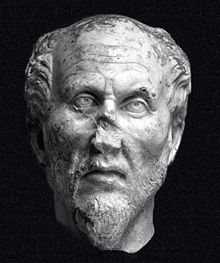
Plotinus was a Greek Platonist philosopher, born and raised in Roman Egypt. Plotinus is regarded by modern scholarship as the founder of Neoplaton- ism…. Historians of the 19th century invented the term "neoplatonism" and applied it to refer to Plotinus and his philosophy, which was vastly influential during late antiquity, the Middle Ages, and the Renaissance…. His works have inspired centuries of pagan, Jewish, Christian, Gnostic, and early Islamic metaphysicians and mystics, including [some] mainstream [theologians]….
Introductory Comments
Porphyry, in his Life of Plotinus, tells us that a snake appeared under Plotinus's bed as he lay dying, then slipped away through a hole in the wall - at the very moment Plotinus died. Later writers have found in this small detail a surprising range of meanings. Some have taken the snake to symbolize the soul's endless return to its source - the ancient image of the serpent curled into a ring, biting its own tail. Others have seen a figure of wisdom and the divine - the sacred animal long coiled about the staffs of healers and oracles. And still others point to the snake's most famous trick: just as the serpent sheds its worn skin and glides away renewed, so the soul of Plotinus casts off its mortal coil to return to the One.
But to venture a more acerbic reading: Picture Plotinus on his deathbed, straining to summon back those thrilling dreams of transcending flesh, family, and friends to dissolve into the One. Then the breath stops, and the dreams die with him. At that very instant a snake appears beneath the bed and, indifferent, slides away through the wall. It spares not a glance for the dead philosopher and his grand mystical ambitions. It is off in search of new life: a fresh crop of plump little human babies, blessed with no pretensions to be anything other than what they are - warm, crawling animals who, like the snake, hug the earth and take their whole delight in it. That is, until they grow up, straighten their backs, and wander off into worlds that exist only in their minds.
Some of Plotinus's Key Positions
Three principles are key to understanding the world: the One, the Intellect (Nous), and the Soul. The One transcends and precedes everything else. It is not a God who deliberately created the world; rather, it is the ultimate source from which all else flows. It has no definite attributes - indeed, it lies beyond being and beyond description - yet everything emanates from it in a descending series of stages, each less perfect than the one before.
The everyday, bodily world we normally experience is therefore only a poor imitation of a higher, immaterial, and intelligible reality. Our task is to transcend this physical copy so that we may more clearly see, and ultimately merge with, Reality itself.
A crucial distinction emerges at the level of Intellect. Here the knower and the known are one and the same: in contemplating the Forms, Intellect contemplates itself. This unity of thinker and thought is the defining feature of Nous - and it stands one step below the One, which lies beyond even the division between knower and known.
The ascent, then, reverses the descent of emanation. Rising from our lowly station as individual souls, we first grasp nature, the lower reach of the World Soul. We then ascend to the Forms and the orientation toward the Good that is nature's source. Finally, through Intellect, we may attain an ecstatic union with the One.
Place in the History of Ideas
Plotinus's Place in History of Ideas
Henry Osborn Taylor: The synthetic genius of Plotinus enabled him to weave into his system valuable elements from Aristotle and the Stoics. But he was above all a Platonist. He presents the spiritual triad: the One, the Mind, the Soul. From the One comes the Mind, that is, the Nous, which embraces the totality of the knowable or intelligible, to wit, the Cosmos of Ideas. From that, come the Soul of the World and the souls of men. Matter, which is no-thing, gains form and partial reality when informed with soul. Plotinus's attitude toward knowledge of the concrete natural or historic fact, displays a transcendental indifference exceeding that of Plato. Perceptible facts with him are but half-real manifestations of the informing spirit. They were quite plastic, malleable, reducible. Moreover, thoughts of the evil of the multiple world of sense held for Plotinus and his followers a bitterness of ethical unreality which Plato was too great an Athenian to feel.
Russell: To the Christian, the Other World was the Kingdom of Heaven, to be enjoyed after death; to the Platonist, it was the eternal world of ideas, the real world as opposed to that of illusory appearance. Christian theologians combined these points of view, and embodied much of the philosophy of Plotinus.... Plotinus, accordingly, is historically important as an influence in molding the Christianity of the Middle Ages and of theology.
Random Thoughts on Plotinus
Plotinus was enamored of, besotted with, rapturous over, the One. But in the history of ideas he was hardly alone. There has been a whole procession of mystics whose deepest desire was to merge with the One - or, for those who relish recursivity, to be one with the One. Pagans, like Plotinus and Proclus; Christians, like St. John of the Cross and Meister Eckhart; Jews, like Isaac Luria; Sufis, like Rumi - virtually every religious tradition has produced passionate believers in what Evelyn Underhill called "the art of union with Reality."
But there's the troublesome word: "art." It points to a contradiction lurking within the mystic's goal of transcending the illusion of individuality to merge with the hidden Oneness of things. For there is a certain pride in the word "art." It implies that one has achieved something, mastered something, that few others can. Call it spiritual enlightenment, call it a higher state of consciousness - the ability to transcend one's ego risks becoming a powerful boost to that very ego. Is there any way around this catch-22? Perhaps, if one could master the art of selfless self-mastery, though the phrase sounds suspiciously like a Zen koan. But the surer route may be artlessness. If you are lucky enough to possess an innate, instinctive sense of connection with others and with the world around you, you are unlikely to feel you have achieved anything at all. It's simply who you are, how you're made - not a summit reached, but a starting point. Lucky you. Lucky DNA.
Anselm (God, being perfect and eternal, is stable, uniform and flawless.)
Dante (Pursuit of love is a transcendental experience and a test of virtue.)
Eckhart (Personal detachment allows us to sense God's presence within us.)
Ficino (A hierarchy of substances descends from God down to lowly matter.)
Ibn Tufail (Preoccupation with the physical world can never lead to happiness.)
Porphyry (The purely contemplative part of the Soul is its higher & eternal part.)
Proclus (Though souls descend into the material world, a divine Unity exists.)
Swedenborg (There are links among the physical, spiritual, and divine worlds.)
Thinkers with opposing positions:
Bergson (Universals or essences do not actually exist in the real world.)
Collingwood (Metaphysics is just heuristic principles helping us grasp reality.)
Gassendi (Understanding relies on our senses, not on our deductive reasoning.)
Heraclitus (Like a flowing river, everything changes and nothing is eternal.)
Holbach (The universe is simply matter in motion. It has no spiritual dimension.)
Oakeshott (Philosophy is self-scrutinizing, but not a higher mode of thinking.)
Ovid (Earthly or romantic love is the most appropriate subject for poetry.)
Royce (Even idealistic postulates must rest ultimately on pragmatic grounds.)
What others said about Plotinus
Porphyry: [Plotinus] was of ascetic habits, was ashamed of his body, ate neither flesh nor bread, despised medicine, [dismissed] personal history.
Walter Terence Stace: [Plotinus'] words are as grappling irons let down into the depths of our subconsciousness, which draw our own inner experiences nearer to the conscious threshold.
Henry Osborn Taylor: The ethics of Plotinus consisted in purification and detachment from things of sense. This is asceticism. And Plotinus was an ascetic, not through endeavor, but from contempt. He did not struggle to renounce the world, but despised it with the spontaneity of a sublimated temperament.
Russell: But truth is not the only merit that a metaphysic can possess. It may have beauty, and this is certainly to be found in Plotinus; there are passages that remind one of the later cantos of Dante's Paradiso....
E. R. Dodds: [Plotinus is] not the starting-point of Neo-Platonism but its intellectual culmination.
Porphyry: [Plotinus] was gentle, and always at the call of those having the slightest acquaintance with him. After spending twenty-six years in Rome, acting, too, as arbiter in many differences, he had never made an enemy....
Russell: Like Spinoza, [Plotinus] has a certain kind of moral purity and loftiness, which is very impressive. He is always sincere, never shrill or censorious, invariably concerned to tell the reader, as simply as he can, what he believes to be important. Whatever one may think of him as a theoretical philosopher, it is impossible not to love him as a man.
Hegel: The point of greatest importance and the leading characteristic in Plotinus is his high, pure enthusiasm for the elevation of mind to what is good and true, to the absolute.