Parmenides (c. 515 BC - c. 450 BC)
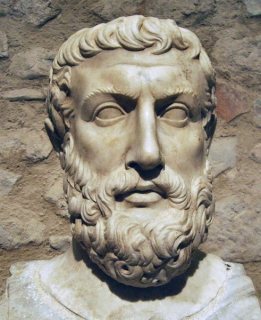
Open Parmenides's interactive page (graphs of influences, similar and opposing positions, and quotes)
Background
Parmenides of Elea
Born: c. 515 BC in Elea, Magna Graecia (in what
is now Italy)
Died: c. 450 BC
Schools: Eleatic school, Pre-Socratic Philosophy
Main interests: Metaphysics, Ontology,
Epistemology
Notable ideas: "Thought and being are the
same," The truth–appearance distinction
Influences: Pythagoras, Xenophanes of Colophon,
Heraclitus, Anaximander, Ameinias
Influenced: Zeno of Elea, Melissus of Samos,
Democritus, Leucippus, Socrates, Anaxagoras,
Aristotle, Spinoza, Nietzsche, Heidegger,
Severino, Pseudo-Denys, Empedocles, Plato
From Wikipedia
In his poem [On Nature], Parmenides prescribes two views of reality. The first, the Way of "Aletheia" or truth, describes how all reality is one, change is impossible, and existence is timeless and uniform. The second view, the way of "Doxa," or opinion, describes the world of appearances, in which one's sensory faculties lead to conceptions which are false and deceitful. Parmenides has been considered the founder of ontology and has, through his influence on Plato, influenced the whole history of Western philosophy.
Introductory Comments
If Heraclitus can be said to have fallen in love with paradoxes, so too can Parmenides, his supposed antagonist. But Parmenides's paradoxes were more abstract - no dipping of toes into a river, but a great deal of strange talk about what is and what is not. He graciously admits that what is, is, but summarily dismisses what is not as mere nothing. What is is, and what is not is not, and never the twain shall meet. Therefore, change is an illusions. (See Key Positions.)
And if it is true, as claimed in the section on Heraclitus, that a man's paradoxes tell us some- thing about the man himself, it seems only fair to extend the same courtesy to Parmenides and his elusive paradoxes. (Besides, without some such speculation, there'd be precious little to say about the personality of any pre-Socratic philosopher.) So what sort of creature becomes so captivated by metaphysical reflection that he can deny almost everything that is staring him, and us, in the face?
Perhaps we should picture him as a human version of Ouroboros - the snake that devours itself into nothingness. Or better yet, a human version of the Cheshire Cat: a very satisfied fellow, who has just pulled off the ultimate disappearing act, grinning with increasing satisfaction as he, the world, and everything in it dissolve away - and grinning most broadly of all when nothing is left but the grin itself.
Some of Parmenides's Key Positions
All reality is one, changeless, uniform, and necessary. We think otherwise only because of the world of appearances - those faulty, misleading, yet strangely beguiling impressions that spring from our senses.
Generation and destruction are prime examples of such false appearances. Reason tells us that non-being - "that which is not" - is unintelligible, since what is nothing can be neither conceived nor spoken of.
To put the argument more precisely: if something cannot be conceived, it cannot figure in any explanation. But explaining generation requires a transition from non-being to being, and explaining destruction the reverse. Both demand the inconceivable. Therefore, both are impossible.
Perceptions of motion and change are likewise illusions - deceptive images of what is in truth a changeless, eternal reality. So too are perceptions of separate things: deceitful visions of what is in fact a single, indivisible whole.
Plus, consider this: Separate things require empty space to divide them. But empty space is yet another form of non-being, of "what-is-not" - and so it cannot exist. Since "what-is-not" is inconceivable, the very notion of distinct, separate things collapses.
Place in the History of Ideas
Parmenides's Place in History of Ideas
Russell: [The essence of Parmenides’ argument amount to this:] When you think, you think of something; when you use a name, it must be the name of something. Therefore both thought and language require objects outside themselves. And since you can think of a thing or speak of it at one time as well as another, whatever can be thought of or spoken of must exist at all times. Consequently there can be no change, since change consists in things coming into being or ceasing to be.
Gregory Vlastos: The philosophy of Parmenides is a strange blend of mysticism and logic. It is mysticism, for its goal is not the gradual and cumulative correction of empirical knowledge, but deliverance from it through the instantaneous and absolute grasp of "immovable" truth. This is... the way of revelation: it lies "beyond the path of men." Yet this revelation is itself addressed to man's reason and must be judged by reason. Its core is pure logic: a rigorous venture in deductive thinking, the first of its kind in European thought.
James Warren: [Parmenides left us with] an odd and alienating picture of reality. Following consistently the ban on "what is not," it has turned out that we are left with an unfamiliar reality, which leaves no room for change, plurality, motion, difference, people, days or nights.
Random Thoughts on Parmenides
Heraclitus and Parmenides are usually cast as archrivals: Heraclitus insisting that all is flux, an eternal war of opposites; Parmenides insisting that all is permanence, a single undifferentiated reality. It's a tidy contrast - but a little too tidy. Look closer and the two turn out to agree on more than their reputations suggest. Heraclitus, for all his talk of rivers and strife, also holds that reality is ultimately one: seen from the standpoint of the Logos - the rational principle underlying all things - the Many resolve into a single unity. He also insists that the world in its essence, Fire, is indestructible. Parmenides, meanwhile, agrees that ordinary experience presents us with a world in which things seem to come into being, change, and pass away.
So, though the two philosophers differ in pro- found ways, there is a sense in which the two can be seen as mirror images of one another. Heraclitus emphasizes the many things in flux while insisting that they ultimately form a unity; Parmenides emphasizes the one eternal reality while acknowledging that many things seem to us in flux. The two reflect on the world in similar ways, but, as with all mirrors, in reverse: Heraclitus says, in effect, "Many things in flux (though ultimately one)," while Parmenides says, "One eternal reality (though appearing as many things in flux)." As with so many disputes, part of the difference lies in what each thinker places inside the parentheses.
Influences
Parmenides was influenced by: Ameinias, Anaximander, Heraclitus, Pythagoras, Xenophanes
Parmenides influenced: Anaxagoras, Aristotle, Democritus, Empedocles, Heidegger, Leucippus, Melissus, Nietzsche, Plato, Pseudo-Denys, Severino, Socrates, Spinoza, Zeno of Elea
Similar and opposing positions
Thinkers with similar positions:
- Bosanquet (Reality is ideal, whole and one. There are no real separate things.)
- Plato (Appearance and reality are two very different things.)
- Porphyry (Being perfect & eternal, the One is stable, uniform & unchanging.)
- Royce (Our ideas ultimately refer to a universal whole in which they belong.)
- Socrates (We should question assumed truths to see if they are in fact true.)
- Zeno (Careful analysis proves that motion and change are impossible.)
Thinkers with opposing positions:
- Adorno (Our concepts are not eternal, but change with history and society.)
- Collingwood (Metaphysics is just heuristic principles helping us grasp reality.)
- Deleuze (There is no one substance, only an always-differentiating process.)
- Democritus (The void exists as the empty space between atoms.)
- Democritus (Everything is the result of natural laws related to matter & motion)
- Gassendi (Understanding relies on our senses, not on our deductive reasoning.)
- Heraclitus (Constant change is a fundamental aspect of the world.)
- Moore (Objects exists & are defined in part by their relations to other objects.)
- Sextus Empiri. (Demonstrative reasoning doesn't lead to true knowledge.)
- Whitehead (The world is not a static thing, but an ongoing process.)
What others said about Parmenides
- Seneca: If I accede to Parmenides there is nothing left but the One; if I accede to Zeno, not even the One is left.
- Wolfgang Pauli: Nonbeing did not simply mean "not being present" [to him] but pointed to a problem concerning the thinking function. [To him] nonbeing is that which cannot be grasped by thinking reason.
- Zeno: These writings of mine were meant to protect the arguments of Parmenides against those who make fun of him and seek to show the many ridiculous and contradictory results which they suppose to follow from the affirmation of the one. [I tried to show] that their hypothesis of the being of many, if carried out, appears to be still more ridiculous….
- Popper: [Parmenides' argument] was, for all I know, the first deductive theory of the world, the first deductive cosmology: One further step led to theoretical physics, and to the atomic theory.
- Cassirer: Parmenides declared that we cannot separate being and thought, for they are one and the same thing.
- William Guthrie: Presocratic philosophy is divided into two halves by the name of Parmenides. [He] brought speculation about the origin and constitution of the universe to a halt, and [forced] a fresh start on different lines.
- Nietzsche: [A = A is a] tautological insight [that] proclaims inexorably: What is not, is not. What is, is. And suddenly Parmenides felt a monstrous logical sin burdening his whole previous life.... But the same moment that shows him his crime illuminates him with a glorious discovery. He has found a principle... remote from all human illusion.
- Robert Pirsig: Parmenides made it clear for the first time that the Immortal Principle, the One, Truth, God, is separate from appearance and from opinion, and the importance of this separation… cannot be overstated.
Schools: Eleatics, Pre-Socratic Philosophy
Main interests: Epistemology, Infinity, Mathematics, Metaphysics
Parmenides's answers to philosophical questions
Epistemology
Perceptions of movement and change are illusions - deceptive images of what is in fact a changeless, eternal reality.
Empirical evidence is not to be trusted. Our sensory faculties beguile us with images, but truth can be found only thru reason.
Ignore all sensory impressions, no matter how compelling, and trust only what reason teaches us, no matter how strange.
The opinions of men are all false, yet "shalt thou learn of these things also, since thou must [confront them] in thy journey."
Language
We've named 2 forms, what is & what's not, but what's not should have no name. That is how we've strayed from the truth.
Metaphysics
Thought is Being. What can be thought must exist. What cannot be thought does not exist.
Since all things are eternal, they have no creator: "Everything that exists has always existed. Nothing can come from nothing."
Being is an eternal constant. Nothing comes into being from nonbeing. Nothing changes from being into nonbeing.
Becoming is impossible, for it would entail that which is NOT transforming into that which IS - and nothing begets nothing.
Don't be misled by appearances: "[W]hat exists is uncreated and imperishable for it is whole and unchanging and complete."
Mind and matter are, metaphysically speaking, the same thing, "for 'to be thought' and 'to be' are the same thing."
The world is one undifferentiated reality. What seems like multiple things are merely the illusions or distortions of our senses.
Individuation is merely a distorted sensory appearance. Nothing exists but one, uniform, unchanging, undifferentiated reality.
What-is-not can't come to be, for nothing results from what-is-not. Nor can what-is-not be thought, for it is nothing.
Logical deduction, not the empirical investigation, leads us to ultimate, metaphysical truth.