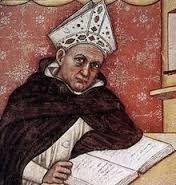
Albertus Magnus was a German Dominican friar, philosopher, scientist, and bishop. Canonized in 1931, he was known during his lifetime as Doctor universalis and Doctor expertus; late in his life the sobriquet Magnus was appended to his name. Scholars such as James A. Weisheipl and Joachim R. Söder have referred to him as the greatest German philosopher and theologian of the Middle Ages. The Catholic Church distinguishes him as one of the Doctors of the Church.
Introductory Comments
Along with Abelard, Aquinas, Roger Bacon, and Duns Scotus, Albertus Magnus belonged to the first great generation of university scholars - men who taught philosophy and theology in what were then Europe's newest centers of learning. Most were associated with the University of Paris, one of the earliest universities and, by the thirteenth century, already renowned for theological and philosophical study. What made Paris matter wasn't just its faculty but its method. Scholasticism - a rigorous, dialectical style of inquiry now more often mocked than read - set out to reconcile faith and reason through careful argument rather than assertion. The University of Paris became Scholasticism's true home.
Abelard, the first great Scholastic, delighted in weighing both sides of a question before showing that the apparent contradictions were not as irreconcilable as they first appeared. Albertus's student Aquinas sought to harmonize Aristotle's philosophy - what he regarded as the highest achievement of human reason - with Christian doctrine. Bacon, by contrast, shifted Scholasticism away from purely speculative argument by stressing observation and empirical investigation. Albertus, in effect, embraced both approaches. He relied on Aristotle's writings while also conducting careful studies of the natural world, arguing that creation reveals a God who delights in complex and beautiful diversity no less than in rational and universal order.
Some of Albertus Magnus's Key Positions
Aristotle is rightly regarded by the Muslim philosophers as the greatest of the pagan thinkers. His account of natural philosophy and his mapping of the sciences remain reliable guides for our own study and research. However, Aristotle and his Muslim commentators must be corrected where they depart from Christian truth.
But Aristotle's devotion to science does not in itself threaten religious faith. On the contrary, science can deepen faith. The study of the heavens, for instance, shows how celestial bodies influence the world below - yet leave free will and moral responsibility intact. Such knowledge illuminates Christian understanding.
Philosophers in the Neoplatonic tradition offer similar help. Pseudo-Dionysius is the prime example: by showing how all things flow forth from God and return to Him, he clarifies the nature of goodness and so points us toward a truly Christian life. Here again, philosophy proves the friend of religion.
The same bond between our knowledge of God and our pursuit of goodness appears in natural law. Since all things spring from God, so too must every law framed by man. Human law must therefore accord with reason, for God gave us reason precisely so that we might discover His universal law. A law that offends reason isn't just a bad law - it forfeits the title "law" altogether.
Place in the History of Ideas
Albertus Magnus's Place in History of Ideas
Randall Collins: Albert's encyclopedic works are impressive mainly for their scope. Albert regarded himself as following Aristotle, which he did in the arrangement of the sciences, and in holding that knowledge is based on the senses.... Yet Albert's ontology is much closer to Neoplantonism. For him the soul is an intel- lectual substance, not the form of the body (as it was for Aristiotle...). Universals are divine Ideas situated in God; the human soul has knowledge of universals by divine illumination, much along the lines of Augustine's doctrine of the inner light.... An independent Aristotelean- ism awaited the radical Averroists and Albert's own independent pupil, Thomas Aquinas.
Hegel: It is said of [Albertus Magnus] that in his youth he showed himself very dull and stupid, until, according to a legend, the Virgin Mary appeared to him..., incited him to the study of Philosophy, liberated him from his dulness of understanding, and promised him that he should enlighten the Church, and, in spite of his science, should still die in the faith. What hap- pened was in accordance with this prophecy, for five years before his death he forgot all his philosophy as quickly as he learned it, and then actually died in the dulness and orthodoxy of his earlier years. Hence there is regarding him an old saying: "Albert changed quickly from an ass into a philosopher, and from a philosopher into an ass."
Random Thoughts on Albertus Magnus
Albertus embraced both science and philosophy, but from his vantage point the two were never separate to begin with. Indeed, the terms "science" and "philosophy," as we now use them, were not clearly prised apart until the Scientific Revolution of the 16th and 17th centuries. Before then, to study the natural world was simply to do philosophy; during the Revolution, it was to do "natural philosophy." And in 1833, driving one more wedge into what had once been a grand and unified enterprise, William Whewell coined the word "scientist" - so that those who studied nature need no longer rub shoulders with the navel-gazing, prose-intoxicated philosophers.
The split was overdue, and it paid off handsomely: modern science owes its speed and its rigor to specialists who no longer had to double as metaphysicians. But something got lost in the divorce settlement. Before the split, the working assumption was that truth is one thing, seamless and whole, however many angles the intellect might use to approach it. After it, a fault line opened up - running from the stars overhead to the ground underfoot. On one side lay hard facts and proven theories; on the other, moral values, metaphysics, and religion. For most of us today, the universe now comes with that crack built in. It's a crack that keeps a modern would-be Albertus from doing what the actual one did without a second thought: finding in the study of nature something morally weighty and spiritually alive.
Albertus Mag. influenced:Aquinas, Berthold of M., Bruno, Dante, Dietrich of F., Eckhart, Heymeric de C., Nicholas of C., Pico, Ripelin, Hugh, Suso, Henry, Tauler, John, Ulrich of S.
Similar and opposing positions
Thinkers with similar positions:
Anselm (Reason cannot replace faith, but can work together with faith.)
Aquinas (God is both the source and the pinnacle of justice and natural law.)
Avicenna (The pursuit of science is consistent with religious devotion.)
Cicero (Friendship is the harmony between things divine and human.)
Ficino (The soul is immortal and seeks to ascend to a spiritual union with God.)
John of Damas. (Aristotle's philosophy is compatible with Christian beliefs.)
Pseudo-Denys (To truly know the moral good we must know the eternal Good.)
Schopenhauer (Music can encourage contemplation & liberate the spirit.)
Thinkers with opposing positions:
Averroes (The individual's soul ends when he or she dies. It is not eternal.)
Blake (Pursuit of science can lead to a sterile and atheistic worldview.)
Feuerbach (God is for us the outward projection of a human's inward nature.)
Holbach (The universe is simply matter in motion, bound by laws of nature.)
Jefferson (I accept Jesus's precepts but not the corruptions of Christianity.)
Kierkegaard (Christianity must be accepted on faith alone, never on reason.)
Rousseau (Progress in the sciences and arts has led to decay and immorality.)
Spinoza (God is not transcendent. Everything in Nature is part of God.)
What others said about Albertus Mag.
Daniel Kennedy: [Albertus] surpassed all his contemporaries, except perhaps Roger Bacon, in the knowledge of nature.
Mark Fuehrer: Even more so than his most famous student, St. Thomas of Aquinas, Albert’s interests ranged from natural science all the way to theology. He made contributions to logic, psychology, metaphysics, meteorology, mineralogy, and zoology.
Richard Tarnas: Albertus was the first medieval thinker to make the firm distinction between knowledge derived from theology and knowledge derived from science. The theologian is the expert in matters of faith, but in mundane matters the scientist knows more. Albertus asserted the independent value of secular learning and... empirical observations....
Ernst Meyer: No botanist who lived before Albert can be compared with him, unless it be Theophrastus.... and after him none has painted nature in such living colors, or studied it so profoundly, until the time of Conrad....
Bacon, Roger: What is useful in his works might be summed up in a treatise twenty times as short as they are.
Mark Fuehrer: He was deeply involved in an attempt to understand the import of the thought of Aristotle in some orderly fashion that was distinct from the Arab commentators who had [previously written about] Aristotle.
Copleston: ... in his own philosophical thought Albert was by no means a thorough Aristotelian but mixed Aristotelian theories with ideas derived from Platonism, Neoplatonism and Islamic philosophy.... Thus he used the language at any rate of emanation, though he explained the theory in a manner consonant with the Christian theology of creation.
Amable Jourdain: Whether we consider him as a theologian or as a philosopher, Albert was undoubtedly one of the most extraordinary men of his age; I might say, one of the most wonderful men of genius who appeared in past times.
Schools: Aristotelianism, Christian Theology, Medieval Realism, Natural Law Theory, Scholasticism
Main interests: Alchemy, Anthropology, Astrology, Botany, Ethics, Faith, Free/Unfree Will, Friendship, History of Philosophy, Immortality, Law, Logic, Metaphysics, Mineralogy, Music, Psychology, Religion, Science, Theology, Zoology
Albertus Mag.'s answers to philosophical questions