David Ricardo (1772 - 1823)
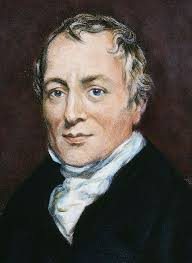
Open Ricardo's interactive page (graphs of influences, similar and opposing positions, and quotes)
Background
David Ricardo
Born: 18 April 1772 in London, England
Died: 11 September 1823 (aged 51) in
Gloucestershire, England
Nationality: British
School or tradition: Classical economics
Contributions: Ricardian equivalence, labour
theory of value, comparative advantage, law of
diminishing returns, Economic rent
Main interests: Economics, politics
Influences: Adam Smith, Jeremy Bentham,
Robert Torrens, James Mill, Thomas Malthus
Influenced: Ricardian Socialists, Henry George,
John Stuart Mill, Piero Sraffa, Knut Wicksell,
Robert Barro, John Ramsay McCulloch, Karl
Marx, Friedrich Engels, Franz Oppenheimer,
John Maynard Keynes, George Reisman, Robert
Owen, Nassau Senior
From Wikipedia
Ricardo was a British political economist, politi- cian, and member of Parliament. He is recognized as one of the most influential classical econo- mists, alongside figures such as Thomas Malthus, Adam Smith and James Mill…. Ricardo introduced the concept of "comparative advantage," suggesting that nations should concentrate resources only in industries where they have the greatest efficiency of production relative to their own alternative uses of resources. He argued that international trade is always beneficial….
Introductory Comments
A Sephardic Jew who turned Unitarian, married a Quaker, and was cut off by his father for the trouble, Ricardo learned early what it costs to stand outside other people's arrangements. He made his own fortune on the Exchange, sided with the rising manufacturers against the landed aristocracy, and called himself a liberal - a word then so new to English politics that it still carried a slight foreign accent. He was, of course, a classical liberal, which is not the modern article. But neither was he quite what we now call a conservative: the conservatives of Ricardo's day were the Tory landlords defending the Corn Laws, and he spent his years in Parliament trying to pry their fingers off the price of bread. He wanted the franchise widened and the ballot secret. He once proposed retiring the whole national debt with a single levy on capital - his own capital included. What he did not want was government arranging outcomes.
Try a basketball analogy. Pick-up ball is not lawless. It is a real game with real rules, but the players call their own fouls, nobody evens up the teams, and the sole enforcement mechanism is the shared suspicion that somebody is being a jerk. Refereed basketball catches the illegal screen and the double dribble, protects the smaller player, and stops the clock every ninety seconds to do it. One game has more energy and worse calls. The other has better calls and less energy. Ricardo, for all his dignified portraits, was a pick-up player - and he had the elbows for it.
Some of Ricardo's Key Positions
Import duties and other forms of protectionism impoverish the nations that adopt them. The case here does not rest merely on the claim that tariffs raise prices, though they do. It rests on comparative advantage: a country should specialize in what it produces relatively best, not absolutely best. Even if Portugal could make both wine and cloth more cheaply than England, both countries grow richer if Portugal makes wine, England makes cloth, and they trade.
The Corn Laws show what protection actually costs. By barring cheap foreign grain, they forced English farmers onto ever poorer soil. The price of corn is set by the cost of growing it on the worst land in use, so that price climbed - and with it the rents collected by owners of the better land, who had done nothing to earn the windfall. Corn being the chief item in a laborer's diet, wages had to rise to keep workers fed. Higher wages came straight out of profits, not out of rents. Falling profits meant less accumulation, and less accumulation meant a slower march toward the stationary state where growth stops altogether.
Free trade has its limits, however, when it comes to money. The currency must be anchored to gold to prevent too many notes in circulation. This will require a national bank run by independent commissioners, bound by clear rules, issuing notes redeemable in gold bars and answerable to neither the Treasury nor the City.
Place in the History of Ideas
Ricardo's Place in History of Ideas
Robert Heilbroner: In [Adam] Smith’s world everybody gradually became better off as the division of labor increased and made the community more wealthy. In Ricardo’s world, only the landlord stood to gain. The worker was forever condemned to the margin, for, poor fellow, he tended to chase after every wage rise with a flock of children and thereby to compete his wages right back down to subsistence. The capitalist, who worked and saved and invested, found that all his trouble was for nothing: his wage costs were higher, his profits smaller, and his landed opponent far richer than he. And the landlord, who did nothing but collect his rents, sat back and watched them increase.
Ha-Joon Chang: [Ricardo’s] theory correctly says that, accepting their current levels of technology as given, it is better for countries to specialize in things that they are relatively better at. One cannot argue with that. His theory fails when a country wants to acquire more advanced technologies - that is, when it wants to develop its economy. It takes time and experience to absorb new technologies, so technologically backward producers need a period of protection from international competition during this period of learning. Such protection is costly, because the country is giving up the chance to import better and cheaper products. However, it is a price that has to be paid if it wants to develop advanced industries.
Random Thoughts on Ricardo
The Corn Laws were tariffs on imported grain - "corn" meaning wheat, not the yellow stuff on the cob. A Parliament of landowners had voted to keep bread expensive. Crude enough, and yet few laws have bred so much theory, or so little agreement. Ricardo and Malthus agreed on how the laws enriched landlords, because they explained rent identically. As population grows, farmers plow worse and worse land. Grain must then sell for what the worst acre costs to farm, and owners of better acres pocket the difference. But from there the two walked in opposite directions. Ricardo saw a trick for moving the nation's wealth into the pockets of men who least deserve it. Malthus answered that a nation fed by foreign harvests is hostage to foreign weather and states.
Marx, writing two years after repeal of the Corn Laws, took Ricardo's side but threw out his reasoning. Free trade, he said in 1848, would do nothing for the worker. It would merely speed the system toward collapse, which was precisely why he favored it. Keynes, a century on, thought the wrong man had won the fight. Ricardo denied that an economy could ever produce more than it could sell. Malthus thought it could, and Keynes spent the 1930s proving him right. Ricardo, he grumbled, conquered England as completely as the Inquisition conquered Spain - an analogy Keynes seems not to have examined, since the Inquisition had helped chase Ricardo's Sephardic forebears off the Iberian peninsula in the first place.
Influences
Ricardo was influenced by: Bentham, Malthus, Mill, James, Smith, Adam, Torrens, R.
Ricardo influenced: Barro, Robert, Engels, George, Henry, Keynes, Marx, McCulloch, J., Mill, Oppenheimer, Owen, Robert, Reisman, G., Senior, Nassau, Sraffa, Piero, Wicksell, K.
Similar and opposing positions
Thinkers with similar positions:
- George, Henry (Tariffs keep prices high for consumers & fail to increase wages.)
- George, Henry (Tariffs keep prices high for consumers & fail to increase wages.)
- Hayek (A centrally planned economy will always be inefficient and unstable.)
- Locke (The economic value of a good is based on the work that went into it.)
- Marx (The economic value of a good is based on the work that went into it.)
- Mill (Government interference in an economy is usually counterproductive.)
- Smith, Adam (Govt. must be very careful when interfering with the economy.)
Thinkers with opposing positions:
- Evola (Liberal democracy represents an ignoble trend towards mediocrity.)
- Galbraith (Government has an important role in maintaining a good economy.)
- Goldman (Anarchism is the liberation from oppression of govt. & religion.)
- Lukács (So-called eternal "laws" of economics are merely ideological illusions.)
- Malthus (Protectionist duties can help a country become self-sufficient.)
- Proudhon (Property is theft when it in effect steals the profits from laborers.)
- Pythagoras (All possessions should be in common among friends.)
- Rawls (Govt. should provide greatest benefit to those least advantaged.)
- Shaw (Socialism can cure many of the abuses found in our modern economies.)
What others said about Ricardo
- Galbraith: It is David Ricardo's unique position in history that he was an innovating force in both capitalist and socialist thought.
- Eric Roll: David Ricardo is without doubt the greatest representative of classical political economy. He carried [the] work begun by Smith to the farthest point possible without [directly confronting] the contradiction inherent in it.
- Joan Robinson: He was just at the corner where the capitalists were about to supersede the old landed aristocracy as the effective ruling class. Ricardo was on the progressive side. His chief pre-occupation was to show that landlords were parasites on society. In doing so he was to some extent the champion of the capitalists.
- Robert Heilbroner: [Unlike the worker's and the capitalist's income, the landlord's] income - rent - was not held in line by either competition or by the power of population. In fact, he gained at everyone's expense.
- Ludwig von Mises: Marx's economic teachings are essentially a garbled rehash of the theories of Adam Smith and, first of all, of Ricardo.
- Joan Robinson: He was pro-capitalist as against the landlords more than he was pro-worker as against capitalists (with the Iron Law of Wages, it was just too bad for the workers, whatever happened).
- John Louis Mallett: … he meets you upon every subject that he has studied with a mind made up, and opinions in the nature of mathematical truths.… It is this very quality of the man’s mind, his entire disregard of experience and practice, which makes me doubtful of his opinions on political economy.
- Paul Samuelson: It was David Ricardo himself who believed that Adam Smith’s basic system was flawed at its core. Indeed, it was this critical view of Smith that caused Ricardo to write his "Principles."
Schools: Classical Economics, Utilitarianism
Main interests: Commerce, Economics, Labor, Politics, Property, Wealth
Ricardo's answers to philosophical questions
Economics
"Nothing contributes so much to the prosperity and happiness of a country as high profits."
"The value of a commodity… depends on the relative quantity of labor which is necessary for its production…."
Class struggle is inevitable: "There is no way of keeping profits up but by keeping wages down."
"Labor, like all other things which are purchased and sold…, has its natural and its market price."
Political Philosophy
Though free trade is the best way to stimulate an economy, a central national bank is needed to control the value of currency.
"So essential does it appear to me, to the cause of good government, that the rights of property should be held sacred…."
Society
Society consists of the owner "of the land, the owner of the... capital necessary for its cultivation, and the laborers."