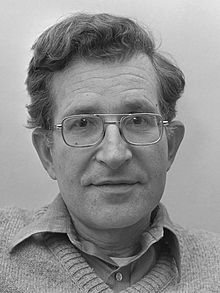
Chomsky is a linguist, philosopher, cognitive scientist, historian, social critic and political activist. Sometimes called "the father of modern linguistics," Chomsky is also a major figure in analytic philosophy and one of the founders of the field of cognitive science…. [He has written] on topics such as linguistics, war, politics, and mass media. Ideologically, he aligns with anarcho-syndicalism and libertarian socialism…. Chomsky developed the theory of transformational gram- mar for which he earned his doctorate in 1955.
Introductory Comments
Before Chomsky, the dominant view held that language was learned the way one learns to ride a bicycle: through reasoned imitation, trial and error, and a generous helping of parental correction. The child, on this account, was a small empiricist, inferring grammar from the rich data of overheard chatter. This account was tidy, intuitive, and - as Chomsky would demonstrate - almost entirely wrong. . Children, he observed, master staggeringly complex grammatical systems with breathtaking speed, often from fragmentary and imperfect input. Reason alone simply can't do that much heavy lifting that fast. The mind, he argued, must come pre-equipped with a Universal Grammar - an innate cognitive scaffolding that makes language acquisition possible at all.
The implications were seismic. If children are born with a specialized language faculty, then B. F. Skinner's behaviorism - which treated the mind as a black box shaped entirely by rein- forcement schedules - was not just incomplete but fundamentally misguided. Chomsky's 1959 review of Skinner's Verbal Behavior is widely credited with helping topple behaviorism and clearing the ground for cognitive science, the discipline that finally dared to peek inside the black box. And when it did, it found that the black box contained not a random bunch of wires and switches, but an entire cathedral of hidden architecture.
Some of Chomsky's Key Positions
In the past, most people have assumed that language is the natural, indeed inevitable, product of reason - that when a species reaches a certain level of intelligence, intelligence must express itself through language.
But when we study how a child in the first few years of his or her life actually acquires lan- guage, and the amazing speed at which he or she acquires it, we realize that young children could never achieve the mastery of language through reason alone, even when combined with a very large exposure to the language of others, which is often not the case.
No, the capacity for acquiring language must be innate. And what is innate here is not merely a behavioral disposition. It must also be concep- tual: there must be a mental template of sorts which the young child uses to make sense of the language he or she is exposed to.
As different as all human languages are, they share the same underlying or "generic" linguis-tic structure. Just as Kant argued that we must possess certain inborn categories of thought to make sense of the world, so we must also poss-ess an inborn Universal Grammar to make sense of language. This faculty, however, is unlikely to be the gradual product of natural selection; it more plausibly emerged as a sudden, distinc- tively human leap in our cognitive architecture.
Place in the History of Ideas
Chomsky's Place in History of Ideas
A. J. Ayer: [Chomsky] argues that children could not display the linguistic capacity that they do unless they were antecedently programmed to adopt a certain form of grammar. For technical reasons, this grammar is held to consist not simply in the choice of certain structures but in the use of certain rules of transformation. The propensity to employ these rules of transforma- tion so as to generate the sentences of whatev- er language we are brought up to employ is regarded as part of the constitution of the hu- man mind.
James McGilvray: The second major area to which Chomsky has contributed... is his work on sociopolitical analysis; political, social, and eco- nomic history; and critical assessment of cur- rent political circumstance. In Chomsky's view, although those in power might - and do - try to obscure their intentions and to defend their actions in ways that make them acceptable to citizens, it is easy… to discern what they are up to.
Norman N. Holland: I do not mean to suggest that linguists have all adopted Chomsky's views. They are still controversial.... Linguists who reject Chomsky's ideas, however, are trying to offer alternatives or to go beyond Chomsky. They are not turning back to Saussure. My point is not that Chomsky is right but that Saussure and Lacan are wrong.
Random Thoughts on Chomsky
Is there any link between Chomsky the linguist and Chomsky the proponent of anarcho-syndicalism and radical critic of empire, propa- ganda, and the "manufacture of consent"? Perhaps the most compelling thread is the parallel between his anti-behaviorism and his anti-authoritarianism. Just as he rejected the notion that language is mere stimulus-response conditioning, he rejected the notion that citizens are passive vessels to be filled with state or corporate messaging. In both arenas, he insists humans are active, creative agents - not blank slates awaiting the chalk of elites.
That parallel, however, is not airtight. Plenty of linguists admire Chomsky's syntax while rolling their eyes at his politics, and plenty of leftists return the favor. Plus, critics from the left have pointed out that Universal Grammar, with its fixed innate structures, sounds more like con- servative Burke than anarchistic Bakunin. And yet - there is something fitting about a man who spent his career insisting that ordinary people possess extraordinary innate capacities, be they for language or for sociey. After all, if toddlers are self-organizing masters of lan- guage, why can't their parents embrace - at least in theory - self-organizing anarchism that shapes workplaces, labor syndicates, and entire communities from below? (Perhaps the answer here is: because they learn from their toddlers what anarachism looks like in practice.)
Bakunin (Law & the state are at times obstacles to freedom & human rights.)
Dewey (Deomcracy applies not just to politics, but also to industry & society.)
Fodor (The mind is inherently modular, with an interplay of distinct processes.)
Humboldt, W. (Language is a system of rules, not just a collection of words.)
Leibniz (Humans are born with certain innate ideas already in their mind.)
Mill (Freedom is not something we find in the state, but in ourselves.)
Pinker (Evolution has created the cognitive tools we use to function & survive.)
Proudhon (As we seek justice in equality, so society seeks order in anarchy.)
Said (Abuses of state authority & all forms of colonialism must be opposed.)
Saussure (We must study signs & symbols to understand how language works.)
Thinkers with opposing positions:
Agamben (The law is always the best guarantor of human freedom & rights.)
Arendt (Only rights granted by the state matter, not "inalienable human rights.")
Hegel (Freedom springs not from within, but from our belonging to a state.)
Heidegger (Language creates a huge abyss between humanity & animality.)
Lakoff (The deep structure of language springs from semantics, not grammar.)
Piaget (Language develops more from reason then from specialized instincts.)
Skinner (Behavior is a matter of stimuli & responses, not psyche or inner states.)
What others said about Chomsky
Said: [Chomsky is] one of the most significant challengers of unjust power and delusions.
Ayer: The man who has done most, if not to develop a true and comprehensive science of language, at least to supply linguistics with a philosophical foundation is Noam Chomsky....
Paul Robinson: He is also a disturbingly divided intellectual. On the one hand there is a large body of revolutionary and highly technical linguistic scholarship, much of it too difficult for anyone but the professional linguist...; on the other, an equally substantial body of political writings, accessible to any literate person but often maddeningly simple-minded.
Chris Hedges: Noam Chomsky is America's greatest intellectual. His massive body of work, which includes nearly 100 books, has for decades deflated and exposed the lies of the power elite and the myths they perpetrate.
David Horowitz: [Chomsky is] the most devious, the most dishonest and... the most treacherous intellect in America.
Robert Barsky: We now hear a lot about how the left has been discredited, the hopelessness of utopian thinking, the futility of activist struggle, but little about the libertarian options that Chomsky [has] so consistently presented.
Zizek: [Chomsky claims that] Western powers [should] intervene [in] Third World countries... on behalf of the defense of Human Rights. My disagreement with Chomsky’s political analyses lies elsewhere: his neglect of how ideology works, as well as the problematic nature of his biased dealing with facts which often leads him to do what he accuses his opponents of doing.
Alfred Kazin: [Chomsky is a] dupe of intellectual pride so overweening that he is incapable of making distinctions between totalitarian and democratic societies, between oppressors and victims.
Main interests: Civil Rights, Communication, Computer Science, Equality, Freedom, Freedom of the press, Government, History of Ideas, Just War, Language, Mind, Political Activism, Political Philosophy, Political Theory, Public Administration, Racism, Revolution, Science, Semantics, Semiotics, Social Criticism, Social Philosophy, War, Welfare State