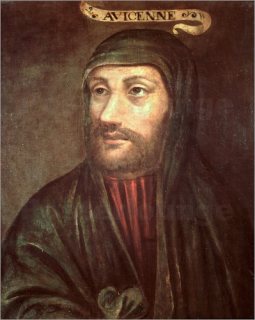
Avicenna was the preeminent philosopher and physician of the Muslim world, flourishing during the Islamic Golden Age, serving in the courts of various Iranian rulers. He is often described as the father of early modern medicine. His philosophy was of the Muslim Peripatetic school derived from Aristotelianism.... Besides philosophy and medi- cine, Avicenna's corpus includes writings on astronomy, alchemy, geography and geology, psychology, Islamic theology, logic, mathematics, physics, and works of poetry.
Introductory Comments
Like his hero Aristotle, Avicenna was an intellectual omnivore - a prodigious polymath who devoured every branch of existing knowledge and pushed several forward himself. His interests, by one accounting, ran to astronomy, alchemy, geography and geology, psychology, Islamic theology, logic, mathematics, physics, and poetry, and that list barely scratches the surface. Yet since Avicenna held that all things emanate from God, one might just as well say he studied a single subject: God, refracted through the countless things that flow from Him. Either way, the man's intellectual appetite was bottomless.
So too, apparently, were his other appetites. By some accounts Avicenna had a lively taste for wine, music, and the pleasures of the bedroom. If the reports are true, the explanation may be as theological as it is physiological. For if all things emanate from God, then perhaps all things disclose something of God's nature - in which case the Koran's prohibitions bind only those who mistake the pleasures of the flesh for mere flesh, missing the God from whom that flesh, and the whole world, flows.
But this may be handing Avicenna more credit than he's owed. Perhaps he indulged the flesh as ravenously as he devoured books for no loftier reason than that he was a ravenous man. Period. Or better still: exclamation mark!
Some of Avicenna's Key Positions
As Islamic theology teaches, the metaphysical distinction between essence and existence is fundamental. The essence of some thing or being is not only what defines that thing or being, it is also what endures throughout its existence. In contrast, existence itself is forever changing, since existence is the irrational realm of the contingent and the accidental.
Since existence is neither rational nor necessar- y, the existence of a thing or being can only be accounted for by its coexistence and interac- tions with other things or beings. Unlike a thing's essence, its existence relies on and borrows from what is outside itself.
With one exception: There's one being whose essence necessitates its existence: God. As Aristotle argued, the causal chain cannot be an infinite one. Without an initial Unmoved Mover, the entire history and immense network of causes - all those existing things interacting with one another - would be impossible.
From the knowledge that God is this Necessary Existence, it follows that all things must ema- nate from God: the soul, intellect, material objects and, indeed, the entire cosmos. The Neoplatonists are therefore right in their emanationist cosmology. However, in most other matters, Aristotle remains the better starting point for our further deliberations.
Place in the History of Ideas
Avicenna's Place in History of Ideas
Johannes Hirschberger: [In Avicenna's writings] the idea of emanation again finds use and application. From God proceed the highest of the intelligences. From them, in turn, emanate one after another the subordinated spirits of the spheres, who by their providence (thought and will) govern the world in all its minute detail. God does not trouble Himself about the individual, but confines Himself to and knows only the universal.
Ralph McInerny: [Avicenna believed that] God is existence, is necessary existence. Avicenna intends to say, not that in God essence and existence are the same, but that God has no essence or nature. This denial can doubtless be explained in terms of the Neoplatonic notion that nature or essence is a limitation or restriction on existence.
Muhsin Mahdi: Nowhere in medieval thought was the contest between Galen and Aristotle as dramatic as in the works of Avicenna, where the two great traditions intersected. Avicenna wrote the medieval textbook of Galenic medicine..., as well as the central medieval statement of Aristotelian biology.... In both works he confronted the problem of the Aristotelian-Galenic division, and settling the contest between the two titanic authorities became the cardinal interest of his life-work in medicine and biology.
Random Thoughts on Avicenna
To see how Avicenna's theology parts ways with the Christian philosophers', a good place to start might be with prayer. Medieval Christians saw prayer as supplication and communion - a way of asking things of a personal God who hears, forgives, and, on a good day, intervenes.
Avicenna had other ideas. His God - the Necessary Existent, from whom all things emanate - neither changes His mind nor takes requests. So what is prayer for? According to Avicenna, it is not a message sent up but a turning inward and upward: the soul orienting itself toward the First Cause and, in the process, perfecting its own reason. To worship is to climb toward the intelligible order flowing from God - an ascent that counts, for Avicenna, as the nearest thing to salvation. Prayer, in short, isn't meant to change God's mind. It's meant to change yours.
This emphasis on submission (the very meaning of the word "Islam") echoes far beyond Avicenna, of course, surviving today in the reflexive Muslim habit of saying "Inshallah" - "if God wills it" - when discussing the future. Even though now worn smooth by daily use, it still nods toward submission to a will beyond one's own. Compare that to the most common quasi-religious phrase in Christian countries: "for Christ's sake," a wonderfully elastic expression of frustration, impatience, or exasperated pleading. But submissive? Not quite.
Influences
Avicenna was influenced by: Abul Hankari, Al-Biruni, Al-Farabi, Al-Kindi, Al-Masihi, Aristotle, Galen, Hippocrates, Muhammad, Plotinus, Rhazes
Leibniz (The universe is governed for the best by a rational providence.)
Nicholas of C. (All the sciences are but the handmaids of theology.)
Plato (Material things correspond to universal forms in the heavenly realm.)
Thinkers with opposing positions:
Al-Ghazali (Muslims can learn little from studying Plato and Aristotle.)
Al-Kindi (Both philosophy and theology primarily concern the nature of God.)
Averroes (The essence of a thing is not ontologically prior to its existence.)
Leibniz (Humans are born with certain innate ideas already in their mind.)
Lyotard (We've outgrown our need for universal theories & grand narratives.)
Merleau-Ponty (The body is our site of knowing the world. It's how we know.)
Sartre (Existence precedes essence: Humans GIVE meaning & purpose to life.)
What others said about Avicenna
Copleston: The greatest Muslim philosopher of the eastern group without doubt is Avicenna..., the real creator of a scholastic system in the Islamic world.
Norman Melchert: [Avicenna] posits a complex series of emanations that govern the heavenly spheres, and finally events here on earth. The world is... eternally unrolling the necessary effects of its eternal and necessary cause.
Johann Erdmann: [Avicenna taught that] purifications of the soul, ascetic practices, prayer and fasting, by which man frees himself from evil, that is from limitation, are the preparations for that infusion in which the understanding, to the degree in which it perceives all, becomes an intelligible world.
Randall Collins: [Avicenna has an early version of Descartes' cogito:] Imagine a man flying in a dark and completely empty space; though he would know nothing of sensory qualities or material bodies, he would... know that he exists.
Johannes Hirschberger: [In his writings] matter is conceived to be eternal. To Avicenna matter is also the principle of individuation.
Russell: [Avicenna thought universals] are at once before things, in things, and after things.... before things in God's understanding.... in things in natural objects.... [and] after things in our thought.
Anthony Kenny: In describing the unique nature of God, Avicenna introduced a novel idea that occupied a central role in all succeeding metaphysics: the distinction between essence and existence. In all creatures essence and existence are distinct.... But God is quite different: in his case, and only in his case, essence entails existence. God is the only necessary being....
Wallace Matson: [Avicenna believed] what Allah, the First Cause, has willed to be must be. But since Allah is absolutely good, the world that flows from Him must be the best possible.... There seems thus to be no freedom.