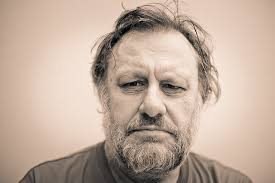
Zizek is a Slovenian philosopher, cultural theorist, and public intellectual…. He primarily works on continental philosophy (particularly Hegelianism, psychoanalysis, and Marxism) and political theory, as well as film criticism and theology…. The idiosyncratic style of his public appearances, frequent magazine op-eds, and academic works, characterised by use of obscene jokes and pop cultural examples, as well as politically incorrect provocations, have gained him fame, controversy, and criticism both in and outside academia.
Introductory Comments
To his critics - especially in the Anglo-American analytic tradition, where philosophy is expected to walk in a straight line - Zizek looks less like a thinker than a one-man variety show. He vaults from Hegel to Hitchcock, from Lacan to toilet design, from Stalin to Kung Fu Panda, pausing only to sniffle, tug his shirt, and deliver a dirty joke as if it were a syllogism. The suspicion is that this is a kind of intellectual three-card monte: dazzle the reader with paradox, smother any objection in pop-culture confetti, and dare them to admit they didn't follow. What looks like dialectical brilliance, the critics say, is really just velocity - keep talking fast enough, and nonsense begins to sound like profundity.
But it is at least worth entertaining the possibil-ity that, with Zizek, the mixed-up media is the message. His method is Hegelian to the core: truth emerges not in tidy propositions but in the collision of registers, where a Marx Brothers gag can expose an ideological fantasy more sharply than a treatise. The vulgar joke and the high-theoretical citation are not decoration; they are the two poles whose short-circuit pro- duces the insight - ideology, for Zizek, lives pre- cisely in the gap between what we solemnly profess and what we cheerfully enjoy. Seen this way, the chaos is choreography, and the clown is doing philosophy in the only costume that fits the subject. Zizek may still be a charlatan, but he is at least a charlatan with a thesis.
Some of Zizek's Key Positions
Subjectivity is a fundamental, if paradoxical, fact. A person is constituted through the symbolic order - through language, social roles, and ideology - and cannot simply stand outside it. Yet this process of constitution is always incomplete. There is always a void or remainder at the heart of the subject that no symbolic identity can fully fill or capture. This is why subjectivity eludes both hard science and soft symbolization, even those symbols the subject applies to itself. Althusser is right that ideology constitutes subjects, but wrong to imply it ever fully succeeds. The subject is not pre-social, but neither is it exhausted by its social constitution.
We should not, though, use this elusiveness as a reason for ideological dualism: the fact that the subject contains an irreducible remainder does not mean the world can be neatly divided be- tween an elusive inner self and a rational outer world of material objects and their relations. This entanglement of self and world means that the subject, though never fully captured, is not simply free either. It is traversed by drives it cannot master and embedded in structures it did not choose. Under liberal capitalism, for ex- ample, the political "freedom" that democratic nations proclaim rests on a deeper unfreedom: liberal societies offer only a formal freedom - freedom of choice within existing power rela- tions. But existing power relations, especially economic ones, deprive us of actual freedom.
Place in the History of Ideas
Zizek's Place in History of Ideas
Matthew Sharpe: Zizek’s work is infamously id- iosyncratic. It features striking dialectical rever- sals of received common sense; a ubiquitous sense of humor; a patented disrespect towards the modern distinction between high and low culture.... Yet Zizek’s work, as he warns us, has a very serious philosophical content and inten- tion. He challenges many of the... assumptions of today’s left-liberal academy, including the elevation of difference or otherness to ends in themselves, the reading of the Western Enlightenment as implicitly totalitarian, and the pervasive skepticism towards any context-transcendent notions of truth or the good.
Roger Scruton: To summarize Zizek's position is not easy: he slips between philosophical and psychoanalytical ways of arguing, and is spell-bound by Lacan's gnomic utterances. He is a lover of paradox, and believes strongly in what Hegel called "the labor of the negative" though taking the idea, as always, one stage further towards the brick wall of paradox.
Adam Kirsch: The curious thing about the Zizek phenomenon is that the louder he applauds violence and terror - especially the terror of Lenin, Stalin, and Mao, whose "lost causes" Zizek takes up in another new book, In Defense of Lost Causes - the more indulgently he is re- ceived by the academic left, which has elevated him into a celebrity and the center of a cult.
Random Thoughts on Zizek
Zizek objects to the contemporary academic tendency to treat philosophy as a mere prob-lem-solving toolkit designed to provide tidy an- swers to pre-packaged ethical or political dilem-mas. When he writes that the task of philoso-phy is "to show how the way we perceive a problem can be itself part of a problem," he is warning us that our very frameworks of "com-mon sense" and objective reason are already contaminated by the invisible smog of ideology. Reason can calculate within this ideological frame, but it cannot see the frame, because the frame is what lets it see anything at all.
Hence Zizek's claim that philosophy's first job is not to answer the question but to ask who wrote it, and in whose interest.In doing so, Zizek wants philosophy to show that the most ordinary concepts are often knotted together with hidden ideology. A simple freedom, a simple choice, a simple identity - these are rarely simple at all once you look closely enough. These apparently simple things, he argues, are where ideology does its deepest and most invisible work. Unpack them and you find that democracy rests on exclusion; freedom depends on constraint; love is as much violence as tenderness. But the question then is: Is Zizek merely a cynic who exults in undermining cher- ished concepts, or is he a Socrates who is trying to show us that the unexamined concept, no matter how cherished, is not worth having?
Althusser (Self-consciousness springs from social ideology and practices.)
Cassirer (Humans are symbolic animals. We comprehend with signs & symbols.)
Durkheim (Collective consciousness produces a society & holds it together.)
Gramsci (The bourgeoisie spreads its politics more thru culture than violence)
Horkheimer (Popular culture can itself be a form of insidious totalitarianism.)
Lacan (Symbols shape both our psychology and our culture.)
Said (Cultural stereotypes in literature can encourage political aggression.)
Veblen (The economy is closely linked to social and cultural practices.)
Thinkers with opposing positions:
Berlin (Certain values, like liberty, are universal and qualify as "natural laws.")
Descartes (Self-consciousness is the inevitable result of introspection.)
Dewey (Democracy and science rely on communicatve rationality of the group.)
Habermas (We must not give up on Enlightenment ideals of reason & science.)
Locke (Freedom is a birthright or natural right by virtue of our humanity.)
Locke (God's natural laws must form the basis of our moral and political systems.)
Mead (Rationality has ethical implications. It's not merely instrumental.)
Spencer (Govt. should not interfere in the economic survival of the fittest.)
What others said about Zizek
John Gray: Few thinkers illustrate the contradictions of contemporary capitalism better than the Slovenian philosopher and cultural theorist Slavoj Zizek.
D. Aitkenhead: At the risk of upsetting Zizek's fanatical global following, I would say that a lot of his work is impenetrable. But he writes with exhilarating ambition and his central thesis offers a perspective [that's] thought-provoking.
Edward R. O'Neill: [In Zizek's writing] a dizzying array of wildly entertaining and often quite maddening rhetorical strategies are deployed in order to beguile, browbeat, dumbfound, dazzle, confuse, mislead, overwhelm, and generally subdue the reader into acceptance.
D. Aitkenhead: In essence, he argues that nothing is ever what it appears, and contradiction is encoded in almost everything. Most of what we think of as radical or subversive - or... simply ethical - doesn't actually change anything.
Tony Brown: Zizek always resists such encapsulations of his work and forces us to carry on thinking. He readily challenges people trying to sum him up.
Tony Judt: [T]he ridiculous Slavoj Zizek [is] a "global" public intellectual who is therefore of no particular interest in any one place or on any one subject. If he is the future of public intellectuals, then they have no future.
Matthew Sharpe: Slavoj Zizek’s work represents a striking challenge within the contemporary philosophical scene. Zizek’s very style, and his prodigious ability to write and examine examples from widely divergent fields, is a remarkable thing…. Prescriptively, Žižek’s work challenges us to ask questions about the possibility of sociopolitical change….
Chomsky: I’m not interested in [Zizek's] posturing - using fancy terms like polysyllables and pretending [he has] a theory when [he has] no theory whatsoever.
Main interests: Alienation, Civil Rights, Class Struggle, Communication, Cultural Studies, Desire, Economics, Equality, Film Theory, Free/Unfree Will, Freedom, Government, History, Human Will, Ideology, Justice, Law, Literary theory, Literature, Music, Political Activism, Political Theory, Politics, Popular Culture, Psychoanalysis, Psychology, Religion, Revolution, Social Criticism, Social Philosophy, Theology