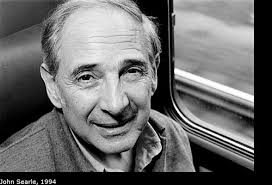
John Searle (1932)
Open Searle's interactive page (graphs of influences, similar and opposing positions, and quotes)
Background
John Searle
Born: July 31, 1932 in Denver, Colorado, USA
Died: September 17, 2025 (aged 93) in Safety
Harbor, Fkorida, U.S.
Alma mater: University of Wisconsin; Christ
Church, Oxford
School: Analytic
Main interests: Philosophy of language,
Philosophy of mind, Intentionality, Social
philosophy, Epistemology, Practical reason,
Ontology, Politics, Artificial intelligence
Notable ideas: Indirect speech acts, Chinese room
Influences: Elizabeth Anscombe, J. L. Austin,
Noam Chomsky, Gottlob Frege, Paul Grice,
David Hume, Bertrand Russell, P. F. Strawson,
Gilbert Ryle, Wittgenstein, Edmund Husserl,
Hubert Dreyfus, Hemingway, Faulkner, F. Scott
Fitzgerald, Bernard Williams
Influenced: Habermas
From Wikipedia
Searle is... noted for contributions to the philoso- phy of language, philosophy of mind, and social philosophy…. In his 1969 book "Speech Acts," Searle sets out to… give his account of illocution- ary acts. There he provides an analysis of what he considers the prototypical illocutionary act of promising and offers sets of semantical rules... to represent the linguistic meaning of devices indicating further illocutionary act types. [He also dinstinguishes] between the "illocutionary force" and the "propositional content" of an utterance.
Introductory Comments
Imagine you are locked in a room. Slips of paper with Chinese characters are passed to you through a slot in the door. You have no idea what any of the characters mean - you don't speak a word of Chinese - but you have an ex- traordinarily detailed rulebook telling you which characters to write in response and pass back out. To everyone outside the room, you appear to be a fluent Chinese speaker. But you are, in effect, merely a very diligent paperpush- er with no idea what the paperwork means. That, Searle insisted, is exactly what a computer does when it "speaks": symbol manippulation all the way down, with nobody home.
From this Searle drew a sweeping conclusion: "strong AI" - the claim that a suitably pro- grammed computer has an actual mind - is not merely unproven but impossible in principle. Programs are defined purely syntactically, but minds traffic in semantics, in genuine about- ness, and no amount of syntax, however clever-ly arranged, can ever bootstrap itself into a mind. You cannot, as it were, squeeze orange juice from a spreadsheet. Searle held this posi- tion unwaveringly for 45 years, and here the story takes a novelistic turn: when he died in September 2025 at the age of 93, the world barely noticed - yet his Chinese Room argument suddenly became the most hotly debated puz- zle in Silicon Valley, as users for the first time interacted with LLMs like ChatGPT and Claude.
Some of Searle's Key Positions
Philosophers like J. L. Austin, Ryle, and Wittgen- stein are right to emphasize that language is used not only to state things, but also to do things. For too long philosophers analyzed language mainly in terms of truth-values - the truth or falsity of assertions. This focus on truth has, ironically, obscured a deeper truth about language itself: Language is not merely a vehicle for descriptions. It is also a system of rule-gov- erned acts which commits us to certain obliga- tions, intentions, and social consequences.
This in turn raises an even more fundamental point about intentionality: the directedness or "aboutness" by which mental states refer to ob-jects and states of affairs in the world. Speech acts mean what they do only because they in- herit this intentionality from the minds of speakers. So understanding intentionality is not only useful for understanding language; it is essential for understanding the mind itself.
The mind has intentional states with their own direction of fit with the world: sometimes the mind aims to represent how the world is; some- times it aims to make the world conform to how it represents it. This means that to under- stand the mind - and to make sense of lan- guage - we must recognize the way intention- ality shapes everything we say and think. More than even that: it is what links humans and other creatures to the world.
Place in the History of Ideas
Searle's Place in History of Ideas
Nicholas Fotion: Since mental states are essentially involved in issuing speech acts, Searle realized that his analysis of language could not be complete unless it included a clear understanding of those states. An important feature of the majority of mental states is that they have an "intentional" structure: they are intrinsically about, or directed toward, something…. Speech acts are intentional in a derivative sense, insofar as they are expressive of intrinsically intentional mental states, including expressed psychological states and propositional contents. According to Searle, the derived intentionality of language accounts for the apparently mysterious capacity of words... to refer not only to things in the world but also to things that are purely imaginary or fictional.
Robert M. Harnish: Searle presents the "Chinese Room" argument against "strong artificial intelligence," the view that mental states are and can be explained by programs running on the brain, by claiming that programs will give you at best the syntax or structure of thoughts, but not their semantics, their intentionality (aboutness)…. Some intentional states, such as perception, memory, intention, have the added feature of causal self-reference, in that their conditions of satisfaction make reference to their own causal role. All intentional states… function against a background of nonintention- al capacities and abilities.
Random Thoughts on Searle
Critics, like Dennett, have been picking the lock on the Chinese Room (see Introductory Com-ments) since 1980, and the most powerful ob- jection remains the Systems Reply: The lonely guy in the room may not understand Mandarin, but guy-plus-rulebook-plus-room-plus-database might - just as no single neuron in your skull understands English, yet somehow you do. Understanding, on this view, is a property of the whole, not of any tidy component within it. Modern LLMs exhibit what looks startlingly like reasoning, analogy, even creative insight and a comprehensive worldview, none of which were predicted by anyone who thought they were just building very elaborate autocomplete.
Your neurons, after all, are themselves just elec- trochemical rule-followers - sodium in, potassi- um out, no semantics in sight - and yet meaning somehow arises. If biological wetware can leap the syntax-semantics chasm, why is silicon for- bidden the same trick, especially once it is em- bodied, multimodal, and causally coupled to the world? None of this proves today's LLMs are conscious; they may well be the most eloquent zombies ever assembled. But it does suggest that Searle mistook a limitation of the isolated man/neuron in the room/brain for a law of na-ture. Yes, that poor guy never learned Chinese - but the room somehow has. And yes, we're no longer sure who is holding the rulebook - but it's there somewhere, and it works somehow.
Influences
Searle was influenced by: Anscombe, Austin, J.L., Chomsky, Dreyfus, Faulkner, Fitzgerald F.S., Frege, Grice, Paul, Hemingway, Hume, Russell, Ryle, Strawson, Williams, B., Wittgenstein
Searle influenced: Habermas
Similar and opposing positions
Thinkers with similar positions:
- Anscombe (Intentions deal with directedness or aboutness of mental states.)
- Austin, J.L. (Words not only assert things, but also do or perform things.)
- Brandom (Much of the meaning of words springs from their inferences and uses.)
- Dennett (We must posit intentional states to explain human behaviour.)
- Durkheim (The social environment does much to shape the minds of people.)
- Grice (Meaning in language is closely linked to the speaker's intentions.)
- Pinker (Language evolved as a practical tool, not as a purely logical instrument.)
- Wittgenstein (Language is an activity or form of life. It's a "game" we play.)
Thinkers with opposing positions:
- Ayer (Language that is not verifiable is not true or untrue but meaningless.)
- Chalmers (It's possible everything material has some degree of consciousness.)
- Dennett (Artificial Intelligence may one day lead to conscious robots.)
- Derrida (The focus on intentionality in speech-act theory is misguided.)
- Feyerabend (The mind/body distinction is confused. The mind is a physical thing)
- McGinn (Our minds may not be equipped to grasp the causes of mind.)
- Russell (Language is ultimately dependent upon a layer of atomic facts.)
- Schlick (A statement that cannot be falsified by evidence is meaningless.)
What others said about Searle
- Joshua Rust: … Searle argues that the structure of language not only mirrors but is derivative of the structure of intentional thought….
- Robert M. Harnish: Over the past forty years, Searle has been working on a selection of problems in philosophy at three levels of description: mind (the basic level), language (the middle level), and society (the highest level).
- Nicholas Fotion: … Searle treated speech acts much more systematically than Austin had. He proposed that each kind of speech act can be defined in terms of a set of rules that identify the conditions that are individually necessary and collectively sufficient for "sincerely and non-defectively" performing an act of that kind.
- Joshua Rust: Searle’s positive view, which he describes as "biological naturalism," is that mental facts are both caused by and features of underlying neurophysiological processes.
- Robert M. Harnish: [Searle assumes] an explanatory asymmetry: higher level phenomena often are to be explained in terms of lower level phenomena.
- Robert M. Harnish: [Searle argued that] [m]ental states are ontologically subjective in that they depend on a mind to exist, but they are epistemically objective in that claims about them are true or false independently of opinion.
- Joshua Rust: According to Searle then, there is no more a mind-body problem than there is a macro-micro economics problem. They are different levels of description of the same set of phenomena.... But Searle is careful to maintain that the mental - the domain of qualitative experience and understanding - is autonomous and has no counterpart on the microlevel….
- Nicholas Fotion: Searle’s interest in social institutions, like his interest in the mind, was also an outgrowth of his study of language. Speech acts, after all, are linguistic entities embedded in social settings.
Schools: Analytic Philosophy, Intuitionism, Linguistic Philosophy philosophy, Neopragmatism, Ordinary Language Philosophy, Social Liberalism, Speech Act Theory
Main interests: Artificial Intelligence, Communication, Computer Science, Consciousness, Epistemology, Fact–value distinction, Human Will, Language, Mind, Politics, Semantics, Social Philosophy, Will
Searle's answers to philosophical questions
Education
At their best, schools transmit "knowledge in a way that combines intellectual openness, critical scrutiny, and logical clarity."
"The student should have enough knowledge of his or her cultural tradition to know how it got to be the way it is."
Epistemology
"Where conscious subjectivity is concerned, there is no distinction between the observation and the thing observed."
Reason does not cause our actions. Reason may dispose us to act in a certain ways, but our desires have the final say.
Language
"For all but the simplest thoughts, one has to have a language to think the thought."
Sentences are often indirect calls for action. For example, the sentence "Can you reach the salt?" is more than just a question.
To understand language, we must recognize the way in which intentions weave themselves into everything we say and write.
Writers can fall down a rabbit hole "where the language is talking about the language, which is talking about the language…."
We often use metaphors to explain cognition (adding machine, computer, etc.), but of course nothing is proved by doing this.
Metaphysics
Consciousness can't be reduced to matter: "where consciousness is concerned, the existence of the appearance is the reality."
Mind
"Consciousness is a biological phenomenon, like… digestion, … and once you accept that, most… hard problems… evaporate."
Mind or consciousness is a subjective experience caused by the material workings of the brain.
To understanding intentionality is to understand the mind's agenda: Concerns, hopes, desires, etc. are linked to certain ends.
"Your brain can go from a state of being conscious to a state of being unconscious…. The... mind-body problem is that simple."
Nature
Darwin showed "the illusion [of design] could be explained by evolutionary processes that contained no such purpose at all."
Philosophy
As to "style and exposition… I try to follow a simple maxim: if you can’t say it clearly you don’t understand it yourself."
"You need to know enough philosophy so that the methods of logical analysis are available to you to be used as a tool."
Religion and Theology
"Nowadays nobody bothers, and it is considered in slightly bad taste to even raise the question of God's existence."