Main interests: Ethics, humanity, justice, politics,
literature, theatre
Influences: Sartre, Augustine, Lev Shestov,
Nietzsche, Dostoyevsky, Kierkegaard, Orwell,
de Beauvoir, Simone Weil, Kafka, Hugo, Freud,
Marx, Kant, André Gide, Hegel, André Malraux,
Herman Melville, Max Stirner, Lev Shestov,
Pascal Pia, Georges Palante, Georges Simenon,
Giacomo Leopardi, Husserl, Plotinus, Stendhal,
Schopenhauer, Bergson, Jaspers
Influenced: Michel Onfray, Samuel Beckett,
Arthur Miller, Amos Oz
From Wikipedia
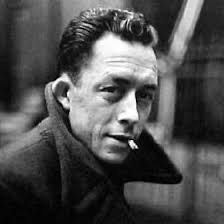
Camus was a French philosopher, author, dramatist and journalist. He was awarded the 1957 Nobel Prize in Literature at the age of 44, the second-youngest recipient in history. His works include The Stranger,The Plague, The Myth of Sisyphus, The Fall, and The Rebel…. Philosophical- ly, Camus's views contributed to the rise of the philosophy known as absurdism. Some consider Camus's work to show him to be an existentialist, even though he himself firmly rejected the term throughout his lifetime.
Introductory Comments
Camus spent much of his career dodging philo- sophical labels the way a matador dodges bulls - gracefully, deliberately, and with a cer- tain flair. He rejected "existentialist" not out of mere contrarianism but because he saw Sartre's brand of existentialism as committing the very sin it claimed to avoid: making a leap of faith, only this time toward radical freedom and po- litical ideology rather than God. For Camus, that was just theology in a turtleneck. He also rejected the label "nihilist," but for the oppo- site reason: the nihilist doesn't grab for a life- line, he just drowns on purpose and calls it wis- dom. Nihilism's was the very trap he urged us to revolt against through passionate living.
As for what label Camus would accept - "absurd- ist" comes closest to a self-description, since he coined the term and owned the framework, at least as a starting point. "Mediterranean humanist" he might have warmed to over a glass of wine. "Moralist," in the old French tra- dition of Montaigne, fits his temperament well - he was always more interested in how to live than in constructing grand theoretical systems. In truth, Camus saw himself as an artist first and a philosopher only by accident - someone who explored ideas not through systems but through stories, characters, and the Algerian sun. If forced at gunpoint to wear a single label, he'd probably shrug, light a cigarette, and say he was simply a man who paid attention.
Some of Camus's Key Positions
As Sisyphus was doomed to forever push a heavy rock up a mountain only so that, when the rock reaches the mountaintop, it can fall to the ground again and Sisyphus begin his strug- gle all over again, so too are we doomed to an absurd existence. Though we are immersed in our struggles, they are all essentially meaning- less - or, if one prefers the adjective, absurd.
Or, to be more exact, whatever temporary meaning our struggles may seem to have is snatched from us in the face of death. We may build our lives in the hope of a better future, but each day brings us only that much closer to death - where all that we have is taken from us in one fell swoop of the Reaper's sickle. What is the meaning in that? What is the meaning of life itself when the ultimate result of life is death?
However, as absurd as life is, this existential fact does not warrant suicide. The struggle of life, though meaningless, does offer purpose and at times even contentment. As Nietzsche taught us, a brave soul can both accept the meaning- lessness of life and, at the same time, embrace the challenges confronting him. Indeed, he can find happiness in a world without meaning. The struggle itself is enough. And so with Sisyphus: As he walks down the mountain again to take on again his heavy burden, "one must imagine Sisyphus happy."
Place in the History of Ideas
Camus's Place in History of Ideas
Ronald Aronson: He ignored or opposed sys- tematic philosophy, had little faith in rational- ism, asserted rather than argued many of his main ideas, presented others in metaphors, was preoccupied with immediate and personal experience, and brooded over such questions as the meaning of life in the face of death. Although he forcefully separated himself from existentialism, Camus posed one of the twentieth century’s best-known existentialist questions, which launches "The Myth of Sisyphus": "There is only one really serious philosophical question, and that is suicide."
Mark Kurlansky: Camus, who worked with the Resistance against the Nazi occupiers of France editing an underground newspaper, Le Combat, often wrote from the perspective of a moral imperative to act. His 1948 novel, The Plague, is about a doctor who risks his life and family to rid his community of a sickness he discovers. In the 1960s, students all over the world read The Plague and interpreted it as a call to activism…. "There are times when the only feeling I have is one of mad revolt," Camus wrote. American civil rights workers read Camus. His books were passed from one volunteer to the next in SNCC. Tom Hayden wrote that he considered Camus to be one of the great influences in his decision to leave journalism and become a student activist. Abbie Hoffman used Camus to explain in part the Yippie! Movement….
Random Thoughts on Camus
Picture Sisyphus walking back down the moun- ain, his rock already tumbling below him, the whole pointless ordeal about to begin again. He knows the score - no redemption waits at the summit, no angel will descend to say "enough," no final push will end the game. And yet Camus insists we must imagine Sisyphus happy, as he walks down the mountain to take up his bur- den again. But why? Are we simply biological machines running on instinct and dopamine, too busy striving to notice that the finish line is a cliff? Is it that we are constitutionally short-sighted, content because we see only what is immediately in front of us?
Or does Sisyphus have good reason to be hap- py? Must meaning be cosmic, eternal, and nota- rized by God to count as an objectibve reality? What would an "objective meaning" even look like - a fact floating in space, meaningful to no one in particular, waiting to be discovered? That notion is incoherent; meaning independ- ent of any mind to hold it is not meaning at all but furniture. To say life can only matter if it matters to the cosmos is like saying love can only be real if it's witnessed by a notary. The rock, the hill, the burning muscles are meaning- ful because they are lived - because Sisyphus would not let the universe's silence be the last word. In the end, the meaning of life may be nothing more - and nothing less - than the defi- ant act of living it anyway, absurd though it be.
Berlin (There is no single criterion of meaningfulness. No absolute certainty.)
Borges (Man's search for meaning in a seemingly infinite universe is fruitless.)
Fromm (Man is burdened by his freedom and often attempts to escape it.)
Heidegger (Each individual's very Being involves engagement with the world.)
Herzen (Humans should never be sacrificed on an altar of glorious abstractions)
Marx (The comfort of religion is illusory & keeps the masses quietly enchained.)
Nietzsche (Philosophy should focus on lived experience, not abstractions.)
Ortega (Man's search for meaning in a seemingly infinite universe is fruitless.)
Proudhon (As we seek justice in equality, so society seeks order in anarchy.)
Sartre (Existence precedes essence: Humans GIVE meaning & purpose to life.)
Thinkers with opposing positions:
Anselm (God, not man, is the source of all meaning and purpose in life.)
Anselm (God, not man, is the source of all meaning and purpose in life.)
Epicurus (Don't fear death. Death is nothingness & therefore nothing to us.)
Marcel (Human life is not self-enclosed. Relationships give birth to meaning.)
Philo (The truth of religion is entirely consistent with reason.)
Plato (Being a copy of a copy of a Form, art removes us even further from truth.)
Pythagoras (Humans exist to observe the heavens and the workings of nature.)
Schopenhauer (Art exists in a realm free of the forces at work on and within us.)
What others said about Camus
David Simpson: To read Camus is to find words like justice, freedom, humanity, and dignity used plainly and openly, without apology or embarrassment….
Ronald Aronson: Camus’s philosophy found political expression in "The Rebel," which along with his newspaper editorials, political essays, plays, and fiction earned him a reputation as a great moralist.
Colin Wilson: Both Camus and Sartre had been neatly hog-tied by their earlier radicalism. Camus came to see that rebellion is a political roundabout that revolves back to the same old tyranny; too ashamed to admit that he had outgrown his leftism, he found himself in an intellectual cul-de-sac. Sartre accused Camus of being a reactionary….
Said: The only people who mattered to Camus and to the European reader of the time, and even now, are Europeans. Arabs [in Camus' "The Plague"] are there to die.
O. Draugsvold: Camus combines a taut writing style, as well as profound insights on society, with the courage to report back from the abyss of despair....
David Simpson: He was honored by his own generation, and is still admired today, for being a writer of conscience and a champion of imaginative literature as a vehicle of philosophical insight and moral truth.
Mark Kurlansky: Because of his 1942 essay, “The Myth of Sisyphus,” in which he argued that the human condition was fundamentally absurd, he was often associated with the existential movement. But he refused to consider himself part of that group. He was not a joiner, which is one of the reasons he was more revered than the existentialist and communist [Sartre].
Ottar G. Draugsvold: As a writer Camus maintained his independence from both friends and enemies in the political and philosophical movements that attempted to subvert his writing to their own ends.