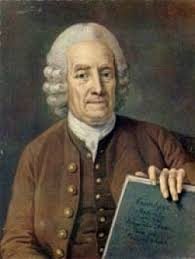
Emanuel Swedenborg (1688 - 1772)
Open Swedenborg's interactive page (graphs of influences, similar and opposing positions, and quotes)
Background
Emanuel Swedenborg
Born: 29 January 1688 in Stockholm, Sweden
Died: 29 March 1772 (aged 84) in London,
England, Great Britain
School: Mysticism
Main interests: Theology, Science, Philosophy,
Religion, Mysticism
Influences: Plato, Aristotle, Newton, Leibniz,
Descartes, Augustine, Plotinus
Influenced: Coleridge, Emerson, Goethe, William
James, Kant, Jung, Blake, Baudelaire, Helen
Keller, August Strindberg, John Chapman
(Johnny Appleseed), George Inness, J. L. Borges,
Sheridan Le Fanu, W. B. Yeats, Robert Southey,
James Macpherson, Margaret Fuller, Henry
James Sr., D. T. Suzuki, Honoré de Balzac,
Charles Fourier, Robert Owen, Czeslaw Milosz,
John Bigelow, Walt Whitman, Arthur Conan
Doyle, E. B. Browning, Carlyle, Dostoevsky
From Wikipedia
Swedenborg was a Swedish Christian theologian, scientist, philosopher, and mystic. He became best known for his book on the afterlife, Heaven and Hell. Swedenborg [also] had a prolific career as an inventor.... In 1741, at 53, he entered into a spiritual phase in which he began to experience dreams and visions.... His experiences culminated in a "spiritual awakening" in which he received a revelation that Jesus Christ had appointed him to write The Heavenly Doctrine to reform Christianity.
Introductory Comments
How did Swedenborg - levelheaded scientist, engineer, and polymath - transform in his late fifties into a full-blown mystic? What triggered the revelations that let him see angels as easily as others see clouds, recover what he called the lost key to the Bible's spiritual code, and map the true nature of heaven and hell, including why some of the dead don't yet know they're dead? And how did he manage to report it all in such extraordinary detail - what the angels wear, what music they sing, what a bird means when it turns up in Scripture? (Beware the raven. It stands for falsity.)
Swedenborg's own answer was that none of this was a departure from reason but a higher use of it. And he had a point, at least about the continuity. His ambitions had always been wide-ranging - manically so. Anatomy, physiology, physics, mechanics, geology, mineralogy, astronomy, cosmology, engineering, mathematics, economics, even Latin verse: he embraced it all. More to the point, he had spent the decade before his spiritual crisis dissecting brains and hearts in a systematic hunt for the seat of the soul. From that vantage, taking on God and His Creation was less a swerve than a culmination - the last and largest entry in an encyclopedic career. (Look under "G" for God.) All he needed was empirical evidence, and that he found all by himself. And all within himself. - If nothing else, one has to admire the economy of the method: the laboratory, the instrument, and the sole qualified observer were all the same man.
Some of Swedenborg's Key Positions
(After his visionary crisis of 1743–45 Swedenborg reversed his earlier claim that "tremulations"of matter can create spiritual states:) Nothing flows from nature into spirit; influx runs the other way. Every natural thing is the image of a spiritual cause, and Scripture carries an inner sense beneath its literal one.
Therefore, the natureal and the so-called supernatural converge: Angels, for example, are not a separate order of creation but human beings who have died, and each of us is already attended by spirits. God casts no one down. At death the outward self falls away, and each person goes freely to the society his ruling love has already made him fit for.
Hell is not a sentence imposed from outside. God, being love itself, condemns no one; the wicked choose hell because they find it congenial, and would find heaven unbearable
The Second Coming has therefore already occurred - not in the sky, but in the unveiling of the Word's inner meaning. With it falls the Trinity of Persons. God is one, and that one God is the Lord Jesus Christ. The Word's also reveals the true nature of salvation: Faith alone saves no one. Charity is required - and charity means less the occasional alms than one's daily work done honestly for others. Together, faith and charity form the basis of spiritual regeneration
Place in the History of Ideas
Swedenborg's Place in History of Ideas
Kant: The thought of Swedenborg is in this quite sublime.... He says all spiritual natures stand in connection with one another, only the community and connection of the spirits is not bound to the condition of bodies; there one spirit will not be far or near to the other, but rather there is a spiritual connection. Now as spirits our souls stand in this connection and community with one another, and indeed already herein this world, only we do not see ourselves in this community because we still have a sensible intuition; but although we do not see ourselves in it, we still stand within it.
Colin Wilson: The real importance of Sweden- borg lies in the doctrines he taught, which are the reverse of the gloom and hell-fire of other breakaway sects. He rejects the notion that Jesus died on the cross to atone for the sin of Adam, declaring that God is neither vindictive nor petty-minded, and that since he is God, he doesn't need atonement. It is remarkable that this common-sense view had never struck ear- lier theologians. God is Divine Goodness, and Jesus is Divine Wisdom, and Goodness has to be approached through Wisdom. Whatever one thinks about the extraordinary claims of its founder, it must be acknowledged that there is something very beautiful and healthy about the Swedenborgian religion. Its founder may have not been a great occultist, but he was a great man.
Random Thoughts on Swedenborg
Swedenborg wrote about parallel worlds two and a half centuries before physicists made a fashion of them. But where the modern versions run to an unfathomable - possibly infinite - number, Swedenborg modestly stops at two: the material and the spiritual. He was not, of course, the first to count them. What sets him apart is what he does with the gap between. Most philosophers and theologians had put the spiritual world above or beyond the material. Swedenborg wove them together. As the soul animates the body, so a divine influx sustains everything we see around us - from frogs to foam, from trees to stone.
The whole world is shimmering with spiritual meaning, for anyone with the eyes to see it. Swedenborg saw it everywhere he looked, and saw further that the two realms are not merely parallel but interdependent. The spiritual gives the material its existence from moment to moment; without that inflow, creation would not so much decay as simply stop. The material, in turn, gives the spiritual something to land in - a place where loves become deeds and choices acquire weight.
To grasp all this is not easy, but Swedenborg assures us that the more we perceive the hidden dimension, the more peace, joy, and love become possible. The world stops being a mere collection of objects and becomes something more like a divine language - a heigthened awareness. - Try matching that, you many-worlds theorists.
Influences
Swedenborg was influenced by: Aristotle, Augustine, Descartes, Leibniz, Newton, Plato, Plotinus, Swedberg, J.
Swedenborg influenced: Balzac, Baudelaire, Blake, Borges, Browning, E.B., Carlyle, Coleridge, Dostoyevsky, Emerson, Fuller, Goethe, Inness, George, James, Jung, Kant, Keller, Helen, Strindberg, Suzuki, D.T., Yeats
Similar and opposing positions
Thinkers with similar positions:
- Chesterton (Let your religion be less of a theory and more of a love affair.)
- Hamann (Intuition and personal genius are best tools for understanding nature.)
- Hegel (Freedom springs not from within, but from our belonging to a state.)
- James (Tho' our bodies live in a physical world, our souls live a spiritual universe)
- Plotinus (There are links among the physical, spiritual and divine worlds.)
- Proclus (Though souls descend into the material world, a divine Unity exists.)
- Schelling (Transcendental philosophy & nature philosophy are complementary.)
- Steiner (An objective, intellectually comprehensible spiritual world exists.)
- Thales (The material workings of nature also have an inherent spiritual aspect.)
Thinkers with opposing positions:
- Calvin (The only way to obtain knowledge of God is to study scripture.)
- Calvin (Salvation is fated. God predestines both the saved & the damned.)
- Feuerbach (Our concept of God reflects our own traits and deepest wishes.)
- Gramsci (Marxism will supplant religion when it meets people's spiritual needs.)
- Holbach (The foundation of morality is not in Scripture but in happiness.)
- Pythagoras (Each soul is immortal and upon death enters into a new body.)
- Stirner (All "sacred truths" in law, morality & religion are artificial concepts.)
What others said about Swedenborg
- Blake: Now hear a plain fact: Swedenborg has not written one new truth. Now hear another: he has written all the old falsehoods.
- A.S. Byatt: And Swedenborg himself saw birds during his sojourns in the Spirit World and it was revealed to him that - in the Grand Man - rational concepts are seen as birds. Because the head corresponds to the heavens and the air.
- Emerson: His rare science and practical skill, and the added fame of second sight and extraordinary religious knowledge and gifts, drew to him queens, nobles, clergy, ship-masters and people about the ports through which he was wont to pass in his many voyages.... He is described... as a man of a quiet, clerical habit, not averse to tea and coffee, and kind to children.
- Alice Hoffman: Swedenborg, the Christian mystic, and the sentiment of charity as divine spoke deeply to him. He felt swept up in something far bigger than himself.
- Johan Henric Kellgren: [Swedenborg is] nothing but a fool.
- Helen Keller: [On reading Swedenborg:] For the first time, immortality put on intelligibility for me, and the earth wore new curves of loveliness and significance.
- Lucas Thorpe: [Kant] almost certainly believed that Swedenborg was deranged.... This does not imply, however, that he did not find his visions morally inspiring.... [W]hat Kant took from Swedenborg was the idea that morality demands that we develop a character that makes us a potential member of a realm of ends, or heaven considered as a community of spirits.
- Robert Frost: I was brought up a Swedenborgian. I am not a Swedenborgian now. But there’s a good deal of it that’s left with me. I’m a mystic. I believe in symbols.
Schools: Christian Theology, Divine Illumination, Mysticism
Main interests: Astronomy, Biology, Chain of Being, Faith, Immortality, Mathematics, Mineralogy, Physics, Religion, Science, Spirituality, Technology, Theology, Wisdom
Swedenborg's answers to philosophical questions
Ethics
Self-love is not inevitable. "One's distance from Heaven is in proportion to the measure of one's self-love."
"We do need to realize, though, that it is the quality of our love that determines the quality of this life."
"Conscience is God's presence in humans."
Love is a type of communion with others: "Feeling the joy of someone else as joy within ourselves - that is loving."
Metaphysics
Spirit is fundamental. "This I can declare: things that are in heaven are more real than things that are in the world."
Spirit will always be distinct from body. "We are all spirits inwardly. This is what's alive in the body, not the body on its own."
Nature
"Man was so created by the Lord as to be able while living in the body to speak with spirits and angels…."
Psychology
"Peace has in it trust in the Lord, that He governs all things, provides all things, and leads to a good end."
Religion and Theology
"Worship does not consist in prayers and in external devotion, but in a life of kindness."
The two most important qualities of God are love and wisdom. These two qualities radiate throughout the spiritual world.
God has arranged all things according to his love & widsom, but we can't always see how everything is for our spiritual good.
It's wrong to see heaven as simply a reward for good deeds, since good deeds are spoiled or tainted if done for self-interest.
The afterlife is a loving place, and everyone is located there according to what they truly loved on earth.
One can't achieve salvation through faith alone. One must also show love and charity towards others.
When reading the Bible we must understand that, just as Jesus often spoke in parables, the Bible is also often allegorical.