Ovid (43 BC - 17 or 18 AD)
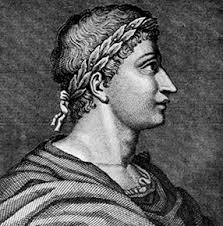
Open Ovid's interactive page (graphs of influences, similar and opposing positions, and quotes)
Background
Ovid
Born: 20 March 43 BC in Sulmo, Italy, Roman
Republic
Died: AD 17 or 18 (age 59–61) in Tomis, Scythia
Minor, Roman Empire
Occupation: Poet
Genre: Elegy, epic, drama
Main interests: Love, mythology, poetry
Influences: Homer, Virgil, Cicero, Catullus,
Augustus, Epicurus, Lucretius, Tibullus,
Callimachus
Influenced: Peter Abelard, Geoffrey Chaucer,
William Shakespeare, Johann Wolfgang von
Goethe, Ezra Pound, Boccaccio, Dante Alighieri,
Petrarch, Seneca, Christopher Marlowe,
Michel de Montaigne, Miguel de Cervantes,
John Dryden, Edmund Spenser, John Milton,
Salman Rushdie, Ted Hughes, Arthur Golding,
Jeffrey Eugenides
From Wikipedia
Ovid was a Roman poet who lived during the reign of Augustus. He was a younger contemporary of Virgil and Horace, with whom he is often ranked as one of the three canonical poets of Latin litera- ture.…. Today, Ovid is most famous for the Metamorphoses, a continuous mythological narrative in fifteen books written in dactylic hexameters. He is also known for works in elegiac couplets such as Ars Amatoria ("The Art of Love") and Fasti. His poetry... greatly influenced Western art and literature.
Introductory Comments
Ovid had his serious side, but he also - God bless him - delighted in foolishness, especially the romantic kind. (Fittingly, infatuation descends from the Latin fatuus, meaning foolish.) He was fascinated by the transformative power of love: how a mere smile, or a certain something in a pair of eyes, can turn the world upside down. To Ovid this looked like a kind of magic. Small wonder, then, that he was drawn to the mythology of metamorphosis - Daphne into a laurel tree, Io into a cow, Actaeon into a stag. Not all of these are tales of infatuation, but infatuation lends poetic credibility to the claim that love can be a genuinely transforming experience.
And what does all this tell us about Ovid the man? One suspects he was writing not merely about the romantic folly of others but, slyly, about his own. He nearly admits as much: "Look, I confess! Cupid, I'm your latest prize, stretching out conquered arms toward your justice." For Ovid, Cupid is a mischievous god who delights in wreaking havoc with his arrows. He turns no one into another species, yet he makes asses of us all, at least in matters of love. (Shakespeare, who knew his Ovid well, made the joke literal in A Midsummer Night's Dream: there a magic flower does Cupid's work, the lovers are shuffled like cards, and poor Bottom is given an actual ass's head.) So who was Ovid? Perhaps something like Montaigne in his lighter moods: a man who liked his romanticism sprinkled with laughter, most of all at himself.
Some of Ovid's Key Positions
Love and sex are not merely powerful forces in human life; they are also serious subjects for literature. Poetry, emotional and evocative by nature, is an especially apt vehicle for capturing love's intoxicating, contradictory textures: the thrill, the folly, the heartbreak, often all in the same stanza.
But love is also social games, with its own moves, ploys, and countermoves - and won less by raw passion than by ingenious tactics. The art of seduction in particular demands both discipline and invention - and, crucially, it can be taught.
This art is best approached without moralizing. Subtlety and caution matter in the pursuit of love, but prudishness is fatal to it. One should savor love's delights, nurse its inevitable wounds, and not brood over the ethics of the whole affair.
What does repay reflection is love's psychological power, above all its capacity to transform. The legends of Greece and Rome testify to the transformative force of all our commanding emotions - love and lust, jealousy and spite, pride, revenge, and remorse.
Those same myths reveal the power of stories themselves. They are not dusty relics but living resources for understanding human nature - with an endless gallery of characters and predicaments through which we can explore ourselves.
Place in the History of Ideas
Ovid's Place in History of Ideas
Ian Johnston: No work from classical antiquity, either Greek or Roman, has exerted such a con- tinuing and decisive influence on European literature as Ovid's Metamorphoses. The emergence of French, English, and Italian national literatures in the late Middle Ages simply can- not be fully understood without taking into account the effect of this extraordinary poem.... The only rival we have in our tradition which we can find to match the pervasiveness of the literary influence of the Metamorphoses is perhaps (and I stress perhaps) the Old Testament and the works of Shakespeare.
Irving Singer: In everything he writes Ovid reveals an interest in the artfulness of love. Though he presupposes the sexual mores of Augustan Rome, he shows how they may be enacted with style. His men learn to mingle poetic and libidinal impulse, and his women are freed from the necessity of being either a matron or a slut. He civilizes the earthly eros, adjusting it to individual needs and tempera- ments, refining it to the point of elegance and human dignity.
Diane Ackerman: In Ovid's writings one finds a full catalogue of love, from chaste worship to unregenerate conniving. Although Augustus banned "The Art of Love," it has endured through the ages, as a brilliantly insightful meditation on love, vanity, and temptation.
Random Thoughts on Ovid
For Empedocles, Love is a cosmic power of attraction, drawing the elements together into the forms we see. For Plato, Love at its highest is the contemplation of absolute Beauty, a rapt gaze beyond the physical altogether. For Lucretius, Love is the generative force that ushers all beings into the world and binds them to it. And then comes Ovid, who tosses out the metaphysics and talks about love as plain sexual attraction - plus the ingenious tactics we deploy to court and seduce. Ovid brought love down to earth, shrinking what the philosophers had inflated into a cosmic force or transcendent reality back to something all-too-human.
Yet in a sense Ovid was only spelling out what lay hidden in his predecessors all along. When Empedocles makes Love the cosmic power of attraction, the unspoken model is surely sexual love - the love in which sheer attraction looms largest. When Plato makes the highest love a contemplation of Beauty, he too leans on that model - for sexual love is where beauty does its most dizzying work. Even Lucretius's claim that Love conjures all beings into the world borrows its plausibility from procreation - the most literal sense in which love "brings beings into the world." Strip away the cosmology, and each philosopher turns out to have been keeping one eye, however discreetly, on Ovid's territory. This does not make them dissemblers, merely poets who mistook their metaphors for metaphysics.
Influences
Ovid was influenced by: Augustus, Callimachus, Catullus, Cicero, Epicurus, Homer, Lucretius, Tibullus, Virgil
Ovid influenced: Abelard, Boccaccio, Cervantes, Chaucer, Dante, Dryden, John, Goethe, Hughes, Ted, Marlowe, Milton, Montaigne, Petrarch, Pound, Ezra, Rushdie, S., Seneca, Shakespeare, Spenser, E.
Similar and opposing positions
Thinkers with similar positions:
- Boccaccio (Earthly or romantic love is the most appropriate subject for poetry.)
- Chaucer (Love cannot be constrained. It must be freely offered and accepted.)
- Danto (Art expresses our human experience, our needs, and our aspirations.)
- Empedocles (Two opposing forces are at work in this world: Love and Strife.)
- Heidegger (Poetry, not philosophy, is best at unveiling the mysteries of Being)
- Schlegel (Love is the highest form of aesthetic enjoyment we have.)
- Shakespeare (The stories we inherit allow us to explore the human experience)
Thinkers with opposing positions:
- Augustine (The end of all love is union with Christ - not with man or woman.)
- Bataille (Violence & erotic excess can be liberating & sacramental experiences.)
- Chesterton (Love means to love that which is unlovable, else it is no virtue.)
- Ficino (The highest form of human love is a communion based on love for God.)
- Foucault (Sex is more linked to the dynamics of power than to anything else.)
- Maimonides (Poetry is of little value, since it was founded on pure invention.)
- Plotinus (The highest form of love transforms the erotic into the ideal & pure.)
- Sade (Heed nothing but your desires; let them alone be your laws.)
- Schopenhauer (Since desire leads to suffering, self-denial is our best path.)
What others said about Ovid
- Dryden: Ovid, the soft philosopher of love: His Love Epistles for my friends I chose; For there I found the kindred of my woes.
- Robert C. Solomon: Ovid observed and participated and offered up what has endured as the classic seduction manual of Western literature, far closer to the nitty gritty of love than Plato's effete and sexless "Symposium."
- Martin S. Bergmann: ... Ovid sets out to teach lovers how to attain a harmonious enjoyment in which both partners will find equal delight without letting the partner affect too radically the inner balance of the lover. Some of the advice he has given remains part of the wisdom of love. Avoid criticism, he argues, always emphasize to the partner his or her best features.
- Irving Singer: Roman that he is, Ovid sees warfare as the ruling theme in love: Cupid wounds the heart with burning arrows, women are described as birds to be snared, game to be hunted down, booty to be carried off....
- Brooks Otis: [In his poems of love, Ovid] was burlesquing an old theme rather than inventing a new one.
- Montaigne: The first taste I had for books came to me from my pleasure in the fables of the "Metamorphoses" of Ovid. For at about seven or eight years of age I would steal away from any other pleasure to read them....
- Shakespeare: Here are only numbers ratified; but, for the elegancy, facility, and golden cadence of poesy, caret. Ovidius Naso [Ovid] was the man: and why, indeed, Naso, but for smelling out the odoriferous flowers of fancy, the jerks of invention? (from "Love's Labour's Lost," Act 4, scene 2)
- Morton Hunt: Despite the honeyed refinement of Ovidian love, it is frequently given stronger flavor by judicious infusions of sadism and masochism. An occasional charge of deliberate cruelty... is essential to keep its fires burning....
Main interests: Cosmology, Desire, Faith, Happiness, Love, Metaphors, Mythology, Poetry, Sexuality, Sublime Nature
Ovid's answers to philosophical questions
Art and Aesthetics
With the help of legends and myths, art provides us with a rich a variety of stories exploring our own human nature.
Poetry is a powerful vehicle for capturing the intoxicating complexities of love and sex.
Ethics
"Desire and reason are pulling in different directions. I see the right way and approve it, but follow the wrong."
Moralism is deadly. The art and delights of love and sex should not be approached from a moralistic standpoint.
Besides being powerful instincts, love and sex are also social games, where ingenious tactics play a major role.
Law
"The purpose of the law is to prevent the strong from always having their way."
Jupiter: "[L]et all men speedily feel that vengeance which they deserve to endure, for such is my determination."
Metaphysics
Time is change: "What was before / Is left behind; what never was is now; / And every passing moment is renewed."
"Time itself flows on with constant motion, just like a river: for no more than a river can the fleeting hour stand still."
"There is nothing constant in the universe. All ebb & flow, & every shape that's born, bears in its womb the seeds of change."
Nature
Though "other animals are prone and... gaze upon the earth, He gave to Man an uplifted face and bade him [look] to heaven."
Psychology
All powerful human emotions have a transformative power: love, lust, jealousy, spite, hate, pride, revenge, remorse.
Love and sex are not only powerful emotions. They are also social games involving ingenious ploys and tactics.
Our memories and our imagination help us endure difficult times: "It's a kindness that the mind can go where it wishes."
"Habits change into character."
"Happy is the man who has broken the chains which hurt the mind, and has given up worrying once and for all."
Religion and Theology
"Those things that nature denied to human sight, she revealed to the eyes of the soul."
"It is convenient that there be gods, and, as it is convenient, let us believe that there are."
Faith is important in all facets of life: "First thing every morning before you arise say out loud, 'I believe,' three times."