Porphyry (c. 234 - c. 305)
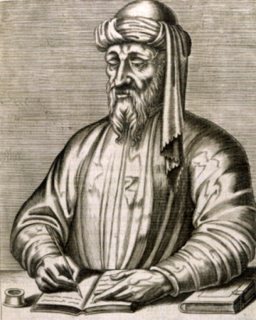
Open Porphyry's interactive page (graphs of influences, similar and opposing positions, and quotes)
Background
Porphyry
Born: c. 234 in Tyre, Roman Empire (now part
of Lebanon)
Died: c. 305 in Rome
Era: Ancient philosophy
School: Neoplatonism
Main Interests: Metaphysics, astrology, logic,
music, language, rhetoric, geometry
Notable ideas: Porphyrian tree, criticism of
Christianity, vegetarianism
Influences: Plotinus, Plato, Aristotle, Ptolemy,
Pythagoras, Euclid, Homer, Origen
Influenced: Sossianus Hierocles, Boethius,
Pappus of Alexandria, Iamblichus, Augustine,
Averroes, Abelard, Duns Scotus, Ockham,
Jerome, Methodius, Eusebius, Apollinaris,
Scholasticism, Arabic Aristotelianism (through
the Isagoge), later Neoplatonism
From Wikipedia
Porphyry was a Neoplatonic philosopher born in Tyre, Roman Phoenicia during Roman rule. He edited and published The Enneads, the only collection of the work of Plotinus, his teacher. He wrote... on a wide variety of topics, ranging from music theory to Homer to vegetarianism. His Isagoge or Introduction, an introduction to logic and philosophy, was the standard textbook on logic throughout the Middle Ages in its Latin and Arabic translations. Porphyry was, and still is, also well-known for his anti-Christian polemics.
Introductory Comments
The most interesting battle Porphyry waged was not, as one might expect, with the vulgar sort who loved their Colosseum and their popinae (the dive bars of antiquity) a little too well, but with the Christians - who, by and large, led exemplary lives. What galled him was their flat refusal to honor the Greco-Roman gods or take part in the customary rituals. As a Neoplatonist, Porphyry himself did not swallow the old mythology whole; he read the gods as manifestations of higher principles. But he feared that yanking the popular gods out from under ordinary people, as the Christians were busily doing, courted social upheaval.
The irony is that Porphyry's Neoplatonism had far more in common with Christianity than with the civic religion he sought to defend. Both pictured reality as a hierarchy, with the One - or the one God - at the summit and everything else proceeding downward through a series of levels, and both drew a dramatic line between the higher spiritual reaches and the lower physical ones. Both, too, held that salvation meant the soul's return to its source. Yet from Porphyry's vantage, Christianity's fixation on a particular crucified man must have seemed too anthropomorphic to count as genuine philosophy.
But then, maybe that is precisely why the Christians are still with us, while the Neoplatonists have long since vanished into the thin air of their own abstractions.
Some of Porphyry's Key Positions
Plotinus was right: The One is the first and most fundamental source of all things. It represents the ultimate unity from which everything flows, yet it lies beyond thought and therefore beyond any clear description in language.
From the One emanates the second level of reality: Intellect (Nous). Intellect contains what Plato called the Forms, which are the thoughts of Intellect. These are the true archetypes lying behind the world we perceive - provided we learn to look past mere surfaces.
That surface belongs to Soul, the third hypostasis, which mediates between Intellect and the material cosmos. Soul doesn't merely reflect the Forms - it actively organizes the sensible world, first through the cosmos as a whole, then through the countless individual, ensouled beings that populate it, humans included. We are thus double citizens, part soul and part body, and philosophy's task is to loosen the body's grip so the soul can turn back toward Intellect.
The study of philosophers such as Pythagoras, Plato, and Aristotle trains us in precisely this ascent, helping to free the soul from its entanglement with the body and the senses. Religion, by contrast, is largely a matter of superstition. In particular, Christianity's central claims are unpersuasive and lack the intellectual depth of the pagan philosophical tradition.
Place in the History of Ideas
Porphyry's Place in History of Ideas
Anthony Kenny: Porphyry, the disciple and biographer of Plotinus,... introduced the logic of Aristotle into the curriculum of the Neoplatonic schools, and his Isagoge became the standard introductory text. Thanks to the work of Boethius, it retained that position well into the high Middle Ages.
Anthony Gottlieb: In his Philosophy from Oracles, Porphyry managed to find a place in Plotinus' scheme of things for all the Olympian deities, plus the souls of divine and semi-divine heroes like Orpheus and Pythagoras. Porphyry even found room for Jesus an an enlightened spiritual teacher, though he was vehemently opposed to the main dogmas of Christianity and wrote a tract against the new-fangled religion. To his way of thinking, Christianity made the geographical mistake of putting Jesus where the One should be.
Eyjólfur Emilsson: He is sometimes claimed as a highly important promulgator of the late ancient branch of Platonism (usually called "Neoplatonism") rather than as an original philosopher. The former claim is certainly true: he applied Neoplatonic doctrines to traditional pagan religion and myths and was in many respects a more extrovert thinker interested in applying Platonic philosophy to various spheres than his master, Plotinus. The judgment that he was unoriginal may, however, be overhasty….
Random Thoughts on Porphyry
"Theurgy" is not a household word today, but it sat at the very center of Porphyry's quarrel with his one-time disciple and fellow Neoplatonist Iamblichus. Theurgy is the view that external rites and invocations are needed to achieve union with the divine. Iamblichus embraced such aids because he thought the soul too deeply mired in the physical world to hoist itself free by its own efforts. To rise to the divine realm, he argued, we need divine help - and that help can be summoned through theurgical ritual. Porphyry saw those same rites as dangerous distractions. If the soul is to ascend, it must do so through its own intellectual and moral purification. What chains the soul to earth, after all, is nothing but its own earthly thoughts and desires; purge those, and the soul rises under its own power - the way a flame naturally rises once nothing holds it down.
The dispute calls to mind hot-air balloons. Before liftoff, someone outside the basket has to untie the ropes anchoring it to the ground - call that theurgy's contribution. But once aloft, the passengers rise higher on their own, by tossing out the sandbags they brought aboard - call that Porphyry's inner purification. Maybe that's the compromise neither philosopher quite reached: let ritual get you off the ground, then let self-purification take you the rest of the way up. Or, if you're feeling less charitable, you might conclude the real question is simply which philosopher was full of more hot air.
Influences
Porphyry was influenced by: Aristotle, Euclid, Homer, Longinus, Numenius, Origen, Plato, Plotinus, Ptolemy, Pythagoras
Porphyry influenced: Abelard, Apollinaris, Augustine, Averroes, Boethius, Duns Scotus, Eusebius, Hierocles, Iamblichus, Jerome, Methodius, Ockham, Pappus of A.
Similar and opposing positions
Thinkers with similar positions:
- Albertus Mag. (The soul both governs & transcends the body. It's beyond nature.)
- Boethius (The purely contemplative part of the Soul is its higher & eternal part.)
- Ibn Tufail (Preoccupation with the physical world can never lead to happiness.)
- MacIntyre (Ethics should emphasize internal virtues, not external results.)
- Plato (The soul, being the very likeness of the divine, is pure and immortal.)
- Plotinus (The One, being perfect & eternal, is stable, uniform and unchanging.)
- Proclus (Though souls descend into the material world, a divine Unity exists.)
- Proclus (Philosophy can liberate the soul from subjection to bodily passions.)
Thinkers with opposing positions:
- Duns Scotus (Universals are real but are not independent of individual things.)
- Epicurus (Happiness comes from maximizing pleasure & minimizing pain.)
- Erasmus (Everything of value in pagan culture is consistent with Christianity.)
- Heraclitus (Like a flowing river, everything changes and nothing is eternal.)
- Holbach (The universe is simply matter in motion. It has no spiritual dimension.)
- Ockham (Universals are just concepts. Only concrete individual things are real.)
- Sade (Heed nothing but your desires; let them alone be your laws.)
- Spinoza (Nothing is good or bad independent of human desires and beliefs.)
What others said about Porphyry
- E. Emilsson: He applied Neoplatonism to pagan religion and other spheres and is as such a key figure the promulgation of Neoplatonic thought.
- J. J. O'Connor: [Porphyry was his nickname.] In fact it was a clever pun since "Porphyry" means "purple" in Greek and he was given this name since he came from Tyre which was famous for the production of the royal purple dye….
- Henry S. Salt: In the writings of such "pagan" philosophers as Plutarch and Porphyry we find a humanitarian ethic of the most exalted kind, which, after undergoing a long repression during medieval churchdom, reappeared, albeit but weakly and fitfully at first, in the literature of the Renaissance, to be traced more definitely in the eighteenth century school of "sensibility."
- Augustine: For even Porphyry promises some kind of purgation of the soul [by calling forth aid of a divine power], though he does so with some hesitation and shame, and denies that this art can secure to any one a return to God….
- Edward Zeller: Porphyry's [strove] to reconcile Plato and Aristotle under the common banner of Neoplatonism.
- Howard Williams: [Porphyry is one] of the most erudite as well as one of the most spiritual, of the literati of any age or people, and certainly the most estimable of all the extant Greek philosophers after the days of Plutarch.
- Proclus: Porphyry in his treatise "On Principles," evinces by many and beautiful arguments, that intellect is eternal, but that at the same time, it contains in itself something prior to the eternal, and through which it is conjoined with the One. For the One is above all eternity, but the eternal has a second, or rather third order in intellect.
- Anthony Gottlieb: Porphyry could not resist the idea that magical practices and spells might provide some useful first steps on the road to the higher realms... though he seems to have realized that [Plotinus would not have approved].
Schools: Neoplatonism, Platonism, Pythagoreanism
Main interests: Animal Rights, Astrology, Geometry, Immortality, Language, Logic, Metaphysics, Music, Rhetoric
Porphyry's answers to philosophical questions
Ethics
Plato is right: Ethics requires that we acknowledge the four cardinal virtues: wisdom, temperance, justice and courage.
"The purification of the soul is the avoidance of all sin… such as pleasure, lust, greed and unjust actions."
Metaphysics
"[B]odies are generated... & corruptible; but soul & intellect are unbegotten… & on this account indissoluble & incorruptible."
"The soul is bound to the body [if trapped by] the corporeal passions; & again liberated by becoming impassive to the body."
Nature
"Not only can logos be seen in absolutely all animals, but in many of them it has the groundwork for being perfected."
Though we may use & even harm animals if necessary for our survival, to do so for pleasure or gluttony is a terrible crime.
Unlike plants, animals can experience pain and fear. This in turn means that they deserve to be treated humanely by us.
We should be nature's protectors: "The Pythagoreans made kindness to beasts a training in humanity and pity." So should we.
Psychology
"Our rational part is in touch with reason and truth, while our irrational part... is the source of all our troubles."
If we, through intellect, free ourselves from the bodily or physical realm, we will find bliss in merging with the One.
Religion and Theology
To be spiritual requires that we transcend our bodies and the physical world itself, so that we can live in a spiritual dimension.
The One is beyond thought and thus also beyond any clear description in language.
"The soul, being eternal, after death is like a caged bird that has been released."
"The Gods have proclaimed Christ to have been most pious, but the Christians are a confused and vicious sect."
Religions are often unpersuasive in their claims and lack the rich philosophical content found in the pagan philosophers.