Giordano Bruno (1548 - 1600)
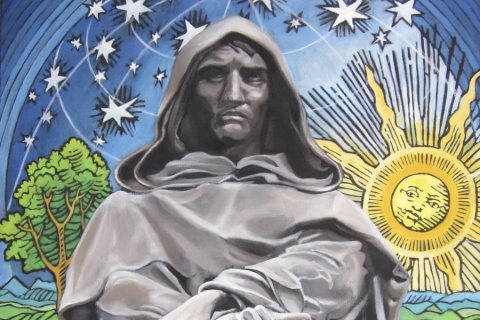
Open Bruno's interactive page (graphs of influences, similar and opposing positions, and quotes)
Background
Giordano Bruno
Born: 1 January 1548 in Nola, Kingdom of Naples
Died: 17 February 1600 (aged 51–52) in Rome,
Papal States
Cause of death: Execution by burning
Era: Renaissance philosophy
Region: Western Philosophy
Schools: Renaissance Humanism, Freemasonry,
Neoplatonism
Main interests: Philosophy, Cosmology, Magic,
Mathematics, Astronomy, Ethics, Religion
Influences: Averroes, Nicolaus Copernicus,
Nicholas of Cusa, Aquinas, Giovanni Pico della
Mirandola, Marsilio Ficino, Lucretius, Ramon
Llull, Heinrich Cornelius Agrippa, Albertus
Magnus
Influenced: James Joyce, Leibniz, Molière,
Schopenhauer, Spinoza, Giorgio Agamben,
Schelling, Jorge Ángel Livraga Rizzi
From Wikipedia
Bruno was tried for heresy by the Roman Inquisi-tion on charges of denial of several core Catholic doctrines, including eternal damnation, the Trini-ty, the divinity of Christ.... Bruno's pantheism was not taken lightly by the church, nor was his teach-ing of... the reincarnation of the soul. The Inquisi-tion found him guilty, and he was burned alive at the stake... in 1600. After his death, he gained considerable fame, being particularly celebrated by 19th- and early 20th-century commentators who regarded him as a martyr for science.
Introductory Comments
Is "a pugnacious mystic" an oxymoron? If not, it is at least a hard idea to wrap one's mind around. Yet that is exactly what Bruno was: a man who believed in both the absolute oneness of being and the absolute rightness of his own books. He could argue that the universe is an infinite, living whole, filled with countless stars and worlds, each a manifestation of the divine - and then take open delight in pouncing on anyone who said otherwise. The contradictions in his personality were at times breathtaking. He combined a mind-blowingly broad vision of the cosmos with a pettiness and vindictiveness that showed no perspective at all.
But perspective itself is a slippery concept. Sometimes we treat a broad view as the mark of wisdom - the wider our sense of time and space, the smaller our petty grievances look by comparison. Other times we say the opposite: come down from the clouds, narrow your focus, look at what's actually in front of you. And if what's in front of you provokes anger, the advice flips again - try to see it from the other person's point of view, walk a mile in their shoes.
So which perspective produces wisdom: broad, narrow, or somebody else's? Perhaps all three. Perhaps wisdom lies not in finding the right perspective but in knowing when to change it. And if so, Bruno's problem may have been not that he was too contradictory, but that he wasn't contradictory enough.
Some of Bruno's Key Positions
Copernicus was right that the earth and the other planets circle the sun - but the same holds for every star. Each star is a sun with its own planets wheeling around it, and those planets very likely harbor life forms of their own. The implications are staggering, all the more so because the universe is infinite.
Since the universe is infinite and has no center, it makes no sense to call it hierarchical. God does not stand above his creation; God is one with it. And if that is so, it is equally senseless to say that God rules the universe, or any planet within it.
This same divine oneness undercuts the doctrine of the Trinity: Christ is the Son of God, but he is not co-eternal with the Father. Here the Catholic Church has fallen into fundamental error and ought to correct it.
The Protestants compounded the error with their insistence on salvation by faith alone. For one thing, salvation does not perpetuate the individual soul forever. On the contrary, it marks the end of the individual soul as it merges into the universal Soul. And what this demands is not faith but virtue, understanding, and heroic striving..
Though some of the astronomical and theological claims of the Bible contradict the positions above, Scripture should still be followed for its moral teachings.
Place in the History of Ideas
Bruno's Place in History of Ideas
Bill Kuhns: [Bruno's] conclusions were simply unbelievable for a late medieval mind: infinite other worlds, inhabited like our own, spread throughout space; a structure to the universe of suns and clusters of suns circling in grand orbits, but no "center" except in the ground beneath two human feet; the presence of God not atop an empyrean throne past the thresh- old of the farthest stars, but inhabiting every atom of matter; an eternal span to matter, which can change its form but never be ex- hausted in any proportion; and finally a logic infinity demanded of him - an innate union of all contraries, by which evil and good, history and the future, localized humanity and an infi- nite universe inform and express one another....
Robert G. Ingersoll: The First Great Star - Herald of the Dawn - was Bruno... He was a pantheist - that is to say, an atheist. He was a lover of Nature, - a reaction from the asceticism of the church. He was tired of the gloom of the monastery. He loved the fields, the woods, the streams. He said to his brother-priests: Come out of your cells, out of your dungeons: come into the air and light. Throw away your beads and your crosses. Gather flowers; mingle with your fellow-men; have wives and children; scat- ter the seeds of joy; throw away the thorns and nettles of your creeds; enjoy the perpetual mir- acle of life.... Did all the priests of Rome increase the mental wealth of man as much as Bruno?
Random Thoughts on Bruno
However contradictory Bruno's personality (see Introductory Comments), it pales beside the contradictions in his ideas. His books were a kaleidoscope of seemingly incompatible interests, blending science, mysticism, magic, astrology, alchemy, mnemonics, religion, and philosophy into an ever-shifting - and at times quite beautiful - picture of the universe. In Bruno's fecund mind, all these realms were free to play off one another. His mystical and magical notions informed his scientific hypotheses, and the hypotheses informed the mysticism; both in turn shaped his cosmology, which shaped them right back. Which in turn informed…. Well, you get the idea.
But if his undisciplined mix of disciplines now looks sloppy, it did not look so to his comtemporaries. We see sloppiness in Bruno because we sort our ideas in ways his contemporaries did not. They kept no proto-Dewey Decimal System on their shelves - and Bruno least of all. Nor was he the only Renaissance writer whose thinking now seems out of the box. Ficino, Pico della Mirandola, Paracelsus, John Dee, Francis Bacon, even Kepler and Tycho Brahe - all shared a broadly holistic worldview, one that drew no firm border between ancient learning, mysticism, magic, philosophy, and science. They all wrote in a transitional age, alive with a rich mingling of traditions and disciplines. A savory Renaissance stew - though one in which the ingredients would look decidedly odd on a modern menu.
Influences
Bruno was influenced by: Agrippa, H. C., Albertus Mag., Aquinas, Averroes, Copernicus, Democritus, Empedocles, Erasmus, Ficino, Iamblichus, Lucretius, Nicholas of C., Paracelsus, Pico, Pythagoras
Bruno influenced: Agamben, Galileo, Hegel, Joyce, Leary, Timothy, Leibniz, Moliere, Reich, Wilhelm, Schelling, Schopenhauer, Spinoza
Similar and opposing positions
Thinkers with similar positions:
- Aristotle (Form & matter are intimately united in the objects of this world.)
- Bacon, Francis (We must pursue science to further our understanding of nature.)
- Bayle (The multiplicity of religions is not the problem, but rather intolerance.)
- Eriugena (God is both the ground of all things and the end or goal of all things.)
- Galileo (The Bible should be followed for its moral teaching, not cosmology.)
- Lucretius (Philosophy aims at liberating man from the fear of death & the gods.)
- Newton (Time and space are both absolute and infinite.)
- Ockham (Faith, not reason, provides the foundation for Christian beliefs.)
- Spinoza (God is not transcendent. Everything in Nature is part of God.)
Thinkers with opposing positions:
- Al-Kindi (Time and space are both finite. God created them.)
- Augustine (God is transcendent. He is above everything in nature.)
- Berkeley (Causation is due to God, not to the interactions of matter.)
- Calvin (Salvation is fated. God predestines both the saved & the damned.)
- Hooker (Religion is based on revelation, but also on reason and tradition.)
- Ibn Tufail (Preoccupation with the physical world can never lead to happiness.)
- Nicholas of C. (God is present in all things and yet transcends all things.)
What others said about Bruno
- Hegel: [Bruno's life represented] a bold rejection of all Catholic beliefs resting on mere authority.
- Corey S. Powell: A major reason he moved around so much is that he was argumentative, sarcastic, and drawn to controversy.... He was a brilliant, complicated, difficult man.
- Thomas Davidson: Bruno was one of... those strange, incomprehensible, pioneer geniuses that lived centuries before their time, destined, apparently, to lay out the tasks for many succeeding ages. He rose not only above the dogmas and superstitions of... mediaeval Catholicism, but, with equal ease and firmness, above the new follies of growing Protestantism.
- Schopenhauer: Bruno and Spinoza are [sui generis]. Each stands... alone; and they do not belong either to their age or to their part of the globe, which rewarded the one with death, and the other with persecution and ignominy.
- Cassirer: The only passion that reigns in Bruno is the passion of the self-affirmation of the Ego, heightened to titanic and heroic proportions.
- James Joyce: [Bruno's] philosophy is a kind of dualism - every power in nature must evolve an opposite in order to realize itself, and opposition brings reunion.
- James Daniel Collins: Like Cusanus and Calvin, Bruno has an unknown and ineffable God. But his God is unknown not in virtue of His infinite actuality and real transcendence of the universe, but in virtue of the immensity of the universe itself and the relative disproportion between it and the human way of knowing and loving.
- Mordechai Feingold: Both admirers and critics of Giordano Bruno basically agree that he was pompous and arrogant, highly valuing his opinions and showing little patience with anyone who even mildly disagreed with him.
Schools: Atomism, Christian Theology, Emanationism, Humanism, Mysticism, Neoplatonism, Platonism, Pythagoreanism
Main interests: Astrology, Astronomy, Classics, Cosmology, Ethics, Free/Unfree Will, Geometry, Infinity, Magic, Mathematics, Poetry, Religion
Bruno's answers to philosophical questions
Epistemology
"I beg you, reject antiquity..., faith, and authority! Let us begin anew by doubting everything we assume has been proven!"
Memory not only represents the past, it also allows us to order & understand reality. Without memory, we'd know nothing.
Ethics
"If all things are in common among friends, the most precious is Wisdom."
"The wise soul feareth not death; rather she sometimes striveth for death, she goeth beyond to meet her. "
Metaphysics
In creating the universe, God united what we call "form” and “matter” into one, undivided reality.
"Time is the father of truth, its mother is our mind."
"There is no top or bottom, no absolute positioning in space. There are only positions that are relative to the others."
"[N]either we ourselves nor any substance doth suffer death. [All things in nature simply] undergo change of aspect."
Nature
We sense "there is one simple Divinity found in all things, one fecund Nature, preserving mother of the universe…."
"Nature is none other than God in things. Animals and plants are living effects of Nature; whence all of God is in all things."
"If God is not Nature herself, He is certainly the nature of Nature, and is the soul of the Soul of the world…."
Philosophy
"By other men's labours we are led to the sight of things most beautiful that have been wrested from darkness… into light."
Philosophy allows us to "argue with Socrates,… doubt with Carneades, find peace with Epicurus,… exceed it with the Cynics."
Religion and Theology
Whereas religion was created in order to govern and instruct the ignorant, the wise need only philosophy for guidance.
Though each of us has a spirit that animates our body, we're also "vivified by a certain total spirit" that animates the universe.
In creating the universe, God became one with it. Therefore, we should not say that God rules over the universe.
The ignorant must rely on faith and Church authority, but the wise need only philosophy and their own understanding.
God created the universe by becoming the universe. It is in fact impossible now to distinguish God from the universe.
God is the immanent force in nature and the all-pervading soul of the infinite universe.
The individual soul does become one with the universal Soul through faith, but rather through virtue and understanding.