Socrates (c. 470 BC - 399 BC)
Open Socrates's interactive page (graphs of influences, similar and opposing positions, and quotes)
Background
Socrates
Born: c. 470 BC in Athens
Died: 399 BC (aged approx. 71) in Athens
Cause of death: Execution by the drinking of
hemlock
Main interests: Epistemology, ethics, politics,
law
Notable ideas: Socratic method of questioning
Influences: Prodicus, Anaxagoras, Archelaus,
Diotima, Parmenides, Heraclitus, Aspasia
Influenced: Plato, Xenophon, Aristotle, Epictetus,
Pyrrho, Kierkegaard, Gandhi, Aristippus,
Antisthenes, Al-Kindi, Epictetus,
From Wikipedia
Socrates was a Greek philosopher from Athens who is credited as the founder of Western philosophy and among the first moral philosophers of the ethical tradition of thought. An enigmatic figure, Socrates authored no texts and is known mainly through the posthumous accounts of classical writers, particularly his students Plato and Xenophon. These accounts are written as dialogues, in which Socrates and his interlocutors examine a subject in the style of question and answer; they gave rise to the Socratic dialogue....
Introductory Comments
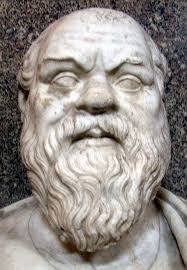
As with the pre-Socratic philosophers, little is known of Socrates the man. Still, it's irresistible to picture him: bug-eyed, pug-nosed, and shab- bily dressed, holding court in the Athenian agora amid a ring of wealthy young men. Perhaps some of them, on first meeting him, played at solemnity - tossing philosophical questions his way for sport. One likes to think Socrates took no offense - that he met their teasing with the same playful humility he brought to everything, professing ignorance while proceeding, with terrible gentleness, to dismantle whatever they thought they knew.
Then the afternoon light fades, the crowd disperses, and Socrates walks home. To Xanthippe. By all ancient accounts, she was a formidable woman with a sharp tongue and a dim view of her husband's career prospects. How the great questioner navigated that particular domestic arrangement is left to the imagination. Though perhaps he left us a clue: Socrates is said to have advised that every man should marry. "If you get a good wife," he reportedly quipped, "you'll become happy; if you get a bad one, you'll become a philosopher." Which, given the kind of philosopher Socrates was, really means this: marry, by all means. If it works out, you'll be a contented man. If it doesn't, you'll be a malcontent who questions everything - and finds his own odd contentment in making everyone else do the same.
Some of Socrates's Key Positions
The Sophists, those teachers-for-hire, treat virtue as a teachable set of practical and rhetorical skills - tools for getting ahead in the city. They are correct in saying that virtue is a kind of knowledge, but they very much mistake its object. Virtue is not knowledge of what seems advantageous or what wins applause; it is knowledge of what is genuinely good and bad.
Such knowledge, however, does not come cheap. Grasping the genuine good is hard work, demanding a discipline few possess. It usually requires guided and relentless questioning by someone else. Such questioning can, step by step, expose the hidden assumptions and quiet confusions buried in a person's beliefs. The aim here is less to hand over a finished doctrine than to clear the ground, leaving people in honest puzzlement and ready to think again.
Several striking consequences follow. If virtue is knowledge, then no one does wrong knowingly: to truly know the good would be to do it, since no one would willingly choose what is bad. And only by doing the good can one achieve a deep sense of well-being. It follows, too, that the unexamined life is not worth living, for a life never tested against the real good drifts along on borrowed opinion. The same principle applies to politics: a city will flourish only when its leaders possess wisdom and are guided by a deep concern for justice and the common good.
Place in the History of Ideas
Socrates's Place in History of Ideas
John M. Cooper: Socrates was a totally new kind of Greek philosopher. He denied that he had discovered some new wisdom, indeed that he possessed any wisdom at all, and he refused to hand anything down to anyone as his personal "truth," his claim to fame. All that he knew, humbly, was how to reason and reflect, how to improve himself and (if they would follow him in behaving the same way) help others to improve themselves, by doing his best to make his own moral, practical opinions, and his life itself, rest on appropriately tested and examined reasons - not on social authority or the say-so of esteemed poets (or philosophers) or custom or any other kind of intellectual laziness.
Nietzsche: Socrates… is the first philosopher of life [Lebensphilosoph],… [He felt that] thinking serves life, while among all previous philosophers life had served thought and knowledge.… Thus Socratic philosophy is absolutely practical: it is hostile to all knowledge unconnected to ethical implications.
Russell: The Platonic Socrates was a pattern to subsequent philosophers for many ages.... His merits are obvious. He is indifferent to worldly success, so devoid of fear that he remains calm and urbane and humorous to the last moment, caring more for what he believes to be the truth than for anything else whatever.
Random Thoughts on Socrates
Socrates claimed that no one does evil knowingly - that to truly understand the good is, inescapably, to do it. His reasoning runs roughly as follows: a person's ultimate good is the health of the soul, the highest and most essential part of one's being. Evil harms that soul. Therefore, anyone who does evil must have lost sight, however briefly, of what actually matters - must have mistaken some immediate gain for a genuine good. Wrongdoing is always, at bottom, a cognitive failure.
The first thing to notice is that this argument is essentially an appeal to enlightened self-interest. Socrates isn't asking us to care about others; he's asking us to care more carefully about ourselves - our real selves, properly understood. Whether that counts as morality, or merely as very good long-term planning, is an open question. Levinas, writing many years later, thought the whole framework was upside down: Ethics doesn't begin with knowledge - not even self-knowledge. It begins with an encounter: the sudden, irreducible presence of another person, the Other. Ethics, on this view, is less an intellectual achievement than a perceptual shift - a wrenching reorientation from self toward the needs and vulnerabilities of someone else. The contrast is sharp. For Socrates, moral failure is a knowledge problem; for Levinas, moral progress requires dismantling the very self-centeredness that Socrates takes as his starting point.
Influences
Socrates was influenced by: Anaxagoras, Archelaus, Aspasia, Diotima, Heraclitus, Parmenides, Prodicus
Socrates influenced: Al-Kindi, Antisthenes, Aristippus, Aristotle, Epictetus, Gandhi, Kierkegaard, Plato, Pyrrho, Xenophon
Similar and opposing positions
Thinkers with similar positions:
- Berlin (Moral values may be equally valid yet also incompatible at times.)
- Bradley (Maximizing pleasures should not be the end moral agents aim for.)
- Epicurus (Only believe what's tested thru direct observation and deduction.)
- Habermas (Reason plays a constructive role in moral, political & social systems.)
- Horkheimer (Popular culture encourages a passive & unquestioning worldview.)
- MacIntyre (Philosophy should return to basic questions that concern all of us.)
- Montaigne (Be a little skeptical when considering all views, even one's own.)
- Pseudo-Denys (To truly know the moral good we must know the eternal Good.)
Thinkers with opposing positions:
- Bataille (To be free means to be unrestrained by any chains of morality.)
- Hamann (I trust the power of passion and symbol over abstraction and logic.)
- Jacobi (Demonstrative reasoning can never lead us to understanding reality.)
- Pascal (Skepticism is a product of the devil and we must fight against it.)
- Protagoras (No absolute truth exists - only what people deem to be the truth.)
- Reid (When philosophy contradicts common sense, it should be dismissed.)
- Vaihinger (If beliefs are useful, we should accept them as if they were true.)
- Williams, B. (Values are internal. They exist in ourselves - not "in the world.")
What others said about Socrates
- Plato: The wisest of you men is he who has realized, like Socrates, that in respect of wisdom he is really worthless.
- Nietzsche: Socrates excels the founder of Christianity in being able to be serious cheerfully and in possessing that wisdom full of roguishness that constitutes the finest state of the human soul. And he [had] the finer intellect.
- Cassirer: In Socrates we no longer have an independent theory of nature or an independent logical theory. We do not even have a coherent and systematic ethical theory - in that sense in which it was developed in the later ethical systems. Only one questions remains: What is man?... His philosophy - if he possesses a philosophy - is strictly anthropological.
- Montaigne: There is nothing more remarkable in the life of Socrates than that he found time in his old age to learn to dance and play on instruments, and thought it was time well spent.
- Diogenes Laërtius: Often when looking at a mass of things for sale, he would say to himself, "How many things I have no need of!"
- Cicero: Socrates was the first to call philosophy down from the sky, to place it in cities, to introduce it even into homes, to force it to consider life and customs, good and evil.
- Mill: The Socratic dialectics, so magnificently exemplified in the dialogues of Plato [is a] contrivance for making the difficulties of the question... present to the learner's consciousness.... They were essentially a negative discussion of the great questions of philosophy and life.
- Popper: [The Socatic method or dialectic is] the art of intellectual intuition, of visualising the divine originals, the Forms or Ideas, of unveiling the Great Mystery behind the common man's everyday world of appearances.
Schools: Deontological Ethics, Intellectualism, Skepticism, Virtue Ethics
Main interests: Death, Epistemology, Ethics, Justice, Political Philosophy, Politics, Social Philosophy, Virtue, Wisdom
Socrates's answers to philosophical questions
Art and Aesthetics
Beauty can, especially for the young, overwhelm reason and judgment. However, "beauty is a short-lived tyranny."
Economics
Wealth is a state of mind, not a bag of gold. "He is rich who is content with the least; for contentment is the wealth of nature."
Education
"The unexamined life is not worth living."
"By asking a series of questions, [a teacher can] stimulate the [the student] to think, and so cause him to learn for himself."
"Education is the kindling of a flame, not the filling of a vessel."
"I cannot teach anybody anything. I can only make them think."
A good education should focus on ethics more than any other subject - ethics in both the personal and public sense.
Epistemology
"The only thing I know is that I know nothing. This is the source of my wisdom."
Truth, especially moral and social truths, is best pursued through a skillful sequence of questions.
Though we may never be absolutely sure of anything, we must continue our pursuit of knowledge.
Ethics
Moral relativism is a cynical position meant to undermine our search for moral truth. Do not give into such cynicism.
We should question our moral assumptions so that reason can lead us toward moral insight.
Virtue is the knowledge of what is good and what is bad in itself - not what acts have good or bad results.
"The happiest people on earth don't have the best of everything... they make the best of everything."
"Once a man knows good from evil, nothing on earth can compel him to act against that knowledge."
"True wisdom comes to each of us when we realize how little we understand about life, ourselves, and the world around us."
"There is only one good, knowledge, and one evil, ignorance."
"True perfection is a bold quest to seek. Only the willing and true of heart will seek the betterment of many."
Our sense of duty springs from our innate virtues: justice, temperance, courage and wisdom.
Though free, we still desire good repute: "The way to gain a good reputation is to endeavor to be what you desire to appear."
"A system of morality that is based on relative emotional values is a mere illusion [and] a thoroughly vulgar conception…."
Only pleasures of the mind are unalloyed: "Worthless people live only to eat & drink; people of worth eat & drink only to live."
Language
Whereas in other professions knowledge is the means to success, the rhetorician achieves his ends merely with words.
Philosophy
Philosophy is the love of wisdom. As such, it is not a final attainment of wisdom but a continual pursuit of wisdom.
Questioning beliefs in a systematic and rigorous manner is the most effective method of discovering their flaws.
Philosophy is the ultimate pusuit: "Strong minds discuss ideas, average minds discuss events, weak minds discuss people."
Insofar as philosophy helps in our understanding of what is best, it improves both our moral and our civic behavior.
Political Philosophy
For a country to thrive, its leaders must have those rare skills and disciplines needed to understand what is truly good.
By emphasizing individuality and all its ensuing differences, democracies often tend toward anarchy and lawlessness.
Psychology
We can find peace in helping others. "Be nicer than necessary to everyone you meet. Everyone is fighting some kind of battle."
"We are what we repeatedly do. Excellence then is a habit."
"He who is not contented with what he has, would not be contented with what he would like to have."
Religion and Theology
"Those who want the fewest things are nearest to the gods."
"To believe without evidence and demonstration is an act of ignorance and folly."
"All men's souls are immortal, but the souls of the righteous are immortal and divine."
Sex and Gender
"By all means, marry. If you get a good wife, you’ll become happy; if you get a bad one, you’ll become a philosopher."
"If we are to use women for the same things as the men, we must also teach them the same things."
Society
All cities are "divided into two, one the city of the poor, the other of the rich: these are at war with one another."