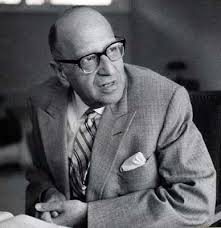
Main Interests: Politics, social theory, sociology,
economics, epistemology, cultural studies,
religion, poular culture
Notable ideas: Critical theory as opposed to
traditional theory, the culture industry
Influences: Kant, Hegel, Friedrich Pollock,
Adorno, Hans Cornelius, Dilthey, Marx, Freud,
Schopenhauer, Vico, Max, Weber, Nietzsche,
Simmel
Influenced: Adorno, Marcuse, Habermas, Walter
Benjamin, Erich Fromm, Foucault, John Zerzan,
Joe L. Kincheloe, Bolívar Echeverría
From Wikipedia
Max Horkheimer was a German philosopher and sociologist who was famous for his work in critical theory as a member of the Frankfurt School of social research. Horkheimer addressed authoritar- ianism, militarism, economic disruption, environ- mental crisis, and the poverty of mass culture using the philosophy of history as a framework. This became the foundation of critical theory. His most important works include Eclipse of Reason, Between Philosophy and Social Science, and…, with Theodor Adorno, Dialectic of Enlightenment.
Introductory Comments
In the early 1930s, two Marxists were puzzling over the same embarrassment. Marx had predicted that capitalism's crises would drive workers to revolution. The crises arrived on schedule; the revolution did not, and much of Europe turned toward fascism instead. Gramsci worked out his answer in a Fascist prison cell. Horkheimer worked out his as director of Frankfurt's Institute for Social Research, soon to flee Hitler. Neither appears to have read the other, yet both concluded that capitalism endures not only through who owns the factories but through philosophies that make inequality look natural, ideologies that make domination look like common sense, and habits of feeling shaped by fear and the wish to fit in. People do not merely live in an economy; they justify it, and sometimes even love it.
The two parted ways in their tools. Gramsci was a political strategist; Horkheimer borrowed from Freud, arguing that to understand why people embrace their own subjection, one must look into the psyche and the family that forms it. Where Gramsci saw culture as a battlefield, Horkheimer, especially in later work with Adorno, saw mass culture as something closer to an assembly line. Films, radio, and advertising shape habits of thought, emotional responses, even the limits of what seems possible. Domination that feels like choice needs little policing. As the devil has long known, the most effective chains are the ones people mistake for jewelry.
Some of Horkheimer's Key Positions
No single discipline can explain how a society works. Economics, sociology, history, and psychology must join forces with the study of culture in its broadest sense - from art, religion, and law to fashion, sports, and popular amusements. The central question is how economic life, the inner lives of individuals, and cultural forms shape one another.
Conventional social science treats the facts it studies as simply given. It describes and manages the world as it is, rarely asking how that world arose, whose interests it serves, or how the researcher's own position shapes the inquiry. Critical theory examines its own social origins and aims openly at emancipation. It seeks not just to understand society but to help remake it, so that social life is organized rationally for the good of all rather than by market forces and the powerful.
Reason has shrunk into a tool for finding efficient means, while the question of which ends are worth pursuing is dismissed as opinion. Enlightenment, meant to free humanity from myth, has become a new myth, and mastery of nature has turned into the mastery of people over one another. Mass culture breeds conformity and weakens the independent individual, leaving people open to authoritarian appeals. As hope for revolution fades, what remains is a defense of individual freedom and a longing for a justice history has not yet delivered.
Place in the History of Ideas
Horkheimer's Place in History of Ideas
Ingar Solty: Today we should recognize that Horkheimer’s focus on how the capitalist system is being reproduced by culture and ideology involved a shift away from political economy.... The shift away from political economy and toward culture essentially meant throwing away the tools for understanding the material foundations of society.
Richard Wolin: In the early years of its exist- ence, Horkheimer described the institute’s program as "interdisciplinary materialism," thereby indicating its goal of integrating Marxist-oriented philosophy of history with the social sciences, especially economics, history, sociology, social psychology, and psychoanaly- sis. The resulting "critical theory" would eluci- date the various forms of social control through which state-managed capitalism tended to defuse class conflict and integrate the working classes into the reigning economic system.
Ingar Solty: For Horkheimer, the working class had been a revolutionary subject only in the abstract.... [it] was essentially an empty place- holder for the subject which would overthrow an economic and social system which they considered wrong. If it failed to live up to its expectations, then it could easily be replaced by another subject of revolution - or the conclu- sion that there was no way out [of capitalism].
Random Thoughts on Horkheimer
Picture a dictatorship that needs no secret police. Its citizens line up for the propaganda, pay for the privilege, and go home humming it. That, roughly, is the nightmare Horkheimer and Adorno sketched in their chapter on the "culture industry." Their claim was not simply that films and radio reflect capitalist values. It was that mass entertainment, standardized like any other factory product, manufactures conformity itself. Citizens become consumers who mistake choosing among brands for freedom and distraction for fulfillment. Old-fashioned tyranny compels obedience at gunpoint; the culture industry gets it with a catchy tune.
Yet history complicates this bleak diagnosis, for popular culture has also served as an engine of protest. Woody Guthrie and Bruce Springsteen gave working-class grievance a melody. Films such as Philadelphia and Milk put human faces on lives the mainstream preferred not to see. Social media helped #MeToo and Black Lives Matter gather momentum at startling speed. Culture can awaken as well as anesthetize. Still, the two theorists saw this objection coming. The culture industry, they argued, doesn't silence dissent so much as absorb it, finding a market niche for rebellion itself. Springsteen’s "Born in the U.S.A.," a bitter song about a neglected Vietnam veteran, was widely heard as a flag-waving anthem, and Ronald Reagan's 1984 campaign tried to claim it. Every revolution, it seems, risks ending up as a T-shirt slogan, available in three sizes.
Adorno (Popular culture encourages a passive & unquestioning worldview.)
Benjamin (At its best popular culture can help bring about social change.)
Bourdieu (Social, cultural, & symbolic capital are also at work in our world.)
Dawkins (Human minds are to a large extent shaped by cultural memes.)
Fromm (We must take responsibility for our individual actions and thoughts.)
Gramsci (The bourgeoisie spreads its politics more thru culture than violence)
Habermas (Rationality has ethical implications. It's not just instrumental.)
Nietzsche (The development & deployment of reason is driven by power.)
Veblen (The economy is closely linked to social and cultural practices.)
Thinkers with opposing positions:
Comte (The study of society should be scientific, quantifiable, and objective.)
Condorcet (Civilization inevitably leads to progress in morality & justice.)
Dilthey (Our understanding depends on past worldviews and interpretations.)
Durkheim (Like all sciences, the human sciences must rely on quantifiable data.)
Engels (The working class will lead the revolution against the bourgeoisie.)
Marx (Economic, rather than cultural, forces drive history and shape society.)
Popper (The search for truth should be completely fact-based and objective.)
What others said about Horkheimer
J.C. Berendzen: As the director [of the Institute for Social Research], he developed a program for interdisciplinary research, oriented toward social change.
Corradetti: It was under Horkheimer’s leadership that members of the Institute were able to address a wide variety of economic, social, political and aesthetic topics, ranging from empirical analysis to philosophical theorization.
Ingar Solty: Horkheimer was thus proposing a non-mechanist and non-economistic Marxism. In practice, however, focusing also on spheres of social life beyond the sphere of production gave way to focusing on hardly anything but the sphere of reproduction - on the family, on culture, on ideology.
Richard Wolin: [Horkheimer] developed an original interdisciplinary movement, known as critical theory, that combined Marxist-oriented political philosophy with social and cultural analysis informed by empirical research.
Claudio Corradetti: The consideration of psychoanalysis by the Frankfurt School was certainly due to Horkheimer’s encouragement.
Ingar Solty: But Horkheimer’s ever-pessimistic outlook reflected the political defeats of his time - and an oft one-sided view of the loss of working-class agency.
MacIntyre: The suspicion is thus engendered that not only Marcuse but also Adorno and Horkheimer actually do not know any logic, and it is certainly the case that, if they do know any, all three have taken some pains to conceal their knowledge of the subject which they are professedly criticizing.
Richard Wolin: Horkheimer felt that Schopenhauer’s pessimistic social philosophy more faithfully reflected the lost prospects for utopia than did the more optimistic social theories of the postwar period.
Main interests: Alienation, Cultural Criticism, Cultural Studies, Desire, Economics, Epistemology, History, History of Ideas, Ideology, Language, Mass Media, Political Philosophy, Politics, Popular Culture, Religion, Social Criticism, Social Philosophy, Social Theory