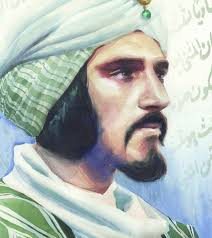
Main interests: Philosophy, logic, ethics, optics,
mathematics, physics, chemistry, psychology,
pharmacology, medicine, metaphysics, theology,
music theory, cosmology, astonomy, astrology
Influences: Plato, Aristotle, Plotinus, Jabir ibn
Hayyan, Proclus, John Philoponus, Nicomachus
of Gerasa, Euclid, Epictetus, Porphyry
Influenced: Abu Zayd al-Balkhi, Ahmad ibn
al-Tayyib al-Sarakhsi, Isaac Israeli ben Solomon,
Abu Ma'shar al-Balkhi, Ibn Miskawayh, Robert
Grosseteste, Al-Farabi, Al-Ghazali, Averroes,
Avicenna, Roger Bacon, Leonardo da Vinci,
Geronimo Cardano, Vitello, Ibn Rushd
From Wikipedia
Al-Kindi was an Arab Muslim polymath active as a philosopher, mathematician, physician, and music theorist. Al-Kindi was the first of the Islamic peri-patetic philosophers, and is hailed as the "father of Arab philosophy." … The central theme under- pinning Al-Kindi's philosophical writings is the compatibility between philosophy and other "orthodox" Islamic sciences, particularly theology, and many of his works deal with subjects that theology had an... interest in, [such as] the nature of God, the soul, and prophetic knowledge.
Introductory Comments
Though raised in Arab and Islamic culture, al-Kindi welcomed other traditions with open arms, especially those of the Greeks. He embraced Islam and Greek philosophy alike, and tried to show that the two illuminate each other.
Take his argument for God's existence. Aristotle had taught that the world is eternal, set in motion by an Unmoved Mover that itself never moves or changes. Al-Kindi accepted the Unmoved Mover but rejected the eternity of the world. His argument: an actually infinite regress - of time, of motion, of anything - is impossible to conceive, and therefore impossible, period. Time itself must have started somewhere. But if it did, something outside time must have started it: a First Cause, uncaused, that al-Kindi identifies with God.
But does this make sense? We can't imagine an infinite series of causes - fair enough. But can we imagine a first cause that has no cause of its own? That's just as hard to picture. Kant would formalize this dilemma a thousand years later as the First Antinomy: reason can argue with equal force that the world had a beginning and that it didn't, and gets tangled either way. One might therefore argue that al-Kindi and Aristotle could proceed with confidence only by keeping their eyes fixed firmly on one horn of the dilemma and not the other. Then again, such selective attention may be the price of doing metaphysics at all. One mystery at a time, thank you very much.
Some of Al-Kindi's Key Positions
Ancient Greek philosophy remains relevant to the new Islamic sciences - geometry, medicine, logic, and physics - and no less to Islamic theology. Thinkers like Aristotle and Plato have much to teach about the nature of the soul and of God.
Consider the soul. Plato and the Stoics, held that the soul is a simple, immaterial substance temporarily lodged in the body, oriented toward the world through faculties like desire and intellect. But desire chains the soul to the transient goods of material life - wealth, status, bodily pleasure - and with them to grief, since everything material eventually slips away. Freedom and inner peace come only when the soul turns from desire toward intellect, its higher faculty.
Our knowledge of God likewise finds guides among the ancients, above all in their metaphysics. Plotinus and the Neoplatonists illuminate the divine oneness from which the manifold world "overflows," while Aristotle's Unmoved Mover clarifies the unique character of God's causal power. Such insights are at once metaphysical and divine.
Even so, the final source and standard of religious truth is revelation, not philosophy. Reason cannot settle every theological question, and the prophet's divinely revealed teaching is by nature more comprehensive than anything a philosopher can offer.
Place in the History of Ideas
Al-Kindi's Place in History of Ideas
Peter Adamson: ... philosophy in the Islamic world was itself a broader legacy of al-Kindi’s, and this in two respects. Firstly, the translations produced in the Kindi circle would become standard philosophical texts for centuries to come - particularly influential would be their translations of certain Aristotelian works (such as the Metaphysics) and of Plotinus, in the Theology of Aristotle. Secondly, though authors like al-Farabi and Averroes hardly mention al-Kindi by name (al-Farabi never does so, and Averroes does so only to criticize his pharmacological theory), they are carrying on his philhellenic project, in which the practice of philosophy is defined by an engagement with Greek philosophical works.
Kiki Kennedy-Day: Other aspects of his position include emphasis on the absolute unity of God, his power - particularly as creator - and creation ex nihilo. The Eternal, that is God, is not due to another; he has no cause and has neither genus nor species. There is no "before" for the Eternal. The Eternal is unchanging, immutable and imperishable. In human terms, death is the soul’s taking leave of the body, which it employed during life. For al-Kindi, the intellect continues. Perhaps the soul is primarily the locus of the intellect. He reiterated in his ethical treatise the idea that humans must choose the world of the intellect over the material world.
Random Thoughts on Al-Kindi
Besides being a philosopher, geographer, physician, mathematician, psychologist, cosmologist, meteorologist, pharmacologist, epistemologist, and ophthalmologist, al-Kindi was also a music theorist. And in a way his theory of music synthesizes all his other "ologies." He treated music as a branch of mathematics, yet he also approached it as an empirical science - one that studied pitch and tonality and how the arrangement of notes yields harmony. And since music moves people deeply, it reaches into psychology as well.
But the most intriguing aspect of al-Kindi's musical theories lies in their spiritual dimension. Like Pythagoras, al-Kindi believed music and the cosmos share a common mathematical structure. The harmony found in music therefore reflects, however imperfectly, the harmony woven into the fabric of reality itself. This helps explain why music plays such an important role in educating the young: Melodies ordered according to harmony and proportion help cultivate harmony and proportion within the listener.
Of course, if the youth of ninth-century Baghdad were anything like the youth of today, they likely preferred their music in sync with their own physical passions rather than with the universe's metaphysical dispassion. Which is just as well - someone has to sire the next generation of math-and-music lovers.
Al-Farabi (Muslims can learn much from studying ancient Greek Philosophers.)
Aquinas (God's existence is revealed in our ordinary experience of nature.)
Aristotle (God, as Unmoved Mover, is the cause of all motion in the universe.)
Epictetus (Serenity can be achieved thru self-discipline, temperance & stoicism.)
Muir (In studying nature we are also directly studying the handiwork of God.)
Nicholas of C. (All the sciences are but the handmaids of theology.)
Plato (Material things correspond to universal forms in the heavenly realm.)
Porphyry (The purely contemplative part of the Soul is its higher & eternal part.)
Thinkers with opposing positions:
Al-Ghazali (Muslims can learn little from studying ancient Greek Philosophers.)
Aristotle (The world was not created, but must have existed for all eternity.)
Avicenna (Metaphysics mainly concerns being qua being, not being of God.)
Harris (It's almost certain that spirit or consciousness ends at death.)
Kierkegaard (Religion must be accepted on faith alone, never on reason.)
Newton (Time and space are both absolute and infinite.)
Oakeshott (Philosophy is self-scrutinizing, but not a higher mode of thinking.)
Singer, Peter (There's no evidence that God exists nor that belief in Him is good)
What others said about Al-Kindi
Pervez Hoodbhoy: AI-Kindi was the first major figure of Islamic scholarship to fall victim to the orthodox reaction against rationalism.
Kiki Kennedy-Day: Like the writings of the Stoics, al-Kindi’s treatise, which is of the "consolation of philosophy" type, exhorts readers to concentrate on the life of the mind and the soul, not of the body.
Ibn al-Nadim: [Al-Kindi was the] best man of his time, unique in his knowledge of all the ancient sciences. He is called the Philosopher of the Arabs. His books deal with different sciences, such as logic, philosophy, geometry, arithmetic, astronomy etc. We have connected him with the natural philosophers because of his prominence in Science.
Robert C. Solomon: [Al-Kindi accepted] Plotinus's notion that the universe consisted of a series emanations, each intelligent, proceeding from the Divine Unity. [This] had significant impact on his conception of the human mind.
Peter Adamson: Al-Kindi’s own thought was suffused with Neoplatonism, though his main authority in philosophical matters was Aristotle.
Ralph McInerny: It was owing to al-Kindi that philosophy became part of Islamic culture; he became known as the "philosopher of the Arabs," and his task... was to reconcile the wisdom of the Koran with Greek philosophy.
Will Durant: Like so many thinkers in that confident heyday of the Moslem mind, [al-Kindi] was an omnivorous polymath, studying everything, writing 265 treatises about everything - arithmetic, geometry, astronomy, meteorology, geography, physics, politics, music, medicine, philosophy.
Copleston: Some of Al-Kindi's ideas may be difficult to reconcile with the Koran, but he certainly did not set philosophy over against theology, nor did he maintain its superiority.