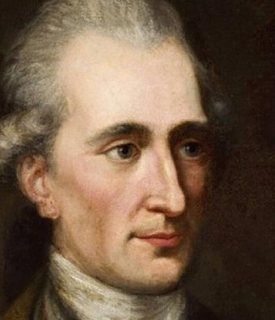
Friedrich Jacobi (1743 - 1819)
Open Jacobi's interactive page (graphs of influences, similar and opposing positions, and quotes)
Background
Friedrich Heinrich Jacobi
Born: 25 January 1743 in Düsseldorf, Electorate
of the Palatinate, Holy Roman Empire
Died: 10 March 1819 (aged 76) in Munich,
Bavaria, Germany
School: German Idealism
Main interests: Common Sense Realism, Faith,
Religion, Metaphysics, Moral Philosophy
Influences: Adam Smith, Thomas Reid, David
Hume, Baruch Spinoza, Gottfried Wilhelm
Leibniz, Christian Wolff, Johann Wolfgang von
Goethe, Johann Georg Hamann, Moses
Mendelssohn, Immanuel Kant
Influenced: Fichte, Hegel, Kierkegaard, Moses
Mendelssohn, Heidegger, Schelling, Jakob
Friedrich Fries, Victor Cousin, Feuerbach,
Schleiermacher, Martin Buber, Friedrich
Bouterwek, Leo Strauss, William Hamilton,
Novalis, Friedrich Hölderlin, Coleridge
From Wikipedia
Jacobi is best known for popularizing the concept of nihilism. He promoted the idea that it is the necessary result of Enlightenment thought and the philosophical systems of Baruch Spinoza, Immanu- el Kant, Johann Gottlieb Fichte and Friedrich Wil- helm Joseph Schelling. Jacobi advocated Glaube (variously translated as faith or "belief") and reve- lation instead of speculative reason. In this sense, Jacobi can be seen to have anticipated present-day writers who criticize secular philosophy as relativistic and dangerous for religious faith.
Introductory Comments
Aristotle called us political animals, and part of what he meant is that we live by contest as much as by cooperation. Small wonder that philosophers so often personalize their quarrels, turning a dispute about ideas into a match between men - including men long dead. Jacobi's writings are fights of just this kind: Jacobi against the reigning champion, with faith itself as the prize.
His first and greatest opponent was Spinoza, which seems an odd choice. Spinoza would later be called a "God-intoxicated man," and Jacobi, who wanted nothing so much as to be intoxicated with God, might have found an ally there. The trouble was Spinoza's God. Not the transcendent Creator of Christianity, but a God wholly immanent in nature - a God who simply is Nature. To Jacobi this was atheism, pure and simple - or impure and convoluted. He made the point in the most explosive way available. In 1785 he published a book of letters to Moses Mendelssohn revealing that Lessing - luminary of the German Enlightenment, dead four years and unable to object - had privately confessed himself a Spinozist.
This book put Spinoza, previously a marginal and suspect figure, at the center of German philosophical debate for the next generation, influencing Kant, Herder, Goethe, and later the Idealists. Jacobi knocked neither Spinoza nor Lessing down and out, but German thought itself never quite recovered its footing.
Some of Jacobi's Key Positions
Too many recent philosophers insist that no belief may be accepted as true unless logic or experience can prove it. Pressed to the end, that demand does not secure knowledge; it dissolves it. Demonstration links one conditioned thing to another, and the chain never closes. Whatever is unconditioned - God, freedom, the existence of the world itself - lies beyond its reach. A God who could be demonstrated would not be God.
It is a mere bias of philosophers to suppose that truth must always be mediated. Every certainty worth having rests on immediate conviction - call it faith, in the plain sense in which a man believes the floor will bear his weight. That the world outside us is real is not the conclusion of an argument but something given in perception itself. Here Kant went astray: a philosophy that never gets past its own representations has lost the world. Spiritual truths stand on the same footing.
Spinoza at least had the courage of consistency. Following the demand for sufficient reason wherever it led, he arrived not at a loving, intelligent, moral Creator but at Nature - impersonal, amoral, rigidly necessary, a system in which nothing is chosen and nothing is for the sake of anything. The cost is the person. If a man's deeds are merely links in a chain of efficient causes reaching back before his birth, he does not act; something acts through him. Better to leap clear of such an argument than follow it over the cliff.
Place in the History of Ideas
Jacobi's Place in History of Ideas
George di Giovanni: Polemicist, socialite, and literary figure, Friedrich Jacobi was an outspo- ken critic, first of the rationalism of German late Enlightenment philosophy, then of Kant’s Transcendental Idealism, especially in the form that the early Fichte gave to it, and finally of the Romantic Idealism of the late Schelling. In all cases, his opposition to the philosophers was based on his belief that their passion for expla- nation unwittingly led them to confuse condi- tions of conceptualization with conditions of existence, thereby denying all room for individ- ual freedom or for a personal God. Jacobi made this point, in defence of individualism..., in a number of public controversies, in the course of which he put in circulation expressions and themes that resonate to this day.
Hegel: This immediate knowledge of God is then the point which is maintained in the philosophy of Jacobi. The faith of Kant and of Jacobi are, however, different. To Kant it is a postulate of reason, it is the demand for the solution of the contradiction between the world and good- ness; to Jacobi it is represented on its own account as immediate knowledge. Everything which has been written upon God since Jacobi's time, by philosophers such as Fries and by theologians, rests on this conception of immediate intellectual knowledge, and men even call this revelation, though in another sense than the revelation of theology.
Random Thoughts on Jacobi
Judo students learn to win not by overpowering an opponent but by borrowing his momentum - a small pull at the right instant, and his own strength puts him on the mat. Jacobi fought philosophers the same way. He rarely denied a thinker's premises; he accepted them, held on, and let them carry the man where he had no wish to go. His throw of Kant is the classic. Kant's critical philosophy insists that categories like causality apply only to appearances, never to things as they are in themselves. Fair enough, says Jacobi - except that the whole system depends on things-in-themselves affecting our sensibility to produce sensation in the first place. That is causality reaching past appearances, exactly where Kant forbids it. Hence Jacobi's famous verdict: without the thing-in-itself he could not enter the critical philosophy, and with it he could not remain there.
Then comes the second judo move. Having declared God and immortality unknowable, Kant lets them back in as postulates - beliefs our moral nature requires us to hold. Jacobi pounces. So the great critic of faith runs on faith after all; he has merely made his version late, laborious, and dependent on a moral argument. Jacobi's own faith arrives first and without effort: perception is already a kind of revelation, and conviction about God comes the same immediate way. And as to immediacy, Kant himself seems to rely on it, else he would not have based his faith in God on the self-evident immedicary of his moral convictions.
Influences
Jacobi was influenced by: Goethe, Hamann, Hume, Kant, Leibniz, Mendelssohn, Reid, Smith, Adam, Spinoza, Wolff
Jacobi influenced: Bouterwek, F., Buber, Coleridge, Cousin, Feuerbach, Fichte, Fries, Jakob, Hamilton, W., Hegel, Heidegger, Holderlin, Kierkegaard, Novalis, Schelling, Schleiermacher, Strauss
Similar and opposing positions
Thinkers with similar positions:
- Blake (Pursuit of science can lead to a sterile and atheistic worldview.)
- Cousin ("Absolute" systems based on deductive abstractions are illegitimate.)
- Goethe (Science and philosophy cannot unravel all the mysteries of the world.)
- Hamann (Intuition and personal genius are best tools for understanding nature.)
- James (Logic is not an adequate measure of what can or cannot be.)
- Kant (The noumena or objective thing-in-itself cannot be directly known.)
- Rand (Writing fiction can be an engaging & effective way to do philosophy.)
- Reid (When philosophy contradicts common sense, it should be dismissed.)
- Smith, Adam (Govt. must be very careful when interfering with the economy.)
Thinkers with opposing positions:
- Berkeley (Essentially the world does not consist of things, but of mental events.)
- Brentano (Philosophy should use methods as rigorous and exact as science.)
- Eriugena (Philosophy is not in the service of theology. Reason precedes faith.)
- Frege (Logic is the appropriate measure of what can or cannot be.)
- Holbach (Religion is an impediment to the moral advancement of humanity.)
- Pyrrho (Given our human limitations, we can never be sure of what is true.)
- Spinoza (The world is completely rational & reason is the key to understanding.)
What others said about Jacobi
- Schopenhauer: [B]y reducing the external world to a matter of faith, [Jacobi] wanted merely to open a little door for faith in general….
- John Herman Randall Jr.: Jacobi... frankly called intuition the source of ultimate knowledge, and abandoned any attempt to reconcile its certainty with the scientific laws of nature.
- George di Giovanni: [Jacobi's] battle cry, which he first directed at the defenders of Enlightenment rationalism and then at Kant and his successors, was that "consistent philosophy is Spinozist, hence pantheist, fatalist and atheist." The formula had the effect of bringing Spinoza to the center of the philosophical discussion of the day.
- Hegel: [Unlike Kant, Jacobi believed] that the categories are not merely subjective, but that they themselves are conditioned. This is an essential difference between the two points of view....
- Randall Collins: If Kant is one hinge of the emergence of Idealism, Jacobi is the counter-hinge.... As key opponent, Jacobi was as central as Kant....
- George di Giovanni: He was also responsible for forging the concept of "nihilism" - a condition of which he accused the philosophers - and thereby initiating the discourse associated with it.
- Wilhelm Windelband: [Jacobi rejected Kant's fundamental subjectivism and argued that without] the presupposition of realism one could not enter the Kantian system, and with the same could not remain in it; for the conception of the sensibility introduced at the beginning involves the causal relation of being affected by things-in-themselves....
- Hegel: In the first place Spinozism is asserted to be Atheism - by Jacobi, for instance - because in it no distinction is drawn between God and the world; it makes nature the real God, or lowers God to the level of nature....
Schools: Common Sense Realism, Counter-Enlightenment, Fideism, German Romanticism, Post-Kantian Philosophy
Main interests: Ethics, Faith, Free/Unfree Will, Literature, Metaphysics, Religion
Jacobi's answers to philosophical questions
Art and Aesthetics
"… the world is beautified by the shining through it of God."
Epistemology
It is a mere bias of philosophers to think that truths are not immediate perceptions, but require mediate demonstration.
"To lay aside all prejudices, is to lay aside all principles. [And] he who is destitute of principles is governed by whims."
An unyielding emphasis on science and reason undermines religion and leads to a type of philosophical nihilism.
Belief is what makes life livable: "In one thing men of all ages are alike: they have believed obstinately in themselves."
Ethics
"I have all reverence for principles which grow out of sentiments; but [not for] sentiments which grow out of principles…."
Without belief in God, men are entirely selfish: "It is not truth, justice, liberty, that men seek; they seek only themselves."
Metaphysics
Since we can justify our actions in the context of existing conditions and in terms of projected results, we have free will.
Nature
"[Man] is capable of contemplating something higher than his own reason, more sublime than the whole universe…."
Religion and Theology
Religion springs from revelation. If we relied on reason alone, we would never have found the loving God who created us.
Though we can't logically or empirically prove religious revelations, we can - and should - accept them as matters of faith.
"I have never found a thorough, pervading, enduring morality but in those who feared God."
Worshipping idols is paganism: "There are but two religions - Christianity and paganism, the worship of God and idolatry."