Hans Vaihinger (1852 - 1933)
Open Vaihinger's interactive page (graphs of influences, similar and opposing positions, and quotes)
Background
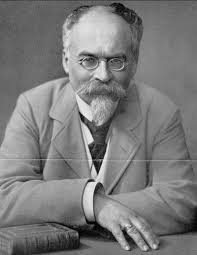
Hans Vaihinger
Born: September 25, 1852 in Nehren,
Württemberg, Germany
Died: December 18, 1933 (aged 81) in Halle,
Province of Saxony, Germany
Alma mater: Tübinger Stift, Tübingen; Leipzig
University; University of Berlin
Schools: Neo-Kantianism, Fictionalism
Main interests: Epistemology, religion, freedom,
science, psychology
Notable ideas: Fictionalism, instrumentalism,
nominalism
Influences: Immanuel Kant, Friedrich Forberg,
Arthur Schopenhauer, Jeremy Bentham, African
Spir, Friedrich Nietzsche, Karl Robert Eduard
von Hartmann
Influenced: Alfred Adler, James Hillman, George
Kelly, Hans Kelsen, John Grinder, Arthur Fine
From Wikipedia
Vaihinger was a German philosopher.... In The Philosophy of "As If" Vaihinger argued that human beings can never really know the underlying reality of the world, and that as a result people construct systems of thought and then assume that these match reality: they behave "as if" the world matches their models. In particular, he used examples from the physical sciences, such as protons [and] electrons.…. [No such] phenomena have been observed directly, but science... pretends that they exist….
Introductory Comments
Most philosophers want to know what is true. Vaihinger was more interested in what is useful, and in how often the two part company. His "philosophy of as if" holds that human beings get through life by leaning on fictions: ideas known to be false, or impossible to verify, that we treat as true because they help us. Mathematicians, for instance, have no business taking the square root of a negative number. Yet they calculate as if such a number existed and reach answers they could get no other way. Economists reason as if people were coolly self-interested calculators, though anyone who has watched a shopper at a clearance sale knows better. Modern physics offers a fresh example: students still learn to picture electrons circling the nucleus like tiny planets, long after quantum mechanics replaced that image with clouds of probability.
Ordinary life is stitched together with as ifs, too. We greet acquaintances as if delighted to see them. We take on new jobs as if we knew what we were doing. But here we risk self-deception. For Vaihinger, what makes an idea a fiction is that it is held with awareness of its falsity. A fiction is a deliberate, conscious departure from reality, adopted because it serves a purpose. He set this against two neighbors. An error is a false idea mistaken for a true one. A dogma is a fiction whose fictional status has been forgotten, so that it is now believed outright. We must remember that, now matter how useful, a ficton is still a fiction.
Some of Vaihinger's Key Positions
No one has ever seen an atom, yet physicists reason as if matter were made of tiny particles, and the reasoning works. Mathematicians calculate with infinitely small quantities and breadthless lines, ideas that collapse into contradiction on inspection, and still get correct answers. Such devices are fictions: ideas known to be false or unprovable, kept because they are useful. Unlike a hypothesis, a fiction makes no claim to truth and is judged only by what it accomplishes.
Science is not unusual in this. Thought is a tool for survival, not a copy of reality. Only sensations are directly given; the orderly world of things and causes is built by the mind. Even the "thing in itself," the reality supposedly behind appearances, is a fiction. We act as if our mental picture matched the world because the picture works. It helps us avoid dangers and seize opportunities.
Fictions are scaffolding: indispensable during construction, removed once the job is done. Trouble begins when a fiction hardens into a hypothesis, and a hypothesis into a dogma.
The same logic reaches ethics and religion. Moral certainty is out of reach, but we do well to act as if a moral law binds us and as if we are free. Criminal law could not function otherwise. God and immortality cannot be proved, yet living as if they were true can supply guidance and consolation. Life without our "as ifs" would be hard to endure.
Place in the History of Ideas
Vaihinger's Place in History of Ideas
Rollo Handy: The Platonic myths were the first stimuli to Vaihinger's eventual theory of fictions. Later, Kant's antinomies also were influential. Lange had said, "Man needs to supplement reality by an ideal world of his own creation"; Vaihinger expanded this view and applied it to science, metaphysics, theology, social ideals, and morality. Fictions are not to be mistaken for true propositions, for fictions are known to be false. They contradict observed reality or are self-contradictory, and so they falsify experience. Something can work as if true, even though false and recognized as false.
Timothy Stoll: Heavily influenced by the nineteenth-century Neo-Kantian Friedrich Albert Lange, as well as by Arthur Schopenhau- er, [The Philosophy of As-If] develops a position that Vaihinger calls "idealistic positivism." The view seeks to wed elements of Kant’s transcen- dental idealism with the Darwinian theory of natural selection, and places central emphasis on the epistemic import of idealization and fiction. Vaihinger’s fictionalism anticipated many of the anti-realist and anti-metaphysical strains of later logical positivism, and represented an important alternative to the Neo-Kantianism of the Marburg, Southwest, and Göttingen Schools.
Random Thoughts on Vaihinger
Suppose Vaihinger is right, and we never meet the world itself, only the models we build of it. What, then, should we call these grand metaphysical as ifs? Practical pretense, perhaps? Educated guesswork? Heuristic devices, handy tools for finding things out? Or we might raid the philosophers’ shelf: Kant’s world of appearances, Darwin’s survival adaptations, Nietzsche’s useful illusions, Wittgenstein’s language games. Plato’s shadows on the cave wall come close, though Plato promised a way out of the cave and Vaihinger offers none. Kierkegaard’s leap of faith comes closer still, except that Vaihinger never leaps. He only acts as if he had.
Or perhaps just storytelling. We spend much of our lives spinning narratives that seem to explain what is happening to us. Reality, alas, has little patience for neat arcs, with their heroes and villains, beginnings, middles, and ends. Stories may be compelling, even (Vaihinger would nod) indispensable, but they never tell the whole story. How could they? The world is a riotous tangle of beings, each complex inside, all overlapping, all jostled by crisscrossing events that no plot could corral. Still, our simplified as-if stories shape our dreams and ambitions, our sense of ourselves and others, our politics, morals, and religion. They are scaffolding of exactly the kind Vaihinger described, except that we never take it down. Instead we hang our lives on it, precariously yet confidently, and try not to look down.
Influences
Vaihinger was influenced by: Bentham, Forberg, F., Kant, Lange, F. A., Nietzsche, Schopenhauer, Spir, Von Hartmann
Vaihinger influenced: Adler, Fine, Arthur, Freud, Grinder, John, Hillman, J., Kelly, George, Kelsen, Hans
Similar and opposing positions
Thinkers with similar positions:
- Adler (Fictions play a large role in shaping human psychology.)
- Deleuze (Philosophy, science, and art are equally creative and practical.)
- Hamann (Faith and belief, rather than knowledge, determine human actions.)
- Lewis, C.I. (Knowledge & evaluation are essentially animal adaptive responses.)
- Peirce (The truth about an event or thing is the totality of its consequences.)
- Protagoras (No absolute truth exists - only what people deem to be the truth.)
- Rorty (The philosophic search for some objective basis of truth is fruitless.)
- Schlegel (There are no first principles that can guide us to the truth.)
- Schlick (Outside logic & math, the truth of statements must rest on evidence.)
Thinkers with opposing positions:
- Ayer (Language that is not verifiable is not true or untrue but meaningless.)
- Bergson (Utility is not a test of truth, but in fact a synonym for error.)
- Carnap (Meaning of a sentence is equivalent to stating its truth conditions.)
- Frege (Logic is the appropriate measure of what can or cannot be.)
- Habermas (We must not give up on Enlightenment ideals of reason & science.)
- Nussbaum (Truth exists and reason is our best tool for finding it.)
- Popper (The search for truth should be completely fact-based and objective.)
What others said about Vaihinger
- Arthur Fine: Vaihinger was the "preeminent twentieth-century philosopher of modeling."
- Rollo Handy: Lange had said, "Man needs to supplement reality by an ideal world of his own creation"; Vaihinger expanded this view and applied it to science, metaphysics, theology, social ideals, and morality.
- George Kelly: [Vaihinger] offered a system of thought in which God and reality might best be represented as paradigms. This was not to say that either God or reality was any less certain than anything else in the realm of man’s awareness, but only that all matters confronting man might best be regarded in hypothetical ways.
- Rollo Handy: Although he held theological doctrines to be false in any literal or factual sense, Vaihinger, somewhat like George Santayana, found considerable aesthetic and ethical merit in Christian doctrines.
- H. L. Mencken: Vaihinger's "As If" philosophy is an unimportant "foot-note to all existing systems."
- Tinothy Stoll: For the bare purposes of… survival, Vaihinger is claiming, the intellect would not have to be a reliable guide to the way the world really is. On the contrary, fictions may have an indispensable role to play here.
- Rollo Handy: Vaihinger maintained that pessimism gives moral strength, enables one to endure life, and helps to develop a more objective view of the world. He emphasized that in his opinion the difficulties of Germany, and especially its defeat in World War I, were largely attributable to the prevailing optimism of German idealism.
- Timothy Stoll: … given Vaihinger’s… view that the use of a concept can be justified on purely practical grounds…, it does not seem unfair to liken him to the pragmatist tradition in a wider sense.
Schools: Fictionalism, Neo-Kantianism, Pragmatism, Skepticism
Main interests: Epistemology, Freedom, Psychology, Religion, Science
Vaihinger's answers to philosophical questions
Epistemology
Our perceptions are the joint product of things in themselves and the operations of our physiological organization.
As Schopenhauer said, the intellect is just the servant of the will. And as Darwin said, the will's desire is survival, not truth.
"[W]hat we generally call truth, namely a conceptual world coinciding with the external world, is merely [an] expedient error."
The purpose of thought is not to discover objective truth, but to adapt ourselves to the world we find ourselves living in.
Pragmatism trumps skepticism: Our thoughts are shaped by our various interests. What we call truths are just useful fictions.
Ethics
We are moral creatures. Therefore, though ethical certainty may not be possible, we need to act as if moral laws exist.
Metaphysics
Even if the existence of matter cannot, strictly speaking, be proven, it is a necessary and very useful fiction.
Political Philosophy
Though the notion of an original social contract is fiction, it is very useful in explaining the role & nature of government.
Religion and Theology
Though we cannot prove the existence of God, we need to believe in a God who offers us both guidance and solace.
Science
To aid in making predictions, scientific models must simplify the world and ignore many of its properties and influences.