Mikhail Bakunin (1814 - 1876)
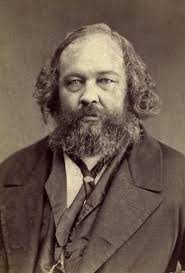
Open Bakunin's interactive page (graphs of influences, similar and opposing positions, and quotes)
Background
Mikhail Bakunin
Born: 30 May 1814 in Pryamukhino, Tver
Governorate, Russian Empire
Died: 1 July 1876 (aged 62) in Bern, Switzerland
School: Anarchism (Collectivist anarchism)
Main interests: Politics, political philosophy,
class struggle, religion
Influences: Fichte, Hegel, Joachim Lelewel,
Proudhon, Marx, Schelling, Alexander Herzen,
Rousseau, Ludwig Feuerbach, Nikolay Ogarev,
Louis Blanc, Nikolay Stankevich, Auguste Comte,
Arnold Ruge, Jean-Baptiste Lamarck
Influenced: Noam Chomsky, Peter Kropotkin,
Errico Malatesta, Fyodor Dostoyevsky,
Benjamin Tucker, Marie Le Compte, Emma
Goldman, Herbert Marcuse, E.P. Thompson,
Neil Postman, A.S. Neill, Sergei Nechayev,
Takis Fotopoulos, Ivan Turgenev, Herbert Read,
Vissarion Belinsky
From Wikipedia
Bakunin was a Russian revolutionary anarchist. He is among the most influential figures of anarchism and a major figure in the revolutionary socialist, social anarchist, and collectivist anarchist traditions. Bakunin's prestige as a revolutionary also made him one of the most famous ideologues in Europe, gaining substantial influence among radicals throughout Russia and Europe…. Bakunin is remembered as a major figure in the history of anarchism and as an opponent of Marxism, especially of the dictatorship of the proletariat….
Introductory Comments
Bakunin was born in 1814 into the Russian landed gentry and spent a comfortable childhood on the family estate, blissfully unaware of the slugfest his life would become. At fourteen he is packed off to artillery school in St. Petersburg. (Yes, the famous anarchist was trained in military discipline.) But he soon discovers that philosophy is more fun than cannons, and considerably more explosive. He resigns his commission, throws himself into German philosophy, Hegel above all, and heads to Berlin to study it at the source. There, among the radical young Hegelians, the student becomes an agitator, announcing that "the passion for destruction is a creative passion."
He's so good at his new job that three nations compete for the privilege of locking him up. For his part in the Dresden uprising of May 1849, Saxony sentences him to death, commutes the sentence, and hands him over to Austria. Austria sentences him to death again, then, not wanting to seem greedy, passes him along to Russia. Then Russia gives him three years of solitary confinement in the Peter and Paul Fortress, plus three more in Shlisselburg, where scurvy costs him his health and his teeth. After his mother pleads with the new tsar, he is exiled to Siberia in 1857. Four years later he escapes by a route worthy of Jules Verne: east through Siberia, across the Pacific by way of Japan to San Francisco, then onward to New York and finally London - where he promptly throws himself back into revolutionary causes. Oh dear.
Some of Bakunin's Key Positions
Socialism is the right goal, but the state is the wrong road to it. Marx expected a workers' state to abolish class rule and then lose its political character. But no state can serve as a temporary tool of liberation. The state has to be dismantled in the revolution and replaced with a free federation of workers' associations and communes, built from the bottom up and joined voluntarily.
The "dictatorship of the proletariat" is a contradiction in terms. Workers who took power would stop being workers. A small minority of officials and learned socialists would then rule in their name, claiming to know the people's interests better than the people did. The result would be a new privileged class and a dictatorship over the proletariat, not by it.
Authority imposed from outside destroys freedom, whether it comes from the state, the church, property, or God. The idea of God asks people to surrender their reason to a heavenly master, and so sanctions every earthly tyranny. If God existed, he would have to be got rid of.
Freedom is by nature both social and universal: no one is free until all are free, since each person's liberty is enlarged by the liberty of others. The revolution therefore has to be international. Its forces would include peasants and the desperate poor as well as the industrial workers on whom Marx pinned his hopes.
Place in the History of Ideas
Bakunin's Place in History of Ideas
Paul Avrich: As a romantic rebel and an active force in history, Bakunin exerted a personal attraction that Marx could never rival.… His broad magnanimity and childlike enthusiasm, his burning passion for liberty and equality, his volcanic onslaughts against privilege and injustice - all gave him enormous appeal in the libertarian circles of his day. But Bakunin, as his critics never tired of pointing out, was not a systematic thinker. Nor did he ever claim to be.… He refused to recognize the existence of any preconceived or preordained laws of history.… He believed, on the contrary, that men shaped their own destinies, that their lives cannot be squeezed into a Procrustean bed of abstract social formulas.… And yet, however erratic and unmethodical, his writings abound in flashes of insight that illuminate some of the most important social questions of his time - and of ours.
E. H. Carr: Bakunin was the apostle of liberty in its absolute form - a liberty which... had nothing in common with Hegel's conception of liberty realizing itself in the State. Yet Bakunin, on the strength of his emphasis on propaganda by deed and of his willingness to appeal to the "evil passions," has often been convicted of an affinity with the movements which ultimately issued in Fascism. He was always ready to subordinate theory to the.... the revolutionary impulse....
Random Thoughts on Bakunin
The First International (1864–1876) was where Bakunin's anarchism collided with Marx's communism, in a struggle red in tooth and claw, and in every other sense besides. The irony is that both men wanted the same destination: a society without classes or a state. They quarreled over the route. Marx held that the workers must first win political power and rule through a temporary "dictatorship of the proletariat." Bakunin's answer, in effect, was that no one who holds power ever finds a convenient moment to give it up. Where Marx meant to seize the state, Bakunin meant to smash it. And where Marx had a theory of history, Bakunin trusted the instincts of the masses. Their war was fought through proxies, circulars, and votes. It ended in 1872, when the International expelled Bakunin in his absence.
But the fighting continued on other fronts. Against the followers of Proudhon, who hoped to change society gradually through cooperatives, Bakunin championed insurrection. Against Mazzini, whose Italian republicanism marched under the banner "God and the People," he preached revolution without borders or God. He stormed out of the pacifist League of Peace and Freedom when it refused to embrace socialism. Bakunn was, in short, the revolutionary's revolutionary: too violent for the pacifists, too godless for the believers, too anarchic for the socialists, and too internationalist for the nationalists. The most uncomradely of comrades.
Influences
Bakunin was influenced by: Blanc, Louis, Comte, Feuerbach, Fichte, Hegel, Herzen, Lamarck, Lelewel, J., Marx, Ogarev, N., Proudhon, Rousseau, Schelling
Bakunin influenced: Chomsky, Dostoyevsky, Fotopoulos, T., Goldman, Kropotkin, Malatesta, E., Marcuse, Neill, A.S., Postman, Neil, Read, Herbert, Thompson, E.P., Tucker, B., Turgenev
Similar and opposing positions
Thinkers with similar positions:
- Adorno (Science & reason have become entangled with social domination.)
- Godwin (Government by its very nature counteracts creative & original thinking.)
- Goldman (Anarchism is the liberation from oppression of govt. & religion.)
- Gramsci (Often the ruling class imposes its worldview on the entire culture.)
- Herzen (Humans should never be sacrificed on an altar of glorious abstractions)
- Jefferson (Certain rights are natural or inherent by virtue of our humanity.)
- Kafka (Law is often no more than the pure, immoral force of domination.)
- Kropotkin (A communist republic based on a strongly centralized state will fail.)
- Marx (The comfort of religion is illusory & keeps the masses quietly enchained.)
- Proudhon (As we seek justice in equality, so society seeks order in anarchy.)
Thinkers with opposing positions:
- Agamben (The law is always the best guarantor of human freedom & rights.)
- Arendt (Only rights granted by the state matter, not "inalienable human rights.")
- Hobbes (Government was created to protect people from one another.)
- Lukács (Commmunism should lead to the dictatorship of the proletariate.)
- Montesquieu (Government excesses can be avoided thru' checks & balances.)
- Tolstoy (Though anarchism is a noble cause, violent revolution is terrible.)
- Voltaire (If God did not exist, it would be necessary to invent Him.)
What others said about Bakunin
- Richard Wagner: Everything about him was colossal, and he was full of exuberance and strength.
- G. D. H. Cole: Bakunin's social theory began, and almost ended, with liberty. Against the claims of liberty nothing else in his view was worth consideration at all.
- Charles A.Madison: His approval of violence as a weapon against the agents of oppression led to nihilism in Russia and to individual acts of terrorism elsewhere - with the result that anarchism became generally synonymous with assassination and chaos.
- Paul Avrich: [In Bakunin's judgment the] true revolution, then, would not capture political power; it would be a social revolution, ridding the world of the state itself.
- Steve Cohen: He saw both capitalism and communism as being based on centralized state structures at all times controlled by Jews.
- Peter Marshall: It is difficult not to conclude that Bakunin's invisible dictatorship would be even more tyrannical than a Blanquist or Marxist one, for its policies could not be openly known or discussed.
- Schmitt: Bakunin was the first to give the struggle against theology the complete consistency of an absolute naturalism.... For him, therefore, there was nothing negative and evil except the theological doctrine of God and sin, which stamps man as a villain in order to provide a pretext for domination and the hunger for power.
- Aleksandr Solzhenitsyn: [Bakunin] abjectly groveled before Nicholas I - thereby avoiding execution. Was this wretchedness of soul? Or revolutionary cunning?
Schools: Anarchism, Atheism
Main interests: Agriculture, Class Struggle, Equality, Freedom, Freedom of the press, Labor, Law, Political Philosophy, Politics, Punishment, Religion, Revolution, Social Philosophy
Bakunin's answers to philosophical questions
Economics
Class hierarchies are inherently unjust and must be replaced by a classless society where private ownership is abolished.
Unrestrained capitalism is by nature oppressive and should be replaced with local, self-governing workplaces and communes.
Marx's dictatorship of the proletariat would, in practice, likely degenerate into a Marxist dictatorship over the proletariat.
Ethics
"The liberty of man consists solely in this, that he obeys the laws of nature because he has himself recognized them as such."
Law
Most laws aren't needed, since their object is to "exalt into a system the exploitation of the workers by a ruling class."
Political Philosophy
The best government is no government: "If there is a State, then there is domination, and in turn, there is slavery."
All state governments are oppressive & should be replaced with federations of self-governing workplaces & communes.
"Revolution requires extensive and widespread destruction..., since in this way and only this way are new worlds born."
Justice doesn't require removing all differences between people, but rather providing resources & opportunities to all people.
"From each according to his faculties, to each according to his needs; that is what we wish sincerely and energetically."
Freedom & equality always go together. A society is never truly free until it offers equal opportunities & resources to people.
Psychology
Parents must not be dictators: "Children [aren't] the property of their parents. They belong only to their own future freedom."
Religion and Theology
"The heaven of religion is nothing but a mirage in which man, uplifted by... faith, rediscovers his own image, but magnified...."
"People go to church for the same reasons they go to a tavern: to stupefy themselves, to forget their misery…."
"If God existed, only in one way could he serve the cause of human liberty - by ceasing to exist."
We imagine God to be the ultimate Ruler, but "as long as we have a master in heaven, we will be slaves on earth."
"The liberty of man consists solely… in that he obeys the laws of nature because he has himself recognized them as such…."
"The idea of God implies the abdication of human reason and justice; it is the most decisive negation of human liberty...."
"[Christ] did everything for mankind, finding His satisfaction and His delight in the dissolution of His material being."
"A Boss in Heaven is the best excuse for a boss on earth, therefore If God did exist, he would have to be abolished."
"He who desires to worship God must harbor no... illusions about the matter but bravely renounce his liberty and humanity."
Society
"Man becomes conscious of himself and his humanity only in society and only by the collective action of the whole society. "