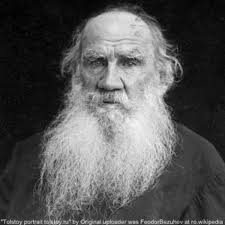
Born to an aristocratic family, Tolstoy achieved acclaim in his twenties with his semi-autobio- graphical trilogy, Childhood, Boyhood and Youth.... His War and Peace, Anna Karenina, and Resurrec- tion, which is based on his youthful sins, are often cited as pinnacles of realist fiction and three of the greatest novels ever written. [Later in life, Tolstoy's] literal interpretation of the ethical teachings of Jesus, centering on the Sermon on the Mount, caused him to become a fervent Christian anarchist and pacifist.
Introductory Comments
For his first 50 years, Tolstoy lived as a Russian count was expected to live, only more so. As a young man he drank, chased women, and gambled so recklessly that he once sold the main house on his family estate to pay his debts. Then came army service, early literary success, and, by the late 1870s, War and Peace and Anna Karenina. He had wealth, land, a large family, and a fame few writers have ever known. And just then, in his late forties, the ground gave way. As he told it in A Confession, he could find no meaning in a life that death would erase. And he thought about erasing it.
The way out was slow. Tolstoy first tried the Orthodox faith of the peasants. Then he decided that the Church had buried Jesus's teaching under ritual and dogma. What remained was the Sermon on the Mount, taken literally: no violence, no oaths, love even for one's enemies. From there it was a short step, for Tolstoy if not for his family, to rejecting the state, private property, and the social order that had made him rich. He renounced the copyright on his later works, gave up meat, and took to plowing in a peasant blouse. His wife Sophia, who was raising their many children and running the estate, found a saint harder to live with than a genius. Their quarrels ended only in 1910, when Tolstoy, at 82, died. By then his writings on nonviolence had reached a young lawyer in South Africa named Mohandas Gandhi. Both men were saints in the eyes of the world. Their wives might have chosen another word.
Some of Tolstoy's Key Positions
The state is organized violence. Behind every law stand the policeman, the jailer, and the soldier. The state is a conspiracy to exploit its citizens, and we should vow to never to serve it again. A true Christian should refuse its oaths, its courts, and above all its armies. But he must not overthrow it by force, which would only replace one violence with another. The state will lose its power when enough people stop cooperating with it.
On a personal note, these convictions came slowly. War at Sevastopol and travel in Western Europe taught me much. But it took a spiritual crisis in middle age to send me back to the Gospels. There I found the heart of Christianity in the Sermon on the Mount, freed from the Church's dogmas, miracles, and sacraments.
Its central commandment is "Resist not evil," which I read as "Do not resist evil by violence." This is not passivity. We must refuse to do wrong and accept punishment rather than inflict it. If struck, we turn the other cheek; if persecuted, we love our persecutors.
Love has outward consequences. We must live simply, work with our own hands, and stop living off the labor of others. Private ownership of land is a grave injustice, and Henry George's single tax on land values would begin to right it. Because a government would collect it, though, it is a first step, not the destination.
Place in the History of Ideas
Tolstoy's Place in History of Ideas
William Dean Howells: Tolstoy awakens in his reader the will to be a man; not effectively, not spectacularly, but simply, really. He leads you back to the only true ideal, away from that false standard of the gentleman, to the Man who sought not to be distinguished from other men, but identified with them, to that Presence in which the finest gentleman shows his alloy of vanity, and the greatest genius shrinks to the measure of his miserable egotism.... Tolstoy gave me heart to hope that the world may yet be made over in the image of Him who died for it, when all Caesar’s things shall be finally rendered unto Caesar, and men shall come into their own, into the right to labor and the right to enjoy the fruits of their labor, each one master of himself and servant to every other. He taught me to see life not as a chase of a forever impossible personal happiness, but as a field for endeavor toward the happiness of the whole human family….
Alexander Fodor: Nearly a century after his death, ... Tolstoy remains a giant in the world of literature. While the impact of his "spiritual" mission cannot be fully gauged, we know that his pacificism, his advocacy of passive resistance to evil through non-violent means, has had incalculable influence on pacificist movements in general and on the philosophical and social views and programs of Mahatma Gandhi, Martin Luther King and Cesar Chavez.
Random Thoughts on Tolstoy
Tolstoy and Dostoyevsky, the twin giants of Russian fiction, lived in the same country, wrote in the same decades, and admired each other's work. Yet they never met. In 1878 they sat in the same St. Petersburg lecture hall, and no one thought to introduce them. When Dostoyevsky died three years later, Tolstoy wrote to a friend that he felt he had lost someone close to him. Perhaps it is just as well that they never talked. Both men placed Jesus at the center of their lives, but it was not the same Jesus.
Dostoyevsky's Christ was the divine Redeemer, a mystery to be embraced. In Siberian exile he wrote that if someone proved Christ lay outside the truth, he would rather stay with Christ than with the truth. In his novels, suffering can redeem. Tolstoy's Jesus redeemed no one. He was the wisest of teachers, and his Sermon on the Mount contained plain instructions: do not answer violence with violence, and love your enemies. To obey them was salvation enough. The Church's miracles and resurrection only got in the way. Answering the Holy Synod that excommunicated him, Tolstoy declared that he had come to love truth above everything. Dostoyevsky chose Christ over truth; Tolstoy chose truth and found Christ in it. Why such different Christs? Perhaps a man who had stood before a firing squad, as Dostoyevsky did in 1849, may not have put much faith in self-improvement and utopian projects. While a count who owned the land as far as he could see, did.
Dostoyevsky (The cure to social ills is not socialism, but a true Christianity.)
Erasmus (The Christian scripture teaches us the transformative power of love.)
Goldman (All wars waged by capitalistic governments are immoral.)
Herzen (Collectivist farming is a cure for many social injustices the poor endure.)
Hutcheson (We should act in unselfish ways to increase happiness of others.)
Orwell (Literature at its best enlightens the reader, both morally & politically.)
Said (Abuses of state authority & all forms of colonialism must be opposed.)
Shakespeare (History's the story of how human passions play out on world stage)
Thinkers with opposing positions:
Aquinas (War is just if fought for a good cause and waged by a proper authority.)
Dennett (Evolution can account for the origin of morality in our species.)
Evola (War can be an ennobling and spiritually fulfilling experience.)
Gramsci (Marxism will supplant religion when it meets people's spiritual needs.)
Harris (We don't need religion to experience compassion, awe, and devotion.)
Machiavelli (Religion is essential for keeping a republic in order.)
Proust (Art is justified by revealing to us the beauty and charm of everyday life.)
Sumner (War springs from the competition for life & will always exist.)
What others said about Tolstoy
Gustave Flaubert: What an artist and what a psychologist!
George Steiner: Tolstoy, like a colossus bestriding the palpable earth, evoking the realness, the tangibility, the sensible entirety of concrete experience... Tolstoy, the embodiment of health and Olympian vitality....
Gandhi: Tolstoy's life has been devoted to replacing the method of violence for removing tyranny or securing reform by the method of nonresistance to evil. He would meet hatred expressed in violence by love expressed in selfsuffering. He admits of no exception to whittle down this great and divine law of love. He applies it to all the problems....
Chesterton: The truth is that Tolstoy, with his immense genius... and vast knowledge of life, is deficient in one faculty and one faculty alone. He is not a mystic; and therefore he has a tendency to go mad.
Gandhi: [Tolstoy is] the greatest apostle of non-violence that the present age has produced.
Arthur Conan Doyle: I am attracted by his earnestness and by his power of detail, but I am repelled by his looseness of construction and by his unreasonable and impracticable mysticism.
Anton Pavlovich Chekhov: When literature possesses a Tolstoy, it is easy and pleasant to be a writer; even when you know you have achieved nothing yourself and are still achieving nothing, this is not as terrible as it might otherwise be, because Tolstoy achieves for everyone. What he does serves to justify all the hopes and aspirations invested in literature.
Hemingway: I started out very quiet and I beat Mr. Turgenev. Then I trained hard and I beat Mr. de Maupassant. I've fought two draws with Mr. Stendhal.... But nobody's going to get me in any ring with Mr. Tolstoy....
Schools: Anarchism, Christian Theology, Internationalism, Primitivism, Virtue Ethics
Main interests: Agriculture, Alienation, Art and Aesthetics, Autobiography, Beauty, Causality, Childhood, Civil Rights, Community, Death, Desire, Environment/Conservation, Equality, Ethics, Faith, Family, Fate, Free/Unfree Will, Friendship, Game Theory, Habits, Happiness, History, Human Will, Just War, Justice, Labor, Law, Literary theory, Literature, Love, Mind, Personal Identity, Political Activism, Politics, Power, Progress, Property, Psychology, Punishment, Religion, Revolution, Salvation, Sexuality, Social Criticism, Time, Tragedy, Virtue, War, Will, Wisdom