Peter Kropotkin (1842 - 1921)
Open Kropotkin's interactive page (graphs of influences, similar and opposing positions, and quotes)
Background
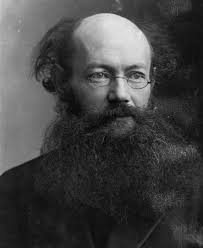
Peter Kropotkin
Born: December 9, 1842 in Moscow, Russian
Empire
Died: February 8, 1921 in Dmitrov, Russian SFSR
Schools: Anarchism, Communism
Main interests: Politics, Sociology, Labor,
Economics, Agriculture, Evolution, Geography,
Literature, Science, History, Ethics
Influences: Bakunin, Darwin, Freud, Karl Kessler,
Marx, Nietzsche, Proudhon, Friedrich Engels,
Charles Fourier, William Godwin, Rousseau,
Louis Blanc
Influenced: Alexander Berkman, Wilde, Errico
Malatesta, Tolstoy, Kafka, Nestor Makhno,
Rudolf Rocker, Shūsui Kōtoku, L. Susan Brown,
Colin Ward, Luigi Galleani, E. Goldman, George
Woodcock, Murray Bookchin, Bob Black, Zizek,
Chomsky, Stephen Jay Gould, Maria Nikiforova,
Ricardo F. Magón, T. Fotopoulos, Herbert Read
From Wikipedia
Kropotkin was a Russian anarchist and geographer known as a proponent of anarchist communism…. He was imprisoned for his activism in 1874 and managed to escape two years later. He spent the next 41 years in exile in Switzerland, France (where he was imprisoned for almost four years), and England. While in exile, he gave lectures and published widely on anarchism and geography. Kropotkin returned to Russia after the Russian Revolution in 1917, but he was disappointed by the Bolshevik state.
Introductory Comments
Few revolutionaries have had a less likely résumé. Kropotkin was born in 1842 into one of Russia's oldest princely families, whose estates were worked by serfs. As a star pupil at the elite Corps of Pages, he served as personal page to Tsar Alexander II. Any sensible forecast would have ended his career as a general or a provincial governor, bemedaled and comfortably loyal. Instead he became the leading theorist of anarchist communism, a man who wanted to abolish not just the tsar but the state itself.
The road away from privilege began at home. Even as a boy, Kropotkin was troubled by the cruelty of serfdom on his family's estates. At court he saw the other end of the system: splendor, vanity, ambition, and a striking indifference to the people who paid for it all. So when the time came to choose a posting, he passed over the fashionable Guards regiments and asked for an obscure Cossack regiment in Siberia. There he spent five years getting an education no university could offer. In a land of brutal winters and scarce resources, he watched peasants, Cossacks, and indigenous peoples survive not by elbowing one another aside but by pooling their efforts. He also watched well-meant reforms from St. Petersburg sink under official paperwork, while villagers quietly managed their own affairs. A few years later, those lessons hardened into anarchism. Who needs a state when people can organize their lives perfectly well on their own, thank you?
Some of Kropotkin's Key Positions
Communism, in which goods are held in common and distributed according to need, is the most just economic arrangement. But it must be anarchist communism, not state communism. A centralized government that takes control of the economy only replaces one master with another. An egalitarian economy requires an equally egalitarian society, built on federations of self-governing communities and worker-run enterprises.
The goal is not a better state but no state at all. Abolishing government need not lead to chaos, because order can grow from free agreement and cooperation rather than from coercion. Anarchism best expresses human freedom and dignity.
Critics who say such a society defies human nature, because Darwinian "survival of the fittest" makes competition the law of life, misread the evidence. Across the animal world and throughout human history, mutual aid is at least as important a factor in evolution as mutual struggle. The species that cooperate best generally survive and flourish best.
The decisive struggle is less between members of the same species than against harsh natural conditions, and cooperation is usually the best way to wage it. Mutual aid means mutual strength; mutual protection means mutual survival. Over time, these same cooperative habits produce more humane societies, more advanced cultures, and the foundations of morality itself.
Place in the History of Ideas
Kropotkin's Place in History of Ideas
E. H. Carr: It is difficult... to avoid the feeling that in this mild latter-day anarchism of Kropot- kin something has been lost of that fierce dy- namic of revolt which animated the anarchism of Bakunin. Bakunin's indignation at the wick- edness of the tyrant was no doubt accompa- nied by a naive faith in the constructive capac- ity and untutored goodness of the masses. In Kropotkin this faith has got mixed up with the Victorian belief in the inevitability of progress. His anarchism, no less than Marx's communism, claimed to have a scientific foundation. It was "more than a mere mode of action or a mere conception of a free society;" it was "part of a philosophy, natural and social," and "must be treated by the same methods as [the] sciences."
Kirkpatrick Sale: … Kropotkin was able to move away from the absurdist limitations of individu- al anarchism and no-laws anarchism that had flourished during this period and provide in- stead a vision of communal anarchism, follow- ing the models of independent cooperative communities he discovered while developing his theory of mutual aid. It was an anarchism that opposed centralized government and state-level laws as traditional anarchism did, but understood that at a certain small scale, communities and communes and co-ops could flourish and provide humans with a rich materi- al life and wide areas of liberty without central- ized control.
Random Thoughts on Kropotkin
Kropotkin liked to say that his quarrel was not with Darwin, only with Darwin's louder disciples. Darwin himself, he pointed out, had noticed that sociable animals often thrive. It was popularizers like Thomas Huxley who turned nature into a gladiators' show. Against them, Kropotkin insisted that mutual aid matters at least as much as mutual struggle in the success of species, humans included. So who won? More than a century later, the honest answer is neither side, or both. Natural selection rewards organisms that outcompete their rivals, but it also rewards cooperation whenever cooperating helps them survive and reproduce.
Within a species, cooperation arises through kin selection (helping relatives who share your genes) and reciprocal altruism (you scratch my back, I'll scratch yours). Between species, it appears as mutualism, partnerships that benefit both sides: bees and flowers, cleaner fish and the larger fish they groom. The liveliest dispute concerns groups. E. O. Wilson, late in his career, defended multilevel selection: within a group, selfish individuals beat cooperators, but between groups, cooperative groups win. Critics such as Dawkins and Pinker reply that selection on genes and individuals explains it all. Kropotkin would feel most at home with Wilson, though even Wilson would ask him for a tighter mechanism. In short, evolution is neither all boxing match nor all hippie commune. It is more like an awkward dance: sometimes stepping on toes, sometimes moving in harmony.
Influences
Kropotkin was influenced by: Bakunin, Darwin, Engels, Fourier, Freud, Godwin, Herzen, Marx, Mill, Nietzsche, Proudhon, Rousseau
Kropotkin influenced: Berkman, A., Bookchin, M., Chomsky, Goldman, Gould, S.J., Kafka, Kotoku, Shusui, Makhno, N., Malatesta, E., Read, Herbert, Rocker, Rudolf, Tolstoy, Ward, Colin, Zizek
Similar and opposing positions
Thinkers with similar positions:
- Bakunin (To be free, every form of hierarchical authority must be rejected.)
- Godwin (Government by its very nature counteracts creative & original thinking.)
- Goldman (Anarchism is the liberation from oppression of govt. & religion.)
- Kafka (Law is often no more than the pure, immoral force of domination.)
- Proudhon (All forms of absolutisms are evil: government, capitalism & religion.)
- Pythagoras (All possessions should be in common among friends.)
- Stirner (All hierarchical associations, like church and state, are oppressive.)
- Veblen (The leisure class is addicted to wasteful and conspicuous consumption.)
Thinkers with opposing positions:
- Burke (The idea of the overthrowing government is horrible and dangerous.)
- Carlyle (The history of the world is but the biography of great men.)
- Cicero (Liberty is the power to do that which is permitted by law.)
- Fourier (What's needed to fix social injustice isn't revolution, but cooperation)
- Herzen (Revolutions often end up just replacing one dictatorship with another.)
- Lukács (Commmunism should lead to the dictatorship of the proletariate.)
- Smith, Adam (The common interest requires each seek economic self-interest)
- Tolstoy (Though anarchism is a noble cause, violent revolution is terrible.)
What others said about Kropotkin
- Abraham Heyn: … the purest and most upright apostle of individualism… the righteous man (tsadik) of the new world… a pure and crystalline soul.
- Anna Strunsky: A scientist, humanitarian and of royal birth, Kropotkin is a genius of the age; not only does his colossal intellect cause him to stand in bold relief, but his personality is one of indescribable and unduplicated power.
- E. H. Carr: [Kropotkin believed], in contradiction to the Darwinian theory of progress through the struggle for existence, that animal life, as well as primitive human societies, survived not through processes of mutual destruction but through processes of cooperation. Towards this conception human society was constantly and continuously evolving.
- S. J. Gould: Kropotkin did not deny the competitive form of struggle, but he argued that the cooperative style had been underemphasized and must balance or even predominate over competition in considering nature as a whole.
- Wilde: Two of the most perfect lives I have come across in my own experience are the lives of Verlaine and of Prince Kropotkin….
- Errico Malatesta: [Kropotkin was not] a real man of science; [he lacked] the capacity to forget his desires and preconceptions in order to observe the facts with an impassive objectivity.
- Stephen Jay Gould: We must shed the old stereotype of anarchists as bearded bomb throwers.... Kropotkin was a genial man, almost saintly according to some, who promoted a vision of small communities setting their own standards by consensus for the benefit of all, thereby eliminating the need for most functions of a central government.
- Alexander Berkman: [Kropotkin believed that] the heart of the Russian masses was uncorrupted and they would rally themselves to a clear understanding of the evil of the Dictatorship and of Bolshevik tyranny.
Schools: Anarchism, Atheism
Main interests: Agriculture, Botany, Commerce, Community, Economics, Equality, Ethics, Evolution, Geography, History, Labor, Law, Literature, Political Activism, Politics, Science, Social Philosophy, Social Theory
Kropotkin's answers to philosophical questions
Economics
No necessary link exists between labor & the value of commodities. Things should simply be distributed for the common good.
Property is the cause of most social injustice: Those with property do all they can to deprive others of propety.
"The means of production being the collective work of humanity, the product should be the collective property of the race."
Education
"Not only are we taught a mass of rubbish, but what's not rubbish is taught so as to make us waste as much time as possible."
Ethics
"[W]e can affirm that in the ethical progress of man, mutual support - not mutual struggle - has had the leading part."
Law
"The law is an adroit mixture of customs... beneficial to society..., and others that are of advantage to [only] a ruling minority."
"The law has no claim to human respect. It has no civilizing mission; its only purpose is to protect exploitation."
Laws "that are of advantage to a ruling minority, but harmful to the masses of men" are particularly egregious.
Current laws have nothing to do with justice. They in many ways place us "every day in opposition to the law of conscience."
"... the rights of man are respected only so long as no one tries to use them against the priveleged classes."
Nature
Nature teaches us the vital importance of mutual aid, which "is as much a law of animal life as mutual struggle."
Political Philosophy
"The origin of the state [lies] in the fact that it works in favor of the propertied minority against the propertyless."
Social harmony can result from an equilibrium between a multitude of forces & influences. It requires no government at all.
Though peaceful change is always to be preferred, there are times when injustice is so entrenched, revolution is necessary.
Society
"All... progress in the past... and intellectual improvement of the human race is due to the practice of mutual aid...."