Murray Rothbard (1926 - 1995)
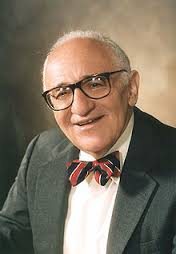
Open Rothbard's interactive page (graphs of influences, similar and opposing positions, and quotes)
Background
Murray Rothbard
Born: March 2, 1926 in Bronx, New York City
Died: January 7, 1995 (aged 68) in New York City
School: Austrian School
Interests: Economics, politics, political activism
Influences: Locke, Ludwig von Mises, Ayn Rand,
Milton Friedman, Friedrich Hayek, Albert Jay
Nock, H.L. Mencken, Lysander Spooner, Harry
Elmer Barnes, Frank Chodorov, Aquinas, Joseph
Schumpeter, Jean-Baptiste Say, Carl Menger,
Plato, Aristotle, William Graham Sumner,
Herbert Spencer, Franz Oppenheimer, John C.
Calhoun, Frédéric Bastiat, Adam Smith, Thomas
Kuhn, Edmund Burke, Benjamin Tucker
Influenced: Ron Paul, Walter Block, Joseph
Sobran, Lew Rockwell, Thomas E. Woods, Jr.,
Hans-Hermann Hoppe, Roderick T. Long, Gary
North, Joseph Salerno, Samuel Edward Konkin
III, Rand Paul, Robert Nozick, Mark Thornton
From Wikipedia
Rothbard was a central figure in the 20th-century American libertarian movement and a founder... of anarcho-capitalism…. Rothbard argued that all services provided by the "monopoly system of the corporate state" could be provided more efficient- ly by the private sector and wrote that the state is "the organization of robbery systematized and writ large." He called fractional-reserve banking a form of fraud and opposed central banking. He… opposed all military, political, and economic interventionism in the affairs of other nations.
Introductory Comments
Rothbard's vision was to take liberty to its logi- cal terminus and then keep walking. Building on the Austrian economic tradition of Ludwig von Mises, Rothbard's anarcho-capitalism imagines a society with no state at all - no tax collector, no monopoly courts, no standing army - just individuals, voluntary exchange, and private property defended by competing protection agencies and adjudicated by private arbitrators. His anarcho-capitalism imagines society not as a political commonwealth ruled from above, but as a vast web of free agreements, private property, and market competition, where order emerges not from command but from consent. Where classical liberals wanted to chain the Leviathan, Rothbard wanted to dissolve it in the acid bath of the free market.
In explaining his anarcho-capitalism, Rothbard wore two different hats. As spokeman for prax- eology, he laid out a value-free economic sci- ence: starting from the axiom that humans act purposefully, it deduces what will happen when, say, a government imposes a price ceil- ing - shortages, queues, black markets - without ever saying whether that's good or bad. But Rothbard also laid out a separate natural-rights argument that coercion is unjust, full stop. Praxeology tells you the rent control will cause a housing shortage; ethics tells you it's also theft. Rothbard wore both hats with gusto - but never, he insisted, at the same time.
Some of Rothbard's Key Positions
Because we are purposive and rational animals, our economic decisions can be logically and objectively analyzed. And because our econom- ic decisions can be logically and objectively ana- lyzed, economic laws are akin to geometric axioms. That is, they are fundamental, self-evident and unchanging.
And this is why the current "scientific" ap- proach to economics is so wrongheaded: Since we're not rats in a maze, we need not - and should not - rely on empirical studies in our economic analysis. Instead, we should use those economic laws or axioms to draw logical conclusions about our economic behavior.
And once we trace the logic of economic laws or axioms to draw logical conclusions, we see that government meddling in economic choices is unnecessary and harmful. In the intricate but orderly play of the market, both individuals and society prosper most when voluntary decisions are left undisturbed.
Indeed, we would do even better if there were no government at all. In an anarcho-capitalist society, private property would be upheld by private protection agencies, which compete with each other in a free market and which provide consumers both protective and judicial services. And thus, anarchism in practice "is not really anarchism at all."
Place in the History of Ideas
Rothbard's Place in History of Ideas
Lew Rockwell: Murray N. Rothbard was just one man with a typewriter, but he inspired a world-wide renewal in the scholarship of liberty. During 45 years of research and writing, in 25 books and thousands of articles, he battled every destructive trend in this century - socialism, statism, relativism, and scientism - and awakened a passion for freedom in thousands of scholars, journalists, and activists.
David Gordon: As [Rothbard] deepened his understanding of laissez-faire economics, he confronted a dilemma. The arguments for market provision of goods and services applied across the board. If so, should not even protec- tion and defense be offered on the market rather than supplied by a coercive monopoly? Rothbard realized that he would either have to abandon laissez-faire or embrace individualist anarchy. The choice... was not difficult.
Roderick Long: It may come as a surprise to learn that for Rothbard the New Left's most "crucial contribution to both ends and means… is its concept of 'participatory democracy.'" … This may seem less surprising once one realizes that for Rothbard the free market is the fullest realization of participatory democracy.… The political appeal of participatory democracy for Rothbard was its requirement of decentraliza- tion, and its rejection of a layer of political "representatives" above the people.
Random Thoughts on Rothbard
Hayek, though himself no fan of big govern- ment, thought Rothbard's anarcho-capitalism rested on a dangerous illusion. Law, Hayek ar- gued, is not simply another service that com- peting private agencies can provide à la carte. It is the framework within which all other ex- changes take place - the shared grammar that makes economic life intelligible. Without a sovereign legal order providing stable, predict- able, universally binding rules, Rothbard's com- peting protection agencies, each enforcing their own rules, would produce not spontaneous or- der but something closer to a protection racket.
Nozick delivered perhaps the sharpest internal critique of Rothbard's anarcho-capitalism: even if one begins from libertarian premises, compet- ing protection agencies would naturlly consoli-date into a dominant agency that effectively becomes a minimal state - not by conquest, but by an invisible-hand process as dominant pro- tection agencies gradually consolidated their monopoly on force simply by being the most efficient at its job. In that sense, anarcho-capi-talism may contain the seed of the very state it rejects. And even if Nozick is wrong and private agencies somehow stayed plural and stable, a deeper problem remains: they'd answer to shareholders and paying customers, not to citizens. And a society policed by firms you can't hold democratically accountable starts to look less like freedom and more like feudalism.
Influences
Rothbard was influenced by: Aquinas, Aristotle, Burke, Chodorov, F., Friedman, Hayek, Kuhn, Locke, Mencken, Menger, Carl, Mises, Nock, Albert J., Plato, Rand, Say, Jean-B., Smith, Adam, Spencer, Sumner
Rothbard influenced: Block, Walter, Hoppe, H., North, Gary, Nozick, Paul, Rand, Paul, Ron, Sobran, Joseph, Woods, T.
Similar and opposing positions
Thinkers with similar positions:
- Godwin (Government by its very nature counteracts creative & original thinking.)
- Goldman (Anarchism is the liberation from oppression of govt. & religion.)
- Mises (A priori reason, not empirical & statistical analysis, explains economics.)
- Nozick (No laws should limit people's consensual acts in economic matters.)
- Proudhon (All forms of absolutisms are evil: government, capitalism & religion.)
- Rand (Rights are best secured by minimal state limited to narrow functions.)
- Ricardo (The economic value of a good is based on the work that went into it.)
- Smith, Adam (Govt. must be very careful when interfering with the economy.)
Thinkers with opposing positions:
- Bentham (Govt. should play an assertive role in improving general welfare.)
- Condorcet (Enlightenment principles can lead us toward the perfect society.)
- Friedman (Empirical, statistical analysis, not a priori reason, explains economics.)
- George, Henry (The burden of taxes should rest on landowners, not workers.)
- Keynes (Government has an important role in maintaining a good economy.)
- Ortega (Modern capitalism has demoralized humanity & weakened morality.)
- Rawls (It's useful to see govt. as a social contract conceived in a state of nature.)
- Shaw (Socialism can cure many of the abuses found in our modern economies.)
What others said about Rothbard
- Hans-Hermann Hoppe: There would be no anarcho-capitalist movement to speak of without Rothbard.
- Lew Rockwell: Rothbard was called [an enemy of the state] because he applied traditional standards of morality to government. If it is wrong for a person to demand your money or your life, it is also wrong for [the state] to do so.
- Roderick Long: … Rothbard also found the idea [of participatory democracy] appealing outside the narrowly political sphere…. And he praised "fascinating experiments in which workers are transformed into independent and equal entrepreneurs." Traditional "socialist" goals such as workers' control of industry, then, were apparently not anathema to Rothbard.
- Chomsky: [Rothbard's ideal society is] a world so full of hate that no human being would want to live in it.... First of all, it couldn't function for a second - and if it could, all you'd want to do is get out, or commit suicide or something.
- JoAnn Rothbard: He managed to make a living for 40 years without having to get up before noon. This was important to him.
- Lew Rockwell: He combined idealism with realism, scholarship with accessibility, and boundless curiosity with commitment to truth…. And he set all who knew him an example of how a man should live his life.
- Brad Spangler: It is my contention that Rothbardian anarcho-capitalism is misnamed because it is actually a variety of socialism, in that it offers an alternative understanding of existing capitalism (or any other variety of statism) as systematic theft from the lower classes and envisions a more just society without that oppression.
- David D. Friedman: He thought he was a great economist, but practically nobody within the profession agreed…. He was ignored because he held extreme pro-market views, which were ideologically unpopular in the academy.
Schools: Anarchism, Individualism, Libertarianism, Natural Law Theory
Main interests: Commerce, Economics, Equality, Ethics, Free/Unfree Will, History, Law, Political Activism, Political Philosophy, Politics, Wealth, Welfare State
Rothbard's answers to philosophical questions
Economics
Because we're rational animals, our economic decisions can be analyzed as a rational process based on self-evident axioms.
"[I]t is a happy fact that the maximization of the wealth of one person or group redounds to the benefit of all…."
Unrestrained capitalism is the only true form of capitalism: "Capitalism is the fullest expression of anarchism."
"There is one good thing about Marx: he was not a Keynesian."
Ethics
We should "develop a natural-law ethics based on nature rather than, or at least to supplement, ethics based on... revelation."
Law
"The natural law is... a profoundly 'radical' ethic, for it holds the existing status quo… up to the… unyielding light of reason."
Punishment should be purely and frankly retributive - a system of "a tooth (or two teeth) for a tooth."
Metaphysics
The law of causal determinism doesn't apply to human beings. All our thoughts & actions assume, at least implicitly, free will.
Nature
"Nature is simply the environment on earth…, and to treat it as a separate being in the image of man is sheer nonsense."
Political Philosophy
"The State is an inherently illegitimate institution of organized aggression, of organized… crime against its subjects...."
Governments aren't needed. With anarcho-capitalism, private companies can do all that governments currently do, but better.
"The State says that [we] may not take from another by force… [what] belongs to another. And yet the State… does just that."
In the complex but rational give & take of an economy, governmental interference leads only to a dumber & weaker economy.
Wars are justified only in support of freedom, such as the American Revolution and the South's war against Northern tyranny.
Freedom is the precondition "of all the other goods...: moral virtue, civilization, the arts and sciences, economic prosperity."
The state can't guarantee the rights of citizens when its very existence necessarily deprives citizens of some essential rights.
"Education in liberty is of course vital, but it is not enough; action must also be taken to roll back the State…."
Consenting adults not only be should left alone as to all sexual matters, they should be left alone as to all economic matters.
"The great fact of individual difference & variability (that is, inequality) is evident from the long record of human experience."
The state should not get invovled in general welfare, nor should it acknowledge any rights to basic needs, like health care.
"If each individual is unique, how else can he be made 'equal' to others than by destroying most of what is human in him…?"
Science
Insofar as our actions are rationally based on self-evident axioms, social sciences can proceed likewise - not unlike geometry.
Sex and Gender
The growth of the welfare state was due in large part to politically active spinsters who had too much time of their hands.
Society
All civil rights legislation, including the 1964 Civil Rights Act, violates libertarian principles and should therefore be repealed.