Bacon, Francis (1561 - 1626)
Open Bacon, Francis's interactive page (graphs of influences, similar and opposing positions, and quotes)
Background
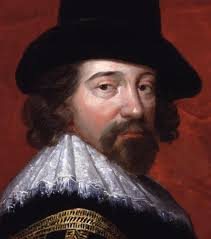
Francis Bacon
Born: 22 January 1561 in Strand, London,
England
Died: 9 April 1626 (aged 65) in Highgate,
Middlesex, England
Alma mater: Trinity College, Cambridge and
University of Poitiers
Era: English Renaissance, The Scientific
Revolution
Schools: Renaissance Philosophy, Empiricism
Main interests: Natural philosophy,
Philosophical logic
Influences: Plato, Aristotle, Cicero, Niccolò
Machiavelli, Michel de Montaigne, Vanoccio
Biringuccio, Bernard Palissy, Bernardino
Telesio, William Gilbert, Roger Bacon
Influenced: Thomas Hobbes, Isaac Newton, John
Locke, William Petty, Encyclopédistes, Basil
Montagu, Thomas Jefferson, Diderot
From Wikipedia
Bacon has been called the father of empiricism. He argued for the possibility of scientific knowl-edge based only upon inductive reasoning and careful observation of events in nature. He believed that science could be achieved by the use of a skeptical and methodical approach whereby scientists aim to avoid misleading them-selves.… [T]he general idea of the importance and possibility of a skeptical methodology makes Bacon one of the later founders of the scientific method.
Introductory Comments
Two of the greatest figures in the history of English law, Francis Bacon and Edward Coke were also lifelong enemies. They first crossed swords in the court of Elizabeth I. Bacon enjoyed the advantage of family connections, but Coke's sheer legal brilliance carried him swiftly into prominence. In 1594 the two fought bitterly over the vacant post of Attorney General. Coke won. In 1597 they fought over the hand of Lady Elizabeth Hatton, a wealthy young widow. Coke won again.
When James I took the throne, Bacon's fortunes improved. He was made Solicitor General in 1607 and Attorney General in 1613. Bacon used his rising power to help engineer Coke's downfall, pressing charges of misconduct that led, in 1616, to Coke's dismissal from the bench. Yet Bacon's growing sway over the king bred resentment among his peers. So it came as no surprise that in 1621, after Bacon had slid into debt, a parliamentary committee charged him with twenty-three counts of corruption - with Coke among his fiercest pursuers. The verdict: Bacon fined £40,000, stripped of office, and barred from Parliament for life. Coke, it seemed, had the last laugh.
Or did he? By freeing Bacon from the grind of public office, Coke inadvertently handed him the leisure to write - and it was the writing, not the politics, that won Bacon his lasting fame. Posterity, it turns out, awards the last laugh to whoever writes the better book.
Some of Francis Bacon's Key Positions
The potential of science is virtually unlimited. Though it advances slowly and by degrees, it can improve the human condition in countless practical ways and may one day grant powers now unimaginable.
But to unlock that potential, its practitioners must submit to a demanding discipline: the patient gathering of evidence joined to rigorous inductive reasoning. At the same time, these practitioners must also guard against the "Idols" - the habits, prejudices, and assumptions that distort human judgment.
This also rules out conclusions drawn from a priori argument alone. Only claims backed by at least some empirical evidence deserve consideration. Even Aristotle's formal and final causes fall away, for both carry the scent of metaphysics.
Genuine progress also requires that experiments be carefully designed to answer specific questions. They should permit objective measurement and, where relevant, distinguish clearly between positive and negative results.
The law, too, might be improved by inductive methods. The principles underlying unwritten custom can be discovered by examining how cases have actually been decided. Once set down in writing, the law could be administered more clearly and more fairly.
Place in the History of Ideas
Franics Bacon's Place in History of Ideas
Will Durant: His achievement was not the less great because it was indirect. His philosophical works, though little read now, "moved the intellects which moved the world." He made himself the eloquent voice of the optimism and resolution of the Renaissance. Never was any man so great a stimulus to other thinkers.... The whole tenor and career of British thought have followed the philosophy of Bacon. His tendency to conceive the world in Democritean mechani- cal terms gave to his secretary, Hobbes, the starting-point for a thorough-going material- ism; his inductive method gave to Locke the idea of an empirical psychology, bound by ob- servation and freed from theology and meta- physics; and his emphasis on "commodities" and "fruits" found formulation in Bentham's identification of the useful and the good. Wherever the spirit of control has overcome... resignation, Bacon's influence has been felt.
Peter Urbach: [Bacon] believed that theories should be advanced to explain whatever data were available in a particular domain. These theories should preferably concern the underlying physical, causal mechanisms and ought, in any case, to go beyond the data which generated them. They are then tested by drawing out new predictions, which, if verified in experience, may confirm the theory and may eventually render it certain, at least in the sense that it becomes very difficult to deny.
Random Thoughts on Franics Bacon
Believe so that you may understand. Augustine's counsel makes fine sense in a religious setting - but turn it toward science and it collapses. In science we hardly need urging to believe; we need urging to doubt. We need to distrust our homespun, intuitive pictures of the world. We need to challenge revered authorities - even one as towering as Aristotle. We need to question everything we take for granted.
This is harder than it sounds. As William James observed, belief is the default setting of our species - indeed, of every species. The aim of life is not truth but survival, and survival runs on a stock of confident beliefs. Doubt, then, cuts against the very grain of our nature.
Bacon knew this well. He saw it in the whole catalog of mental errors he traced to the four Idols of the Mind: the Idols of the Tribe (rooted in human nature), of the Cave (in the quirks of the individual), of the Marketplace (in the slippery imprecision of words), and of the Theater (in inherited dogmas and systems). The scientist, Bacon urged, must strip away what he thinks he knows and begin in doubt rather than belief - then observe patiently, devise experiments, keep records, hunt for patterns, and, where the evidence allows, draw conclusions. Or as Bacon himself put it: "If a man begin in certainties he shall end in doubts; but if he will be content to begin in doubts he shall end in certainties."
Influences
Bacon, Francis was influenced by: Aristotle, Bacon, Roger, Biringuccio, Cicero, Democritus, Drebbel, Empedocles, Gilbert, Machiavelli, Montaigne, Palissy, Parmenides, Plato, Telesio
Bacon, Francis influenced: Comte, Diderot, Hobbes, Hume, Jefferson, Kant, Locke, Mill, Montagu, Newton, Petty, Vico
Similar and opposing positions
Thinkers with similar positions:
- Al-Ghazali (Science is a separate discipline from other forms of thinking.)
- Avicenna (The pursuit of science is consistent with religious devotion.)
- Diderot (Enlightenment and the creation of a better world lie within our power.)
- Einstein (Epistemology without contact with science is an empty scheme.)
- Epicurus (Only believe what's tested thru direct observation and deduction.)
- Roger Bacon (Theories supplied by reason should be verified by sensory data.)
- Thales (Knowledge of nature springs only from careful study and reasoning.)
- Wittgenstein (Much confusion springs from the enchantment of language.)
Thinkers with opposing positions:
- Feyerabend (There is no universal methodological guidelines in science.)
- Goodman (There's no sharp divisions between art, science & normal experience)
- Humboldt, A. (In nature no single fact should be considered in isolation.)
- Kuhn (Careful observations in science are less important than concepts.)
- Kuhn (Science progresses unevenly thru a series of paradigm shifts in thinking.)
- Maistre (Authority in politics does not derive from reason, but from religion.)
- Marcel (Science & technology threaten to destroy the mystery of being.)
- Popper (Basic statements in science are not mere reports of passive sense data.)
- Rousseau ("Progress" in science & reason has not benefitted humankind.)
What others said about Bacon, Francis
- Izaak Walton: The great secretary of nature and all learning, Sir Francis Bacon.
- Jefferson: Bacon, Locke and Newton. I consider them as the three greatest men that have ever lived... and as having laid the foundation of those superstructures which have been raised in the Physical and Moral sciences.
- William Hepworth Dixon: Bacon's influence in the modern world is so great that every man who rides in a train, sends a telegram, follows a steam plough, sits in an easy chair, crosses the channel or the Atlantic, eats a good dinner, enjoys a beautiful garden, or undergoes a painless surgical operation, owes him something.
- Thomas Young: Bacon first taught the world the true method of the study of nature, and rescued science from that barbarism in which the followers of Aristotle, by a too servile imitation of their master, had involved it.
- Christopher Brooks: Bacon sees nature as an extremely subtle complexity, which affords all the energy of the [scientist] to disclose her secrets.
- Hugh Barr Nisbet: [Bacon was] supremely confident... that inductive methods can provide us with ultimate and infallible answers concerning the laws and nature of the universe.
- Huxley: To anyone who knows the business of investigation practically, Bacon's notion of establishing a company of investigators to work for "fruits," as if the pursuit of knowledge were a kind of mining operation and only required well-directed picks and shovels, seems very strange.
- Ernst Mayr: Inductivism had a great vogue in the eighteenth and early nineteenth centuries, but it is now clear that a purely inductive approach is quite sterile.
Schools: Christian Theology, Empiricism
Main interests: Beauty, Classics, Ethics, Friendship, Happiness, Immortality, Law, Logic, Love, Meteorology, Politics, Progress, Psychology, Science, Tragedy, Utopia, Virtue, Wealth, Wisdom
Bacon, Francis's answers to philosophical questions
Art and Aesthetics
"The job of the artist is always to deepen the mystery."
"The best part of beauty is that which no picture can express."
Education
Learning is not only in the interest of the individual, it is also a crucial tool in advancing social values and projects.
Epistemology
Reliable knowledge springs from induction - gathering particular instances in order to make generalized conclusions.
Human perception "is like a false mirror, which, receiving rays irregularly, distorts and discolors the nature of things."
The Idols of the Tribe (natural but often false perceptions) can't be avoided, but can be recognized & compensated for.
Science involves a slow & empirical process, but as it advances, the condition of man improves in many practical ways.
A priori speculations should be abandoned. The new sciences must be based only on the inductive method.
"The logic now in use serves rather to fix... the errors [of] commonly received notions than to help the search for truth."
Truth is gradually revealed through empirical evidence, guided by experiments that allow for negative instances.
Beliefs are of the Cave (uniquely ours) or of the Market (commonly accepted). Knowledge, unlike belief, requires evidence.
Ethics
"Seek first the virtues of the mind; and other things either will come, or will not be wanted."
"... whosoever in the frame of his nature and affections is unfit for friendship, he taketh... of the beast, [not] humanity."
"Death is a friend of ours; and he that is not ready to entertain him is not at home."
History
The approach to history varies according to its subject matter and audience: natural, civil, ecclesiastical, and literary.
Language
An inapt or confused use of words can obstruct clear thinking and lead people into accepting all sorts of absurdities.
The aim of rhetoric is to support reason, "not to oppress it." The discipline of rhetoric is not responsible for its misuse.
Words often lead to confusion either because they don't name real things or because they distort or badly define what's real.
Law
Laws are sometimes hidden. These unwritten laws can be discovered by examining the evidences of their applications.
"Judges must beware of hard constructions & strained inferences;... there is no worse torture than the torture of laws."
"In causes of life and death, judges ought... cast a severe eye upon the example, but a merciful eye upon the person."
Torture is a times justifiable, especially if it can help further an investigation of a threat to the state.
Metaphysics
Aristotle's formal and final causes play no role in science, which concerns itself only with material and efficient causes.
Philosophers should stop the vain pursuit of metaphysics and instead study the empirical world.
Philosophy
"Lastly, there are [false] Idols which have immigrated into men's minds from the various dogmas of philosophies...."
As long as philosophy acknowledges its subordination to theology, it can safely investigate a wide variety of matters.
Logic may play an important role in critical disputation, but it plays a minimal role in scientific discovery.
"Philosophy when superficially studied, excites doubt, when thoroughly explored, it dispels it."
Political Philosophy
"Above all things, good policy is to be used, that the treasure and moneys in a state, be not gathered into few hands."
Psychology
We can best understand the strange workings and battles of our emotions by reading the poets and the historians.
"Choose the life that is most useful, and habit will make it the most agreeable."
Religion and Theology
"Men fear death as children fear to go in the dark; and as that... fear in children is increased with tales, so is the other."
"I had rather believe all the Fables in... the Talmud and the Alcoran, than that this universal frame is without a Mind."
Faith reveals certain mysteries of God. However, reason can examine what faith reveals to make useful inferences.
"I had rather believe all the fables in the legends and the Talmud... than that this universal frame is without a mind."
"A little philosophy inclineth man's mind to atheism, but depth in philosophy bringeth men's minds about to religion...."
Science
Natural philosophy is both speculative (physics and metaphysics) and practical (mechanics and magic).
"Human knowledge and human power meet in one; for where the cause is not known the effect cannot be produced."
Science is basically a matter of induction: Science progresses through careful experiments and the listing of results.
Though science is based on induction, this induction is guided by experiments and an attention to negative instances.
The practical use or productivity of science determines not only its value but also its truth or validity.
Mathematics is a useful tool in physics, but physics is corrupted when math seeks to dominate it, rather than serve it.
"[B]y far the greatest obstacle to the progress of science… is found in this - that men despair and think things impossible."
"The real and legitimate goal of the sciences is the endowment of human life with new inventions and riches."
Sex and Gender
"He that hath wife and children hath given hostages to fortune; for they are impediments to great enterprises...."
Society
In science, understanding leads to power, and power to progress: "We cannot command Nature except by obeying her."
Idols of the Tribe (common beliefs) & Idols of the Theatre (philosophical beliefs) are often obstacles to progress & truth.
"Things alter for the worse spontaneously, if they be not altered for the better designedly."
The advancement of learning, especially scientific learning, is the force driving the general advancement of society.
"Man seeketh in society comfort, use and protection" and these are linked to wisdom of behavior, of business, and of state.