Jonathan Edwards (1703 - 1758)
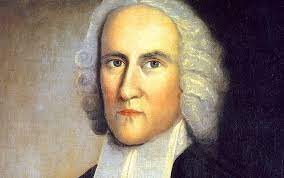
Open Edwards's interactive page (graphs of influences, similar and opposing positions, and quotes)
Background
Jonathan Edwards
Born: October 5, 1703 in East Windsor,
Connecticut Colony
Died: March 22, 1758 (aged 54) in Princeton,
Province of New Jersey
Occupations: Pastor, theologian, missionary
Notable works: Sinners in the Hands of an
Angry God, Religious Affections
Tradition or movement: Evangelical Reformed
(Puritan)
Main interests: Religion, Theology, Revivalism,
Freedom of the will, Metaphysics, Ethics,
Epistemology
Influences: Solomon Stoddard, John Locke, Isaac
Newton, George Whitefield, Malebranche,
David Brainerd, John Calvin
Influenced: Samuel Hopkins, Joseph Bellamy,
Jonathan Edwards Jr., Gideon Hawley,
Nathaniel William Taylor
From Wikipedia
Edwards was an American revivalist preacher, philosopher, and Congregationalist theologian. A leading figure of the American Enlightenment, Edwards is widely regarded as one of America's most important and original philosophical theolo- gians…. Recent studies have emphasized how thoroughly Edwards grounded his life's work on conceptions of beauty, harmony, and ethical aptness, and how central the Age of Enlighten- ment was to his mindset. Edwards played a critical role in shaping the First Great Awakening....
Introductory Comments
Edwards was America's first philosopher of the first rank, yet he is remembered chiefly for one sermon. The story goes like this. On a July morning in 1741 he rides to Enfield, Connecticut, a town that has so far shrugged off the revival sweeping its neighbors. He reads from his manuscript - by tradition in a level voice, with scarcely a gesture - and describes a God sickened by the sight of sinners, dangling them over the pit "much as one holds a spider, or some loathsome insect, over the fire." He lays out, in lurid detail, the eternal rotisserie awaiting them, unless they are among those God saves for no reason they can claim or earn. Before he can finish, the congregation is weeping and groaning and crying out to know what they must do. By the time Edwards finishes, the poor sinners are so undone by terror they can barely walk home.
Edwards was fascinated and aghast in equal measure by the evangelical wildfire that swept the colonies in the 1740s, a Great Awakening he did more than any other American to interpret and defend. Reserved minister and disciplined intellectual, he struggled to make sense of all the melodrama and histrionics. Part of him was glad to see a dry, moralizing pulpit trampled by passionate conviction. Another part suspected the outbursts might be counterfeit - not merely theatrical pretense, but something subtler and worse: sincere self-deception, or the devil's own imitation of grace. How is one to know the difference? [See Random Thoughts.]
Some of Edwards' Key Positions
The saving power of faith springs not from human will but from God's "mere and arbitrary grace" - arbitrary not in the sense of capricious, but in the sense of unowed, answering to nothing outside God himself. He chooses some for eternal life and passes others by. Some think this a horrible doctrine. Yet once the heart consents to it, it becomes "exceeding pleasant, bright, and sweet."
However, this doctrine of arbitrary grace must not lead us into religious passivity. On the contrary, it should make us zealous in our evangelicalism. For though salvation can come only through God's grace, we can either resist this grace or yield to it. We can either keep God at a distance or let Him into our hearts..
To help us accept God's grace, religious revivals can play a remarkable - at times miraculous - role, for both the individual and the community. Though some clergy condemn these revivals as excessively emotional, we, as emotional creatures, often require passionate appeals to overcome our resistance to God's grace.
Missionary work also has its place. Though we should be strict as to who are to be admitted for communion, we should remember that all humans have souls and deserve to hear God's word. And even when such efforts do not save souls, they may at least improve morals - no small benefit, though never to be mistaken for true virtue.
Place in the History of Ideas
Edwards' Place in History of Ideas
V. L. Parrington: Never had the traditional [Calvinist] theology been so sorely in need of a champion as at the beginning of the second quarter of the eighteenth century; and such a champion God raised up - many devout Calvin- ists believed - in the person of Jonathan Edwards. Armed at all points - a theologian equipped with the keenest dialectics, a meta- physician endowed with a brilliantly speculative mind, a psychologist competent to deal with the subtlest phenomena of the sick soul - here was a man who might be counted on to justify the ancient dogmas to the troubled churches of New England.
Robert C. Whittemore: Completely unappreci- ated by his own generation, Edwards is today generally recognized at the greatest theologian of the spiritual life America has yet produced. [Perry] Miller has called the Religious Affections "the most profound exploration of the religious psychology in all American literature," and if it is not quite that, it is still a landmark in the history of American theology. The question it seeks to answer is fundamental to every faith in any age: "What is the nature of true religion? and wherein do lie the distinguishing notes of that virtue and holiness, that is acceptable in the sight of God?" Edwards'reply is as sweeping as it is simple: "True religion, in great part, consists in holy affections."... In these "fervent exercises of the heart."...
Random Thoughts on Edwards
Edwards was a man of formidable intellect - a metaphysician who read Newton and Locke in his teens and wrote a treatise on the will that still gives philosophers trouble - devoting that intellect to defending the sobbing, fainting, unrestrained religion of the revival. Sharper still: he used his mind to argue that the mind is not where the deepest truths land. The paradox begins to dissolve once we see what Edwards meant by "affections." Affections are not mere moods or feelings that wash over us; they are the soul's inclinations in vigorous exercise - the will itself in motion, leaning toward or away. On this view the old partition between cold reason and hot passion is a fiction. Nobody grasps that honey is sweet without tasting it, and nobody grasps the loveliness of God without relishing it.
Which leaves the hard question: how to tell true affections from a strange social contagion or some demonic funny business? Edwards's underwriter here is the Holy Spirit, who dwells within as a new principle, giving what Edwards called a sense of the heart - a capacity to perceive divine beauty as such. Fine, but that is a claim about the invisible. How does anyone check it? Here Edwards is far more bracing than his reputation suggests. Tears, tremblings, fluent talk of Scripture - none of these proves anything, one way or the other. The test is how a person lives, over years, under pressure. The great defender of religious feeling ends by saying that feeling cannot certify itself. Watch the life.
Influences
Edwards was influenced by: Brainerd, D., Calvin, Locke, Malebranche, Newton, Paul of Tarsus, Stoddard, S., Whitefield
Edwards influenced: Bellamy, J., Dickinson, Edwards, J. Jr., Hawley, G., Hopkins, S., Taylor, N.W.
Similar and opposing positions
Thinkers with similar positions:
- Al-Ghazali (Causation is due to God, not to the interactions of matter.)
- Aquinas (Philosophy & revelation are different means of reaching same truth.)
- Berkeley (God alone is the only real cause at work in the world - not matter.)
- Malebranche (Mind & body are not causally linked. All causuality is due to God.)
- Newton (Intricate design we see in nature proves existence of Great Designer)
- Schleiermacher (Religious experience involves sense of absolute dependence.)
- Spinoza (A true love must be a love of all being - everyone and everything.)
Thinkers with opposing positions:
- Berlin (Moral values may be equally valid yet also incompatible at times.)
- Calvin (The only way to obtain knowledge of God is to study scripture.)
- Darwin (Intricate design in the natural world can be explained thru science.)
- Democritus (Everything is the result of natural laws related to matter & motion)
- Descartes (A radical metaphysical split exists between realms of mind & matter)
- Galileo (The Bible should be followed for its moral teaching, not cosmology.)
- Lucretius (Philosophy aims at liberating man from the fear of death & the gods.)
- Newman (Emphasis on emotional conversion undermines role of the church.)
- Seneca (We should be free of unruly emotions, as they disturb judgment.)
What others said about Edwards
- James Wm. McClendon Jr.: Jonathan Edwards is preeminently a theologian of the heart and of the affections....
- Neil Postman: Edwards was one of the most brilliant and creative minds ever produced by America. His contribution to aesthetic theory was almost as important as his contribution to theology.
- V. L. Parrington: His intellectual and spiritual life was molded by a God-consciousness as passionate as that of Spinoza.... [H]e must build a philosophical universe about the Godhood, justifying his mysticism by a metaphysical idealism. He must examine critically the foundations of his creed and establish his theology upon philosophy.
- John E. Smith: By thus meditating between Berkeley on the one hand and Locke, Descartes, and Hobbes on the other, the young Edwards hoped to rescue Christianity from the deadweight of rationalism and... skepticism.
- Douglas A. Sweeney: Edwards shows us that true religion is primarily a matter of holy affections.
- George Whitefield: ... wonderful Satisfaction in being at the House of Mr. Edwards. He is a Son himself, an hath a Daughter of Abraham for his wife. A sweeter Couple I have not yet seen.
- David F. Wells: As Jonathan Edwards observed a long time ago, we act on our strongest motive. If our strongest motive, our deepest desire, is to know God, it will generate the discipline that we need to pursue this.... If this is not our strongest motive, we will find ourselves with multiple, alternative, and competing foci. These will inevitably distract us.
- Kevin Roose: If... Edwards had decided to become a blacksmith or a pastry chef instead of leading the Great Awakening, would evangelical Christianity still have become America’s dominant religion? I have a hard time thinking so.
Schools: Augustinianism, Christian Theology, Determinism, Divine Illumination, Metaphysical Idealism, Occasionalism, Voluntarism
Main interests: Art and Aesthetics, Causality, Consciousness, Epistemology, Ethics, Faith, Free/Unfree Will, Happiness, Immortality, Metaphysics, Religion, Salvation, Science, Theology
Edwards's answers to philosophical questions
Art and Aesthetics
Beauty is primarily a sign of God's benevolence. Secondary beauty is a mere image & consists in symmetry, harmony, etc.
Education
"One of these grand defects of our education system is that children are habituated to learning without understanding."
Epistemology
"Truth is the agreement of our ideas with the ideas of God."
Ethics
We are capable - through God's grace - of pure benevolence, & only acts springing from benevolence are genuinely virtuous.
Benevolence toward particular people or groups is most virtuous when "subordinate to [a] benevolence to Being in general."
"A man of a right spirit is not a man of narrow and private views, but is greatly... concerned for the good of the community…."
"True liberty consists only in the power of doing what we ought… and in not being constrained to do what we ought not…."
Metaphysics
All things are ultimately ideas, and all ideas ultimately spring from and exist in God. God is everything and everywhere.
God "is the sum of all being, and there is no being without his being; all things are in him and he in all."
People are free when they act solely upon their own desires - even though these desires are ultimately determined by God.
What people consider a material body can actually be resolved into the nonmaterial ideas of color and resistance.
All seeming interactions in the temporal world are in fact mental events meticulously coordinated by God.
In creating all our ideas & perceptions, God also creates all perceived individuation - all the ways we determine identity.
Nature
"There are also many things wherein we may behold [God's] awful majesty: in the sun..., in comets, in thunder...."
"God created man for nothing else but happiness. He created him only that He might communicate happiness to him."
"Surely there is something in the unruffled calm of nature that overawes our little anxieties and doubts…."
Psychology
"God is the highest good" and "the only happiness with which our souls can be satisfied."
Religion and Theology
"He that has doctrinal knowledge and speculation only, without affection, never is engaged in the business of religion."
"God’s absolute sovereignty… is what my mind seems to rest assured of, as much as of anything that I see with my eyes."
"Reason is the God-given means for discovering the truth that God discloses, whether in his world or his Word."
God's role now is mainly as a judge. Indeed, he "is dreadfully provoked; his wrath towards you burns like fire...."
"I felt God at the first appearance of a thunder-storm." And I heard "the majestic and awful voice of God’s thunder."
The crucial power of religious faith does not spring from our human will, but form God's "mere and arbitrary grace."
To declare God's perfections in prayer and ritual does not incline God further towards us. But it affects our own hearts.
Jesus taught us the value of love, but "a truly Christian love, either to God or men, is a humble broken-hearted love."
Sex and Gender
God gave men and women different but complementary roles and responsibilities in marital, family and religious life.