Pythagoras (c. 570 BC - c. 495 BC)
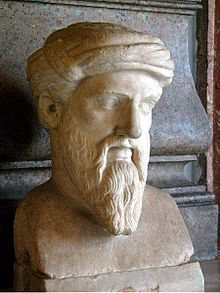
Open Pythagoras's interactive page (graphs of influences, similar and opposing positions, and quotes)
Background
Pythagoras
Born: c. 570 BC in Samos (a Greek island in the
eastern Aegean Sea)
Died: c. 495 BC (aged around 75) in Metapontum
(an important city of Magna Graecia, now Italy)
Era: Ancient philosophy
Region: Western philosophy
School: Pythagoreanism
Main interests: Metaphysics, Music, Ethics,
Mathematics, Politics, Mysticism, Cosmology
Notable ideas: Musica universalis (Music of the
Spheres), Pythagorean tuning, Pythagorean
theorem
Influences: Thales, Anaximander, Pherecydes,
Themistoclea
Influenced: Philolaus, Alcmaeon, Parmenides,
Plato, Aristotle, Euclid, Empedocles, Hippasus,
Heraclitus, Kepler, Leonardo da Vinci
From Wikipedia
Pythagoras was an ancient Ionian Greek philosopher and the eponymous founder of Pythagoreanism. His political and religious teachings were well known in Magna Graecia and influenced the philosophies of Plato, Aristotle, and, through them, the West in general….. The teaching most securely identified with Pythagoras is metempsychosis, or the "transmigration of souls," which holds that every soul is immortal and, upon death, enters into a new body. He may have also devised the doctrine of the [Music of the Spheres]….
Introductory Comments
One of the few things historians agree on about Pythagoras is that he led a semi-religious community in southern Italy built around a near-mystical devotion to mathematics. Numbers themselves - not as tools for counting sheep or calculating debts, but as objects of pure contemplation - seem to have carried genuine spiritual significance for Pythagoreans. And though what Pythagoras believed about the gods remains unclear, his teachings on the soul, purification, and cosmic order suggest a worldview that was religious in some sense, even if not in a conventionally Greek one.
We know even less about the actual practices of the Pythagoreans, though remarks by Aristotle are suggestive. Picture, if you will, a mon- astery for math nerds: "monks" strolling about in long robes, muttering geometrical theorems to themselves, and observing strict rules concerning diet, cleanliness, and abstinence. And at night (though here our imagination may be getting the better of us), they spin in circles until they become so intoxicated by the music of the spheres that they collapse to the floor one by one. Why stop there? Perhaps, once the room stops spinning, these math nerds dust themselves off and spend the rest of the evening doing what nerds have always done: playing games (possibly with the beans they were forbidden to eat) and talking an impressive amount of highly informed nonsense.
Some of Pythagoras's Key Positions
Mathematics is not merely a useful tool - it is the most perfect form of knowledge, because the entire universe is arranged according to numbers and the relationships between them. Indeed, all things are made of numbers.
To study geometry and mathematics is there- fore to learn the secrets of the universe and to participate in a discipline that is at once rational and spiritual. This is why the serious student of mathematics should live in a community that reflects those same qualities: one in which possessions are shared and rules of purity and self-denial are observed.
Purity matters for a specific reason: the soul, upon death, passes into a new body - possibly that of another animal. One's life must therefore be kept pure if the soul is to ascend to a better existence in its next incarnation. This doctrine of transmigration also implies that all living things possess souls and are, in a meaningful sense, our kin. The universe itself is kin to us: like us, it is governed by number.
And if one is sufficiently attuned, one can actually hear it. The planets and stars move according to mathematical ratios, and in doing so they produce a kind of cosmic symphony. Ordinary people cannot perceive the Music of the Spheres - but those with the purest hearts and clearest minds can.
Place in the History of Ideas
Pythagoras's Place in History of Ideas
Russell: The combination of mathematics and theology, which began with Pythagoras, characterized religious philosophy in Greece, in the Middle Ages, and in modern times down to Kant. Orphism before Pythagoras was analogous to Asiatic mystery religions. But in Plato, Saint Augustine, Thomas Aquinas, Descartes, Spinoza, and Kant there is an intimate blending of religion and reasoning, of moral aspiration with logical admiration of what is timeless, which comes from Pythagoras, and distinguishes the intellectualized theology of Europe from the more straightforward mysticism of Asia.... I do not know of any other man who has been as influential as he was in the sphere of thought…. The whole conception of an eternal world, revealed to the intellect but not to the senses, is derived from him.
Aristotle: [Followers of Pythagoras] thought they found in numbers, more than in fire, earth, or water, many resemblances to things which are and become; thus such and such an attribute of numbers is justice, another is soul and mind, another is opportunity, and so on.... Since, then, all other things seemed in their whole nature to be assimilated to numbers, while numbers seemed to be the first things in the whole of nature, they supposed the elements of numbers to be the elements of all things, and the whole heaven to be a musical scale and a number.
Random Thoughts on Pythagoras
Pythagoras, Descartes, Pascal, Leibniz, Frege, Peirce, Russell, Whitehead, Quine: Why are so many major philosophers also mathematicians? And why have so many mystics attributed spiritual significance to numbers - Pythagoras again, along with the kabbalists and countless numerologists within the world's religions? Is it because, as Russell suggests, mathematics gives rise to "the whole conception of an eternal world, revealed to the intellect but not to the senses"? Or, for the mystics, an eternal world revealed to the spirit rather than the senses?
Perhaps an even more interesting question, however, is: why does the abstract nature of mathematics lead some people toward philosophy and others toward mysticism? Why does one mathematician become fascinated by logic, language, and epistemology, while another senses a cosmic harmony or divine order? Einstein seems to have been drawn in both directions. "The most incomprehensible thing about the universe," he famously remarked, "is that it is comprehensible." Part of what makes that statement so interesting is that it expresses both a philosophical question and a spiritual mystery. Why should the universe be governed by mathematical laws that are intelligible to creatures such as ourselves? Why should we and the universe speak the same language (E = mc²)? Pythagoras seems to have asked the same sort of questions 2500 years ago.
Influences
Pythagoras was influenced by: Anaximander, Pherecydes, Thales, Themistoclea
Pythagoras influenced: Alcmaeon, Aristotle, Empedocles, Euclid, Heraclitus, Hippasus, Iamblichus, Kepler, Leonardo, Parmenides, Philolaus, Plato
Similar and opposing positions
Thinkers with similar positions:
- Anaximander (The cosmos is ordered, harmonious and rational.)
- Einstein (The sense of wonder at the mysteries of the universe is religious.)
- Empedocles (Souls can be reincarnated from humans into animals & vice versa.)
- Engels (From each according to his ability, to each according to his needs.)
- Newton (Mathematics is key to understanding actual workings of this world.)
- Plato (Ontology should be modeled on the discipline of mathematics.)
- Russell (Math provides an abstract structure to our understanding of the world.)
- Thales (The material workings of nature also have an inherent spiritual aspect.)
Thinkers with opposing positions:
- Goethe (Science and philosophy cannot unravel all the mysteries of the world.)
- Hamann (I trust the power of passion and symbol over abstraction and logic.)
- Heidegger (Poetry, not philosophy, is best at unveiling the mysteries of Being)
- Lewis, C.I. (First principles in logic must be based on pragmatic considerations.)
- Locke (Knowledge is empirical and springs from observing the actual world.)
- Mill (Logic is not an autonomous discipline, but a branch of psychology.)
- Niebuhr (Utopianism is always out of place in our sinful and imperfect world.)
- Putnam (Mathematics is not a purely logical, but a "quasi-empirical" method.)
What others said about Pythagoras
- Arthur Koestler: Pythagoras of Samos was both the founder of a new religious philosophy, and the founder of Science, as the word is understood today.
- Whitehead: In a sense, Plato and Pythagoras stand nearer to modern physical science than does Aristotle. The two former were mathematicians, whereas Aristotle was the son of a doctor.
- Iamblichus: Pythagoras [thought one must pay attention to] the senses, as when one… hears beautiful rhythms and melodies. Consequently he laid down that the first erudition was that which subsists through music's melodies and rhythms, and from these he obtained remedies of human manners and passions, and restored the pristine harmony of the... soul.
- Milton: If our hearts were as pure, as chaste, as snowy as Pythagoras's was, our ears would resound and be filled with that supremely lovely music of the wheeling stars.
- Russell: Personal religion is derived from ecstasy, theology from mathematics, and both are to be found in Pythagoras.
- Seneca: Pythagoras… held that all beings were interrelated, and that there was a system of exchange between souls which transmigrated from one bodily shape into another….
- Cassirer: The mathematical expression gives us a new and more comprehensive view, a freer and larger horizon of knowledge. But to hypostatize number as did the Pythagoreans, to speak of it as the ultimate reality, the very essence and substance of things, is a metaphysical fallacy.
- Porphyry: [Pythagoas was the first to maintain] that the soul is immortal…, that it changes into other kinds of living things…, that events recur in certain cycles and that... all living things should be regarded as akin.
Schools: Eleatics, Mysticism, Pre-Socratic Philosophy, Pythagoreanism, Rationalism
Main interests: Animal Rights, Cosmology, Ethics, Geometry, Immortality, Magic, Mathematics, Metaphysics, Music, Politics
Pythagoras's answers to philosophical questions
Education
"Educate the children and it won't be necessary to punish the men."
Ethics
"True and perfect Friendship is, to make one heart and mind of many hearts and bodies."
Moral behavior requires freedom but "none can be free who is a slave to, and ruled by, his passions."
History
All things and events come and go in cycles. And since all things and events are repeated in cycles, nothing is truly new.
Language
"Silence is better than unmeaning words."
Law
"As soon as laws are necessary for men, they are no longer fit for freedom."
Metaphysics
The universe is essentially mathematical, as seen in its order, proportion & harmony. Yet numbers are immaterial & eternal.
"Time is the soul of this world."
Nature
Humans are smarter than other animals, but are not their masters. All animals were created equal and should be respected.
Since reincarnation often leads to one's soul being reborn in a different animal, we should see and treat all living things as kin.
"As long as man continues to be the ruthless destroyer of lower living beings, he will never know health or peace."
Philosophy
"[Philosophers] value the contemplation and discovery of nature beyond all other pursuits."
Psychology
Man’s soul has three parts: passion, intelligence, and reason. Animals also have the first two parts, but only man has reason.
We are too impulsive and emotional: "Strength of mind rests in sobriety; for this keeps your reason unclouded by passion."
"Concern should drive us into action and not into depression."
Religion and Theology
Spirituality should be based on a reverence for mathematics and a realization that all things are made of numbers.
"There is geometry in the humming of the strings, there is music in the spacing of the spheres."
Every soul is immortal and, upon death, enters into a new body - perhaps that of another animal.
Religious rituals are very important, especially those that may have an effect on the reincarnaton of one's soul after death.
Science
Mathematics is the best way to understand the cosmos, since everything moves according to mathematical equations.