George Mead (1863 - 1931)
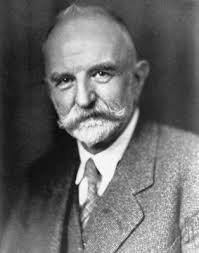
Open Mead's interactive page (graphs of influences, similar and opposing positions, and quotes)
Background
George Herbert Mead
Born: February 27, 1863 in South Hadley,
Massachusetts, United States
Died: April 26, 1931 (aged 68) in Chicago, Illinois
Alma mater: Oberlin College, Harvard University
Era: 20th-century philosophy
Region: Western Philosophy
School: Pragmatism
Institutions: University of Michigan, University
of Chicago
Main Interests: Sociology, social psychology,
communication, language, science, selfhood
Influences: Charles Cooley, John Dewey, William
James, Hegel, Whitehead, Josiah Royce,
Darwin, John B. Watson, Charles Sanders
Peirce, Jane Addams, Wilhelm Wundt
Influenced: Herbert Cooley, Jürgen Habermas,
John Dewey, Eugene Halton, Charles W. Morris,
Erving Goffman
From Wikipedia
Mead was an American philosopher, sociologist, and psychologist.... He was one of the key figures in the development of pragmatism. He is regarded as one of the founders of symbolic interactionism, and was an important influence on what has come to be referred to as the Chicago School of Sociol- ogy…. Much of Mead's work focused on the development of the self and the objectivity of the world within the social realm: he insisted that "the individual mind can exist only in relation to other minds with shared meanings."
Introductory Comments
For a pragmatist, the world shows up as a series of problems to be solved. A tree becomes shelter, a stone becomes a tool, a stranger becomes an ally or a threat, depending on what the moment demands. Mead shared this outlook with his close friend John Dewey. But he added a twist that kept him from picturing the problem-solver as a lone calculator, tallying costs and benefits in private. The problem-solver, Mead argued, is social to the core. A self develops only as a child learns to take up the attitudes others hold toward it. So even the question "Does this work for me?" is asked by a "me" that other people helped to build. Close behind it comes a second question: "How does this look to those watching, judging, and defining me?"
Mead did not treat these as two impulses that merely happen to share a body. For him, practical action and social exchange form a single process. People solve problems together first, and they learn to solve them alone by holding inner conversations in the borrowed voices of others. Nor did he expect the partnership to stay peaceful. The "I" can always talk back to the "me." Mead suggested that the reformer who defies the crowd is really appealing over its head to a larger, future community. Still, what serves one person may scandalize the crowd, and what wins the crowd's applause may serve no one. Mead trusted such quarrels to end in what he called social reconstruction. A skeptic might suspect they end just as often in a long custody battle over the self.
Some of Mead's Key Positions
The self is not born but made. An infant arrives with a body and a bundle of impulses, and a self, the capacity to be an object to oneself, emerges only through social experience.
Social life begins with gestures, such as the snarl that prompts a retreat. Most work without reflection, as when two dogs circle before a fight. A gesture becomes a "significant symbol" when it calls out in its maker the same response it calls out in others. Speech is the prime example, since speakers hear their own words as listeners do.
Through language, the individual learns to "take the role of the other," seeing the self from someone else’s standpoint. From such experience grows the “generalized other,” the community's organized attitudes, carried within as a standpoint for judging one's own conduct.
The self therefore has two phases. The "me" is the set of others' attitudes the individual has absorbed. The "I" is the individual's never wholly predictable response to them. The self is thus neither simply a product of society nor an independent agent standing apart from it. It is an ongoing dialogue between the two
All this must be understood in the context of pragmatism. The mind arises when an obstacle forces conduct to be rethought, and ideas earn their keep by getting that conduct moving again.
Place in the History of Ideas
Mead's Place in History of Ideas
George Cronk: The essence of Mead’s so-called "social behaviorism" is his view that mind is an emergent out of the interaction of organic individuals in a social matrix. Mind is not a substance located in some transcendent realm, nor is it merely a series of events that takes place within the human physiological structure. Mead therefore rejects the traditional view of the mind as a substance separate from the body as well as the behavioristic attempt to account for mind solely in terms of physiology or neurology.... The emergence of mind is contingent upon interaction between the human organism and its social environment; it is through participation in the social act of communication that the individual realizes her... potential for significantly symbolic behavior (that is, thought).
Ashley Crossman: The self, according to Mead, is made up of two components: the "I" and the "me." The "me" represents the expectations and attitudes of others (the "generalized oth- er") organized into a social self.... When people can view themselves from the standpoint of the generalized other, self-consciousness in the full sense of the term is attained. From this standpoint, the generalized other (internalized in the "me") is the major instrument of social control, for it is the mechanism by which the community exercises control over the conduct of its individual members.
Random Thoughts on Mead
Anyone who has rehearsed an argument in the shower, playing both sides, has met the curious doubleness at the heart of Mead’s account of the self. The self, he held, is not a solitary creature hidden within. It is assembled from the attitudes of others, gathered through countless shared activities until a person can regard itself as others do. The result is both actor and audience: an "I" that acts and a "me" that watches and judges. Oddly, the "I" never catches itself in the act. By the time it notices what it has done, the deed has already joined the "me." Those internalized onlookers also patrol the borders of acceptable thought and behavior, which makes each of us something of our own jailer.
But suppose the mirrors vanished: no audience, no applause, no disapproval. What self would remain? A child who never had them might never develop a self at all - forever a sentient organism adrift in the flow of experience. An adult is another matter, because a formed self carries its society along. Even Robinson Crusoe, alone on his island, could not stop imagining an audience. Dining in royal state with his parrot, dog, and cats, he reflected that the scene would have made a Stoic smile. But if freed from even these imagined watching eyes, what would happen? Would such a self swell to embrace all it surveys, or thin into something ghostly? Would it be gloriously unshackled or miserably unanchored, a cosmic bachelor free to do anything but unsure why it should bother?
Influences
Mead was influenced by: Addams, Jane, Cooley, C., Darwin, Dewey, Hegel, James, Peirce, Royce, Watson, J.B., Whitehead, Wundt
Mead influenced: Blumer, H., Cooley, H., Dewey, Goffman, E., Habermas, Halton, E., Mills, C. Wright, Morris, C.W., Niebuhr
Similar and opposing positions
Thinkers with similar positions:
- Buber (Human life is not self-enclosed. Relationships give birth to meaning.)
- Dewey (Democracy and science rely on communicatve rationality of the group.)
- Durkheim (The individual is a product of social interactions within a culture.)
- Fichte (The awareness of other rational beings leads to our own self-awareness.)
- Foot (Moral judgments, though linked to human nature, can be true and rational.)
- Habermas (We inevitably think and speak as part of cultural traditions.)
- Hare (Moral statements do not objectively describe, but rationally prescribe.)
- Kropotkin (The best economy is a decentralized one based on mutual aid.)
- Royce (Each individual gains fulfillment by joining and serving the larger whole.)
Thinkers with opposing positions:
- Bayle (Reason is a guide that too often leads one astray. Be skeptical.)
- Descartes (A radical metaphysical split exists between realms of mind & matter)
- Piaget (An inherent biological process shapes our rational development.)
- Pinker (Evolution has created the cognitive tools we use to function & survive.)
- Russell (Language that is not verifiable is not true or untrue but meaningless.)
- Schudson (The public sphere as a place of purely rational debate never existed.)
- Skinner (Our behavior can be reduced to matters of stimulus and response.)
What others said about Mead
- Dewey: [Mead has] a seminal mind of the very first order.
- George Cronk: Mead’s theory of the emergence of mind and self out of the social process of significant communication has become the foundation of the symbolic interactionist school of sociology and social psychology.
- Mitchell Aboulafia: Mead... viewed [science] as an activity that was at its heart democratic. For him, science is tied to the manner in which human beings have managed from pre-recorded times to solve problems and transform their worlds. We have just learned to be more methodical about the ways in which we solve problems in modern science.
- Howard F. Taylor: [Mead] thought of society as a human laboratory where [he] could observe and understand human behavior to be better able to address human needs, and [he] used [Chicago] as a living laboratory.
- W. H. Desmonde: [Mead thought of] of the universe as a process rather than as a set of fixed, unalterable essences that remain invariant over time.
- George Cronk: ... Mead’s thought [also] includes significant contributions to the philosophy of nature, the philosophy of science, philosophical anthropology, the philosophy of history, and process philosophy.
- Hans Joas: [George Herbert Mead] approach completely changes the meaning of intentionality, inasmuch as here action is no longer understood as the realization of ends set beforehand.... For the pragmatists, the setting of ends is not an act of consciousness that takes place outside of contexts of action.
- William H. Desmonde: For Mead stimulus and response are meaningful only when viewed as aspects of communication; they cannot be studied in abstraction from the social process in which actions occur.
Schools: Pragmatism, Process Philosophy
Main interests: Communication, Education, Language, Personal Identity, Psychology, Science, Semantics, Social Theory
Mead's answers to philosophical questions
Education
Play & games play a big role in child development, particularly in acquiring social skills. Formal education builds on these skills.
Epistemology
We perceive many things in terms of their practical implications - how they might serve us as a "means of living."
"Man lives in a world of Meanings. What he hears and sees means what he wants or can assume."
History
"History is always an interpretation of the present."
Language
"Language is the primary tool through which individuals develop self-awareness and self-identity."
By allowing us to talk to ourselves about ourselves, language is fundamental in shaping our sense of self.
Metaphysics
"Physical things are not only the meaning of what we see & hear; they are also the means we employ to accomplish our ends."
Mind
Mind does not develop in isolation, inside the brain. Rather, it is the result of "the dynamic, ongoing social process."
Our sense of self is, in a way, a social product. Each self is largely shaped by the behavior and expectations of others.
Political Philosophy
"Warfare is an utterly stupid method of settling differences of interest between different nations."
Science
Science is a social project that involves constructing hypothetical objects that assist us in our attempts to control nature.
Science at times involves fictions - for example, the present as a distinct unit of experience - that facilitate exact measurement.
Society
"The individual mind can exist only in relation to other minds with shared meanings."
We all need society because each self is largely shaped by others - by the thoughts, beliefs, values and behavior of others.