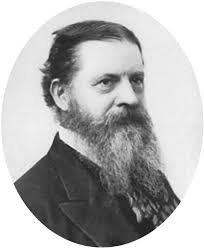
Peirce was an American scientist, mathematician, logician, and philosopher who is sometimes known as "the father of pragmatism." According to philosopher Paul Weiss, Peirce was "the most original and versatile of America's philosophers and America's greatest logician." Bertrand Russell wrote "he was one of the most original minds of the later nineteenth century...." In metaphysics, Peirce was an "objective idealist" in the tradition of German philosopher Kant as well as a scholastic realist about universals.
Introductory Comments
Peirce had nearly every advantage a young American intellectual could want. His father, Benjamin Peirce, was Harvard's foremost mathematician, and he took personal charge of his son's education. The son went on to found pragmatism, pioneer the theory of signs, and do work in logic so original that the world needed decades to catch up. Yet he never held a permanent academic post. His one university appointment, a lectureship at Johns Hopkins, ended abruptly in 1884. The trustees had learned that he lived with Juliette, the woman who became his second wife, before his divorce from the first was final. Elsewhere Peirce's arrogance made enemies with remarkable efficiency.
Arrogance, though, was not the whole story. Peirce suffered most of his life from what was then called facial neuralgia, an excruciating facial-nerve pain he treated with opiates and other drugs. Money, meanwhile, slipped through his fingers. After three decades at the U.S. Coast Survey, measuring the earth's gravity with swinging pendulums, he was forced out in 1891. By then he had already sunk funds he didn't have into Arisbe, a rambling house near Milford, Pennsylvania. He spent his last two decades doing odd jobs - writing reviews, lecturing when friends could arrange it, and living partly on charity from William James and others. Yes, it's all a bit ironic: The original pragmatist and the master of signs repeatedly refusing to be practical and to read the room.
Some of Peirce's Key Positions
Logic is not merely the study of valid argument but the theory of inquiry itself. Inquiry begins in doubt, an uncomfortable state the mind struggles to escape, and aims at settled belief. It advances through three kinds of inference. Abduction proposes a hypothesis to explain a surprising fact, deduction draws out its implications, and induction tests them against experience.
All thought takes place in signs. A sign stands for its object only by being interpreted, that is, by producing a further thought, feeling, or action, called its "interpretant." Meaning is thus a three-way relation among sign, object, and interpretant.
No single inquirer is the measure of truth. Truth is the opinion that an indefinite community of inquirers would eventually reach if investigation were pushed far enough, and reality is what that opinion represents.
One rule above all: do not block the way of inquiry. Do not claim something absolutely certain, or unknowable, or inexplicable. It is true that no belief lies beyond correction. Yet inquiry corrects itself over time, and one theory can be genuinely truer than another.
Finally, a concept's meaning lies in its practical consequences, in what would be experienced under conditions that could be tested. This "pragmatic maxim" is the founding principle of pragmatism.
Place in the History of Ideas
Peirce's Place in History of Ideas
Bertrand Russell: Peirce was a man of tremendous energy, producing a multitude of ideas, good, bad, and indifferent. He reminds one of a volcano spouting vast masses of rock, of which some, on examination, turn out to be nuggets of pure gold. He holds - and I confess that an examination of scientific inference has made me feel the force of this view - that man is adapted, by his congenital constitution, to the apprehension of natural laws which cannot be proved by experience, although experience is in conformity with them.
Max Fisch: It is not sufficiently recognized that Peirce's career was that of a scientist, not a philosopher; and that during his lifetime he was known and valued chiefly as a scientist, only secondarily as a logician, and scarcely at all as a philosopher. Even his work in philosophy and logic will not be understood until this fact becomes a standing premise of Peircean studies.
Robert Burch: Currently, considerable interest is being taken in Peirce's ideas by researchers wholly outside the arena of academic philoso- phy. The interest comes from industry, business, technology, intelligence organizations, and the military; and it has resulted in the existence of a substantial number of agencies, institutes, businesses, and laboratories in which ongoing research into and development of Peircean concepts are being vigorously undertaken.
Random Thoughts on Peirce
Peirce spent much of his life on what he called semiotic, the study of signs and how they mean. Language is our richest system of signs, but hardly the only one: a pointing finger, a portrait, and a weathervane all signify too. Peirce sorted signs into three broad kinds. An icon signifies by resemblance, as a portrait does. An index signifies by a real connection, as smoke indicates fire. A symbol signifies by convention, as most words do. Meanwhile, Saussure was independently proposing a "semiology" of his own, and the two theories make an instructive pair. Saussure's sign has two parts: a signifier, such as a spoken word, and a signified, the concept it calls to mind. Peirce's sign has three parts: the sign, the object it stands for, and the interpretant. That oddly named third term is not the interpreter but the effect the sign produces, whether a thought, a feeling, or an action.
To bring all this down to earth, picture a graduate student passing a café with a sign in the window: "Free Wi-Fi." Its interpretant is a pleasant thought: here is a place to work. That thought becomes a sign in turn, and its interpretant is less welcome: working here means buying coffee. Which means caffeine. Which means a sleepless night. Which means a groggy tomorrow. Which means that, to get anything done, more coffee. The chain has closed into a loop. Peirce held that semiosis could, in principle, go on forever. He may not have had this case in mind, but the café owner certainly did.
Ayer (The verification of a scientific statement fixes its meaning.)
Bolzano (The nature and meaning of truth is complex and multifaceted.)
Chalmers (Like time & space, consciousness may be a basic property of reality.)
Duns Scotus (There's no distinction between essence of a thing & its existence)
Kuhn (Scientific theories & understanding can never be entirely certain.)
Lewis, C.I. (First principles in logic must be based on pragmatic considerations.)
Mead (Our knowledge of the world is largely shaped by pragmatic concerns.)
Popper (Science achieves statistical probabilities, not certainties.)
Quine (Choosing a metaphysical framework is ultimately a pragmatic matter.)
Saussure (We must study signs & symbols to understand how language works.)
Thinkers with opposing positions:
Bergson (Life is a continuously creative force that transcends "laws of nature.")
Bergson (Utility is not a test of truth, but in fact a synonym for error.)
Carnap (Scientific knowledge can be reduced to a series of sense-data claims.)
Hamann (Scientific reason leads to doubts about the reality of the world.)
Marcel (Science & technology threaten to destroy the mystery of being.)
Skinner (Free will is not possible in our deterministic world.)
What others said about Peirce
Paul Weiss: [Peirce was] the most original and versatile of American philosophers and America's greatest logician.
Max Fisch: He is the only system-building philosopher in the Americas who has been both competent and productive in logic, in mathematics, and in a wide range of sciences.
Albert Atkin: C.S. Peirce [is] best known as the earliest proponent of pragmatism.... His thought was a seminal influence upon William James, his lifelong friend, and upon John Dewey, his one-time student. James and Dewey went on to popularize pragmatism thereby achieving what Peirce’s inability to gain lasting academic employment prevented him from doing.
Lewis, C.I.: The contributions of C.S. Peirce to symbolic logic are more numerous and varied than those of any other writer - at least in the nineteenth century.
Russell: Beyond doubt... he was one of the most original minds of the later nineteenth century and certainly the greatest American thinker ever.
Joseph L. Esposito: Peirce had to develop a new vocabulary for [his] new general science of knowing - the study of signs, or semiotics - a task that took a lifetime to even clarify.
Robert Burch: Peirce held that the continuity of space, time, ideation, feeling, and perception is an irreducible deliverance of science, and that an adequate conception of the continuous is an extremely important part of all the sciences. This doctrine he called “synechism,” a word deriving from the Greek preposition that means “(together) with."
Horace Standish Thayer: Peirce was concerned to explicate the idea of meaning whereas James was concerned to explicate the meaning of ideas.
Schools: Common Sense Realism, Deism, Metaphysical Idealism, Neo-Kantianism, Pragmatism, Process Philosophy, Rationalism
Main interests: Chemistry, Communication, Economics, Fact–value distinction, Habits, Language, Logic, Mathematics, Metaphilosophy, Mind, Personal Identity, Psychology, Religion, Science, Semantics, Semiotics, Time, Universals