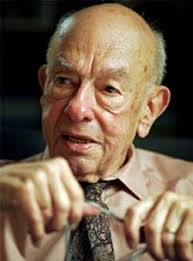
Quine was an American philosopher and logician in the analytic tradition, recognized as "one of the most influential philosophers of the twentieth century."… Quine was famous for his position that first order logic is the only kind worthy of the name, and developed his own system of mathematics and set theory, known as New Foundations. In philosophy of mathematics, he and... Hilary Putnam developed the Quine-Putnam indispensability argument, an argument for the reality of mathematical entities.
Introductory Comments
In his landmark 1951 paper "Two Dogmas of Em- piricism," Quine took aim at two pillars of mod- ern empiricist thought that most philosophers had treated as load-bearing walls. The first dog- ma is the analytic-synthetic distinction - the idea that some statements are true purely by virtue of meaning (like "all bachelors are unmarried") while others depend on how the world happens to be. Quine argued that this distinction is a philosophical mirage: every attempt to define "analyticity" ultimately circles back to equally murky notions like "synonymy" and "defini- tion," each one borrowing its respectability from the others in a kind of conceptual Ponzi scheme. There is, Quine insisted, no clean line where meaning ends and fact begins.
The second dogma holds that each meaningful statement can, in principle, be cashed out as a specific set of sensory experiencees that would verify or refute it. This assumes a kind of one-to-one correspondence between sentences and empirical evidence. Quine finds the idea untena- ble. Statements don't face experience as solitary contestants; they arrive in teams. A physicist testing a hypothesis about electrons is simulta- neously relying on assumptions about instru- ments, mathematics, background theory, and much else besides. Any one of these could be re- vised to accommodate a recalcitrant observa- tion, which means no single statement has a determinate empirical content all its own.
Some of Quine's Key Positions
Philosophy is not an isolated intellectual discipline, completely separate in its majesty from other intellectual disciplines. Rather, philosophy should be seen as continuous with science - more abstract than the empirical sciences, but focused on science as its primary, if not sole, subject matter.
In particular, philosophy attempts to provide an epistemology of science, one that explains how science can develop its far-reaching theories on the basis of mere sensory input. This does not mean that logicians make mandates for the sciences. Instead, they try to explain the existing epistemology hidden in the sciences.
In doing this, philosophers have undermined the claims of logical positivists: When we care- fully consider the nature of empirical evidence, we soon see that most of it is underdetermined. That is, the empirical evidence available to us at a given time is usually insufficient to determine exactly and unambiguously what beliefs we should hold in regarding it. And this in turn, of course, undermines the very foundation of logical positivism. Moreover, the traditional analytic-synthetic distinction - another funda- mental belief of the logical positivists - is unten- able, since the notion of "truth by definition" is hopelessly circular. Plus, it turns out that all scientific truths involve an empirical aspect.
Place in the History of Ideas
Quine's Place in History of Ideas
A. J. Ayer: [Quine] declines to start out with sense-data on the ground that they do not cohere as an autonomous domain, and goes so far as to maintain that it is only by positing physical objects that we obtain any data to systematize. This opting for physicalism divides Quine from James and Lewis, but does not sever his attachment to pragmatism. In fact, the chief interest of his thesis of Ontological Relativity is that it is pragmatic.... If, in the last resort, I cannot find out whether my neighbor is referring to rabbits, or to rabbit-stages, or to rabbit parts..., and if my observations are equally well catered for under each of these interpretations, then the fact that I am theoretically able to differentiate between them is not of much consequence.
Hilary Putnam: I do not agree with Quine, that there is no analytic-synthetic distinction to be drawn at all. But I do believe that his emphasis on the monolithic character of our conceptual system and his negative emphasis on the silliness of regarding mathematics as consisting in some sense of "rules of language," represent exceedingly important theoretical insights in philosophy.... We have to take a fresh look at the framework principles so much discussed by philosophers, disabusing ourselves of the idea that they are "rules of language" in any literal... sense; and… we have to take a fresh look at the nature of logical and mathematical truths.
Random Thoughts on Quine
Recognizing the inadequacy of the two dogmas of empiricism (see Introductory Comments), Quine concluded that knowledge is holistic, and no individual fact or claim is self-standing. By this, Quine meant that our beliefs form an inter-connected web in which logical laws and empiri-cal claims together face the tribunal of experi-ence. And when the tribunal delivers an unwel- come verdict, we have latitude in deciding where to make adjustments. We can revise pe- ripheral claims or, if we are sufficiently stubborn or creative, reach all the way into the interior and revise even logic itself. Nothing in the web is immune to revision in principle, though some nodes are so entangled with everything else that disturbing them would cost us dearly.
This holistic character of knowledge means that every claim you hold depends for its standing on the company it keeps. A statement about elec-trons, a law of logic, and a belief about your breakfast this morning all earn their keep not independently but through their roles in a vast, mutually supporting network. Evict one tenant and the entire building may need restructuring. This is, in one sense, intellectually humbling: we cannot point to any belief and declare it un- touchable, foundational, or guaranteed. But it is also, in another sense, liberating: It means that inquiry is a genuinely open-ended enterprise, not an exercise in abstract ratiocination nor a mechanical march from sensation to certainty.
Davidson (Though mind springs from matter, it can't be reduced to matter.)
Goodman (There are no unquestionable "givens" in what we call knowledge.)
James (Choosing a metaphysical framework is ultimately a pragmatic matter.)
Lewis, C.I. (First principles in logic must be based on pragmatic considerations.)
Mead (Our knowledge of the world is largely shaped by pragmatic concerns.)
Putnam (Mathematics is not a purely logical, but a "quasi-empirical" method.)
Rorty (The search for the ultimate foundation of knowledge is fruitless.)
Schlegel (There are no first principles that can guide us to the truth.)
Sellars (Science can & should attribute subjective inner experience to people.)
Thinkers with opposing positions:
Ayer (The verification of a scientific statement fixes its meaning.)
Carnap (Scientific knowledge can be reduced to a series of sense-data claims.)
Frege (The distinction between analytic & synthetic statements is basic & real.)
Goodman (Philosophy, logic, and math should dispense with set theory.)
Pythagoras (Mathematics is a purely logical method of understanding the world.)
Rousseau (So-called "progress" in science can lead us away from real truth.)
Wittgenstein (Words are tools. A word's meaning is its use in the language.)
What others said about Quine
Martin Weil: His life's work was to find answers to questions such as these: What do we Know? Can we Know? How do we know that we Know?
Putnam: [Quine's indeterminacy of translation thesis is] the most fascinating and the most discussed philosophical argument since Kant's Transcendental Deduction of the Categories.
Ayer: The two dogmas [of empiricism that] Quine rejects are first that there is a fundamental distinction between analytic and synthetic propositions and secondly the dogma of reductionism, "the belief," as he puts it, "that each meaningful statement is equivalent to some logical construct upon terms which refer to immediate experience."
Robert Sinclair: Quine’s philosophy should... be seen as a systematic attempt to understand science from within the resources of science itself. This project investigates both the epistemological and ontological dimensions….
Hayek: I regard Quine as one of our most stimulating philosophers.
Ayer: In general, Quine prefers to talk of linguistic behavior, interpreted by evidences of assent or dissent to various formulations, than to talk of meaning.
Putnam: [We need] to face and explore the insight achieved by Quine, trying to reconcile the fact that Quine is overwhelmingly right in his critique of what other philosophers have done with the analytic-synthetic distinction with the fact that Quine is wrong in his literal thesis, namely, that the distinction itself does not exist at all.
Robert Sinclair: Quine… transforms these philosophical concerns according to those standards of clarity, empirical adequacy, and utility that he takes as central to the explanatory power of empirical science.