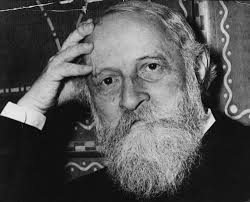
Buber was an Austrian-Israeli philosopher best known for his philosophy of dialogue, a form of existentialism centered on the distinction between the I-Thou relationship and the I-It relationship. Born in Vienna, Buber came from a family of observant Jews, but broke with Jewish custom to pursue secular studies in philosophy. He produced writings about Zionism and worked within the Zionist movement extensively over a nearly 50-year period spanning his time in Europe and the Near East.
Introductory Comments
Most of us know the feeling of being processed: the clerk who takes our order without quite seeing us, the official who sees only a case number, the acquaintance who listens only for a pause in which to talk about himself. Most of us, if we’re honest, have done the processing too. Buber called this the I-It stance: we approach things, and too often people, as objects to be classified, managed, consumed, or maneuvered. This is the mode of science, commerce, and most of our daily business, and no one could get through a day without it. But it flattens whatever stands before us into a set of uses. In the I-Thou relation, the self steps out from behind its schemes and categories to stand before the other rather than above it.
For Buber, this distinction flowers into theology. Every genuine Thou, whether a friend, a stranger, a horse, or a tree, offers a glimpse of what he called the Eternal Thou. God, on this view, is not an object to be proved or argued about. God can only be addressed. And He is met not by turning away from the world but in and through our encounters with it. Nor is the traffic all one way. Buber startled his readers by insisting that God needs us: not in order to exist, but so that creation can reach its meaning. A God who needs us is hardly the remote cosmic overlord of popular imagination. Buber, a lifelong student of the Hebrew Bible, would have also recognized something here: an ancient covenant between man and God in which both parties have something at stake.
Some of Buber's Key Positions
No human being can be understood in isolation. There is no "I" taken by itself, only an I in relation: to other people, to the natural world, to works of art and ideas, and ultimately to God. To exist is to stand in relation, and the quality of a life depends on the quality of its relations.
Relations come in two basic kinds, captured in two word pairs: I-Thou and I-It. In the I-It relation, the other is an object to be experienced, analyzed, classified, or used. In the I-Thou relation, the other is met as a whole and as present, not as a bundle of qualities or a means to some end. Such a meeting is direct and mutual. It engages the whole of one’s being.
The I-It relation is not wicked in itself. Science, work, and ordinary life depend on it, and no one could live without it. The danger lies in living only in that mode, where persons shrink into things to be managed, manipulated, stereotyped, or ignored. Nor can the I-Thou relation last indefinitely.
An I-Thou encounter need not be intense, prolonged, or confined to people. It can happen with a tree, taken not as a specimen or a source of lumber but as this tree, here and now. It can happen in an exchanged glance with a cat. Every such encounter points beyond itself toward the "eternal Thou," God, the one Thou that can never become an It.
Place in the History of Ideas
Buber's Place in History of Ideas
Michael Zank: [Buber's writing] ranged from Jewish mysticism to social philosophy, biblical studies, religious phenomenology, philosophical anthropology, education, politics, and art. Most famous among his philosophical writings is the short but powerful book I and Thou.... The I-it relation prevails between subjects and objects of thought and action; the I-Thou relation, on the other hand, obtains in encounters between subjects that exceed the range of the Cartesian subject-object relation. Though originally planned as a prolegomenon to a phenomenol- ogy of religion, I and Thou proved influential in other areas as well, including the philosophy of education.
Marc A. Krell: Buber and Tillich each took similar paths toward their common destination of religious socialism. Both had been influenced early in their careers by the 19th century German philosopher Nietzsche's rejection of bourgeois culture in his classic book, Thus Spoke Zarathustra, and were further influenced by Karl Marx's doctrine of human self-estrange- ment and objectification in capitalist society while rejecting his anti-religious bias. Moreover, Buber and Tillich, along with all religious socialists, rejected the Marxist "revolutionary dictatorship" of the proletariat. This would represent... the political manifestation of the I-it relationship expressed by Buber that is based on human instrumentalism.
Random Thoughts on Buber
Philosophers have two basic ways of getting us to see what they see. They can point ("Look there!") or they can prove ("Here is why"). Mendes-Flohr frames this as a spectrum running from deixis to apodeixis (see Quotes), and the Greek fits nicely. Deixis means showing or pointing, while apodeixis is the word Aristotle used for strict logical proof. The pointers, Nietzsche and Buber among them, trade in vision and orientation. Buber said as much himself: he had no doctrine to teach, he insisted, only something to point to, as one might lead a friend to a window and gesture at what lies outside. The provers, Aristotle and Spinoza among them, trade in logic and evidence. Spinoza went so far as to lay out his Ethics like a geometry theorem, complete with axioms and proofs.
Yet no one lives at either extreme. Even the most oracular prophet relies on patterns, contrasts, and inferences, or the pronouncements dissolve into noise. And even the most rigorous logician must first decide which questions are worth asking and which premises are worth granting. That choice is itself a kind of pointing. Nor is there a sweet spot, a golden ratio of vision to argument that suits every reader. What strikes one reader as profound insight strikes another as mystical hand-waving. What one admires as careful reasoning, another dismisses as hair-splitting. And so our reaction to Buber may say as much about us as about him. That is a fitting result for a thinker who held that we become who we are only in encounter.
Bergson (Life is a continuously creative force that transcends "laws of nature.")
Fromm (Love is based on care, responsibility, respect, and knowledge.)
Hutcheson (Our motives are often neither self-interested nor materialistic.)
Jaspers (Our freedom is threatened by modern science, economics and politics.)
Kant (All people should be treated as ends in themselves, not means to ends.)
Marcel (Human life is not self-enclosed. Relationships give birth to meaning.)
Mead (The mind and self emerge from the social process of communication.)
Murdoch (Morals improve along with our improved perspective on people.)
Royce (The highest ideal is the creation of a perfected "beloved community.")
Thinkers with opposing positions:
Barth (There is an infinite qualitative distinction between God & mankind.)
Epictetus (Nothing is good or bad independent of human desires & beliefs.)
Evola (The Ego is absolute. To deny this is to be both deluded and enfeebled.)
Hobbes (Our ultimate motive is always to experience pleasure and avoid pain.)
Luther (Man's sinfulness is infinitely distinct from God's perfection.)
Rand (An Individual should exist for her own sake, not for the community.)
Smith, Adam (Humans are consistently rational & narrowly self-interested.)
What others said about Buber
Franz Rosenzweig: In you're setting up the I-It, you are giving the I-Thou a cripple for an opponent.
Paul R. Mendes-Flohr: Infatuated with Nietzsche already as a teenager, [Buber] adopted a discursive strategy of "deixis," pointing, rather than "apodeixis," rational demonstration and argumentation.
Ernst Simon: Buber’s philosophy was centered on the encounter, or dialogue, of man with other beings, particularly exemplified in the relation with other men but ultimately resting on and pointing to the relation with God. This thought reached its fullest dialogical expression in [his 1923 book] "I and Thou."
Michael Zank: The work of Martin Buber remains a linchpin of qualitative philosophical anthropology and continues to be cited in fields such as philosophical psychology, medical anthropology, and pedagogical theory.
Sarah Scott: He advocated a bi-national Israeli-Palestinian state and argued for the renewal of society through... communitarian socialism.
Chaim Potok: [Buber romanticized Hasidism and overlooked its] charlatanism, obscurantism, internecine quarrels, its heavy freight of folk superstition and pietistic excesses, its tzadik worship....
Adam Kirsch: Such haziness [in his writing] was inevitable, because the questions Buber was trying to answer were the most ineffable ones of human life: What is the meaning of our existence? How can we achieve the feeling of wholeness that we so painfully lack? Above all, Buber asked, how do we find our way to God [in the modern age].
Walter Kaufmann: [Buber] tends to blur all contours in the twilight of suggestive but extremely unclear language. Most of Buber’s... readers would be quite incapable of saying what any number of passages probably mean.