Friedrich Schleiermacher (1768 - 1834)
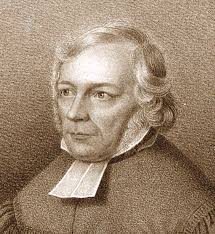
Open Schleiermacher's interactive page (graphs of influences, similar and opposing positions, and quotes)
Background
Friedrich Schleiermacher
Born: November 21, 1768 in Breslau, Silesia,
Prussia (now Wrocław, Poland)
Died: February 12, 1834 (aged 65) in Berlin,
Brandenburg, Prussia (now Berlin, Germany)
Alma mater: University of Halle (1787–90)
Schools: German Idealism, Jena Romanticism,
Berlin Romanticism, Romantic hermeneutics,
Methodological hermeneutics
Main interests: Theology, psychology, ethics,
dialectics, politics, philology
Influences: Kant, Schlegel, Fichte, Schelling,
Johann August Ernesti, Friedrich Ast, Friedrich
August Wolf, Herder, Spinoza, Plato, Carl Jacobi
Influenced: Dilthey, Barth, August Böckh, Rudolf
Bultmann, Tillich, Albrecht Ritschl, Friedrich
Ueberweg, Gadamer, Manfred Frank, Antoine
Berman, Heinrich Ritter, Friedrich Adolf
Trendelenburg, Horace Bushnell
From Wikipedia
Schleiermacher was a German Reformed theologian, philosopher, and biblical scholar known for his attempt to reconcile the criticisms of the Enlightenment with traditional Protestant Christianity. He also became influential in the evolution of higher criticism, and his work forms part of the foundation of the modern field of hermeneutics. Because of his profound effect on subsequent Christian thought, he is often called the "Father of Modern Liberal Theology" and is considered an early leader in liberal Christianity.
Introductory Comments
In his teens, Schleiermacher sent his father the letter no Moravian father wanted to receive: he could no longer believe that Christ's death paid a debt owed for the sins of humankind. The Brethren's schools at Niesky and Barby had raised him on an intimate, heartfelt piety, and now he was walking away from it. Or so it looked. Years later he described himself as a Herrnhuter again, only of a higher order - and that phrase is the key to the man. What he left behind was doctrine. What he kept was the Pietist conviction that religion is something felt before it is anything else.
That conviction found its company in Berlin. Through his friendship with Friedrich Schlegel, Schleiermacher was drawn into the early Romantic movement, whose headquarters were at Jena. The Romantics were not a devout crowd, though hardly a godless one. Their passion was art, and their program was the fusion of poetry, philosophy, and criticism into something that attempted to express the inexpressible. Schleiermacher's inexpressible was not art but the infinite Universe, in language suggestive enough to get him charged with Spinozism. Otherwise his Romantic instincts held: reality approached through intuition and feeling, only now the experience is religious rather than aesthetic. If that sounds soft, it wasn't. The Jena circle read as hard as it felt, and out of his own labor over texts, came hermeneutics - the attempt to make the reading of another mind an art in itself, but with rules.
Some of Schleiermacher's Key Positions
Religion's cultured despisers attack a caricature. They take religion for metaphysics, or for morals with divine backing, then object that science does the first job better and conscience the second. But religion is neither knowing nor doing. It has a province of its own: the intuition and feeling of the infinite within the finite
Christian doctrines are accounts of religious feeling set out in speech; they describe the life of faith rather than report supernatural events. Scripture's worth lies not in miracles offered as credentials, but in the redeemer it discloses: Jesus, whose God-consciousness was unbrokenly potent and who communicates it within the fellowship of the church. Redemption is that transmission.
Reading religious texts requires an art - hermeneutics - whose first rule is bracing: misunderstanding is what happens on its own. Understanding must be sought at every point, along two lines: the grammatical, which places words within the language the author shared, and the psychological, which reconstructs the mind that chose these words and no others.
And the art belongs to no guild. Sacred texts need no special key; the same procedures serve Plato, a letter, an overheard remark. To understand someone is to enter the world he lived in - well enough, at the limit, to understand him better than he understood himself.
Place in the History of Ideas
Schleiermacher's Place in History of Ideas
Rudolf Otto: [Schleiermacher attempted to] lead an age weary with and alien to religion back to its very mainsprings; and to reweave religion, threatened with oblivion, into the incomparably rich fabric of the burgeoning intellectual life of modern times.
John S. Knox: [For Schleiermacher, language] is multi-dimensional. It can mean different things at different times. Schleiermacher was con- cerned that, since the cultural meaning of language is subjective at best, it was most important to focus on discovering the original meanings of the texts. This meant possibly relegating some material to the level of cultural devices and elevating others to universal truths.
Nasrullah Mambrol: Schleiermacher’s Herme- neutics and Criticism is the first text to establish hermeneutics as a modern, systematic disci- pline, and many of his principles are so funda- mental that they are still in use today in a wide range of fields: these principles include the central role of language in human understand- ing, the reciprocal relationship between individ- ual speech acts and the structure of language as a whole, the intimate interdependence of the various elements in language, and the histori- cist principle of understanding the differences between our own culture and that of the text we are interpreting.
Random Thoughts on Schleiermacher
Calling something "German Romanticism" is a little like calling something "weather." The word covers a great deal of unrelated activity, some of it moving in opposite directions. At Jena, the young Romantics - Schlegel, Novalis, Schelling - wanted imagination off its leash, and dreamed of poetry and philosophy fusing into something higher than either. Later, in Heidelberg, Brentano and Arnim hunted folk songs and old tales, after the organic soul of a German nation that did not yet exist. Later still, Romanticism longed for throne and altar; Schlegel himself became a Catholic in 1808. And hovering over all of it, though never quite in it, stood German Idealism - Fichte, Hegel - finishing what Kant had left undone. Hegel had no patience for the Romantics, and less for Schleiermacher: if religion is a feeling of dependence, he sneered, then the dog would be the best Christian.
So where does Schleiermacher belong? He came out of the first group and never entirely left it, but he aimed its instincts at religion rather than at art. No throne and altar for him, and no folklore either. What the Romantics claimed for poetry - that it reaches what argument cannot - he claimed for piety. The oddity is what he did next. Having grounded religion in feeling, he spent his working life on the least dreamy labor imaginable: building the discipline of hermeneutics. It looks like a contradiction. It isn't. For Schleiermacher, feeling was never a fog; it was another mind's interior, and interiors can be entered with care.
Influences
Schleiermacher was influenced by: Ast, Friedrich, Ernesti, J.A., Fichte, Herder, Jacobi, Kant, Plato, Schelling, Schlegel, Spinoza, Wolf, F.A.
Schleiermacher influenced: Barth, Berman, A., Bockh, August, Bultmann, R., Bushnell, H., Dilthey, Feuerbach, Frank, Manfred, Gadamer, Ritschl, A., Ritter, H., Tillich, Trendelenburg, Ueberweg, F.
Similar and opposing positions
Thinkers with similar positions:
- Bergson (Dynamic religion springs from creative emotion & mystical experience)
- Bultmann (We must demythologize Scripture to make God relevant today.)
- Dilthey (Understanding texts requires understanding historical worldviews.)
- Dilthey (Understanding in the human sciences is a type of re-experiencing.)
- Edwards (Emotion plays an important part in religion, especially in conversion.)
- Feuerbach (Religion is principally a matter of feeling & emotional projection.)
- King (God is not only transcendent but also immanent: He dwells in us.)
- Plantinga (Man isn't sufficient unto himself. We need God’s Word & guidance.)
- Schlegel (Love is the highest form of aesthetic enjoyment we have.)
Thinkers with opposing positions:
- Barth (God's perfection makes Him infinitely different from us.)
- Calvin (Salvation is fated. God predestines both the saved & the damned.)
- Derrida (It's fruitless to ground meaning on links betweeen text and the world.)
- Gadamer (Finding the meaning of a text is not an objective process.)
- Holbach (Religion is an impediment to the moral advancement of humanity.)
- Newman (Emphasis on emotional conversion undermines role of the church.)
- Tillich (Humanism today has too much faith in man & all too little faith in God.)
What others said about Schleiermacher
- Barth: If anyone still speaks today in Protestant theology as though he was still among us, it is Schleiermacher.
- Terrence Tice: [Schleiermacher] repeatedly averred that Christian faith is essentially a matter of feeling, especially "feeling absolutely dependent" on God, not of adherence to thoughts or to rules for action.
- John S. Knox: It is not difficult to make connections between Schleiermacher’s philosophy and trends in postmodernity - more a zeitgeist rather than a defined school of thought - such as the following: questioning any access to absolute truth, questioning the trustworthiness of... ecclesial authority, and overemphasizing the personal nature of moral and religious beliefs.
- Nasrullah Mambrol: Schleiermacher’s Hermeneutics and Criticism is the first text to establish hermeneutics as a modern, systematic discipline, and many of his principles are so fundamental that they are still in use today.…
- John S. Knox: Many theologians in his time (and in the present day) feel that... Schleiermacher treads dangerously close to pantheism.
- Michael Forster: Much of his philosophical work was in the philosophy of religion, but from a modern philosophical point of view it is his hermeneutics... and his theory of translation that deserve the most attention.
- Richard von Krafft-Ebing: In religion the primary element is a feeling of dependence, a fact which Schleiermacher recognized long before the later studies in anthropology and ethnography... had led to the same conclusion. It is only at a higher stage of culture that the second and essentially ethical element love of God enters into religious feeling.
- B. A. Gerrish: [Schleiermacher suggested that] the problem with the church’s Christological and trinitarian dogmas was not that they were religiously unfruitful, but that they made no sense.
Schools: Antireductionism, Christian Theology, Continental Philosophy, Fideism, German Idealism, Hermeneutics, Perennial Philosophy, Romanticism
Main interests: Ethics, Faith, Philology, Politics, Psychology, Religion, Theology
Schleiermacher's answers to philosophical questions
Ethics
Ethics is based on the assumption that we can transcend self-interest and conduct ourselves in relation to the highest good.
We should judge our actions in relation to the highest good - that is, the good of society and the universe at large.
Language
"Language is the [way] in which thought is real. For there are no thoughts without speech... No one can think without words."
Metaphysics
All being is essentially ideal and springs from one transcendent source or principle: God.
Human action can only be understood as free action guided by reason and the interaction with other free beings.
The human ego combines both body and soul. For us there is no such thing as "pure mind" or "pure body."
Mind
Our memories fade: "That which was then our innermost I and Self has now become something far off and strange to us."
Psychology
A basic dualism exists between ego and non-ego. When we become conscious of what is not ego, we expand our sense of self.
Religion and Theology
"Religion is the miracle of direct relationship with the infinite; and dogmas are the reflection of this miracle."
"Religion is the outcome neither of the fear of death, nor of the fear of God... It is... essentially an intuition and a feeling."
"The essence of religion consists in the feeling of an absolute dependence."
God's existence is revealed through our religious feeling of dependence - not by practical reason, as Kant claimed.
God and the universe are one. The spatial/temporal plurality of the world is also the spaceless/timeless unity of God.
"[D]esire for personal immortality [shows] a lack of religion, since religion assumes a desire to lose oneself in the infinite...."
"Every event, even the most natural and usual, becomes a miracle, as soon as the religious view of it can be the dominant."
"I cannot believe that [Jesus] was the true eternal God: I cannot believe that His death was a vicarious atonement...."
When studying holy books, we should always keep in mind the historical context and the author's intent.
Sex and Gender
For women, "the beautiful inner life of the fancy, always commands the greater part." For men. it's the outer life of action.