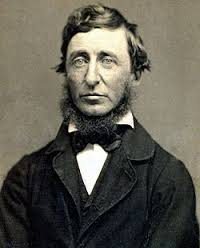
Influenced: Gandhi, J. F. Kennedy, M. L. King, Jr.,
Walt Whitman, Tolstoy, Proust, W. B. Yeats,
Sinclair Lewis, John Cage, Hemingway, Upton
Sinclair, E. Goldman, E. B. White, E. O. Wilson,
B. F. Skinner, Stanley Cavell, G. B. Shaw, John
Zerzan, Paul Auster, W. D. Howells, Annie
Dillard, Wendell Berry, Emile Armand, L. M.
Alcott, Denise Levertov, Loren Eiseley, Ralph
Ellison, Mary Oliver, Hai Zi, Alexander Posey,
J. Burroughs, J. Muir, E. W. Teale, J. W. Krutch
From Wikipedia
Thoreau was an American naturalist, essayist, poet, and philosopher. A leading transcendental- ist, he is best known for his book Walden, a reflection upon simple living in natural surround- ings, and his essay "Civil Disobedience,"... an argument in favor of citizen disobedience against an unjust state…. Among his lasting contributions are his writings on natural history and philosophy, in which he anticipated the methods and findings of ecology and environmental history, two sources of modern-day environmentalism.
Introductory Comments
Most biographies are built from milestones: births, marriages, books, honors, deaths. Thoreau's life reads like a quiet protest against the whole method. His writing keeps insisting that a life is not a tally of goals met or missed. It is an engagement with the world, something to be savored or squandered. "I went to the woods because I wished to live deliberately, to front only the essential facts of life, and see if I could not learn what it had to teach." John Updike's memoir Self-Consciousness makes a kindred case, but Updike looked inward, at a self forever reshaping itself. Thoreau looked outward, above all toward the fields, ponds, and woods of Concord.
To many who knew him, Thoreau seemed a gifted man frittering away his gifts, tramping the countryside for hours each day. Apart from surveying and the family pencil business, he held no steady profession. Even Emerson lamented in his eulogy that his friend had become "the captain of a huckleberry party." In his lifetime Thoreau published just two books. One sold so poorly that he joked about owning a library of some nine hundred volumes, over seven hundred of which he had written himself. But to find out what Thoreau's life was like from the inside, the reader should turn to his Journal, some two million words kept over nearly a quarter century. There, day by day, is the life he thought worth recording. What looked like time wasted in the woods was precisely the time he refused to waste.
Some of Thoreau's Key Positions
Nature’s significance must be experienced firsthand, not merely contemplated from an armchair. People become so absorbed in commerce, social conventions, and daily routines that they lose touch with the natural world to which they belong.
Direct experience of nature can renew the spirit and challenge familiar ways of living. Attentive observation reveals wonders that habit obscures, while time outdoors puts human ambitions and anxieties into perspective. Losing oneself in nature can become a way of finding oneself.
Wildness is especially valuable because it nourishes forms of life and freedom that civilization cannot manufacture. Its value extends beyond untouched wilderness: wildness can also invigorate human thought and imagination.
None of this means ignoring human concerns or social problems. A moral life still requires helping those in need and speaking out against injustice and governmental misconduct. When government action or inaction becomes intolerable, we should resist it - at minimum, by refusing to cooperate with its wrongdoing.
When the law makes someone an agent of injustice, breaking it becomes a moral duty, even at the cost of imprisonment. Civil disobedience expresses fidelity to a higher moral obligation.
Place in the History of Ideas
Thoreau's Place in History of Ideas
James Kendall Hosmer: Among American writers Thoreau was the pioneer of nature-study. Audubon had preceded him but he worked mainly with the brush; to multitudes Thoreau opened the gate to the secrets of our natural environment. The subtle delicacy of the grass-blade, the crystals of the snowflake, the icicle, the marvel of the weird lines traced by the flocks of wild geese athwart the heavens as they migrated, these he watched and recorded with loving accuracy and sensitive poetic feeling as no one in our land before had done. I have thrown a stone upon the cairn at Walden Pond which has now grown so high through the tributes of his grateful admirers. I shall throw still others in grateful admiration if the opportunity comes to me.
Ken Kifer: Thoreau's careful observations and devastating conclusions have rippled into time, becoming stronger as the weaknesses Thoreau noted have become more pronounced.... Events that seem to be completely unrelated to his stay at Walden Pond have been influenced by it, including the national park system, the British labor movement, the creation of India, the civil rights movement, the hippie revolu- tion, the environmental movement, and the wilderness movement. Today, Thoreau's words are quoted with feeling by liberals, socialists, anarchists, libertarians, and conservatives alike.
Random Thoughts on Thoreau
Thoreau was hardly the first to hold up nature as a rebuke to civilization. A century earlier Rousseau had imagined a "state of nature" before property, society, and envious comparison corrupted us. Rousseau's own encounters with nature, though, tended to be gentle: a lakeside reverie, an afternoon of botanizing. Thoreau preferred his served wild. "In wildness is the preservation of the world." By wildness he meant more than wilderness areas. He meant a vitality that keeps nature, societies, and individual souls from growing stale, tame, or spiritually dead. Civilization had its uses, he granted, but it cut us off from life's essential energies, though these energies were at times anything but friendly. Atop Maine's Mount Katahdin, raw nature struck him as vast, inhuman, and more than a little frightening.
Still, a skeptic might ask whether science and technology have preserved the world more effectively than wildness ever did. Modern agriculture feeds billions more people than hunting and gathering ever could. Wild nature, meanwhile, brings plague, famine, flood, and a brutal struggle to survive. Paradise, whatever its charms, came without antibiotics and flood insurance. In fairness, though, Thoreau meant "preservation" less as keeping bodies fed than as keeping spirits alive. And history has added a twist he might have savored. His line became a rallying cry for the conservation movement, which set out to preserve wildness in the most literal sense.
Cavell (Philosophy should ponder the uncanny significance of the ordinary.)
Cicero (If you have a garden and a library, you have everything you need.)
Coleridge (No radical metaphysical split exists between realms of mind & matter)
Emerson (Besides being beautiful, Nature is also a moral & spiritual guide.)
Gandhi (Citizens have a duty to peacefully protest governmental injustice.)
Humboldt, A. (Communion with Nature has a moral and spiritual dimension.)
King (Peaceful protests are not only more moral, they're also more effective)
Marcel (We too often define ourselves by what we own - not who we are.)
Muir (In Wildness is the preservation of the world and the renewal of the self.)
Petrarch (Exploring nature outdoors is both a pleasure and an inspiration.)
Wilson, E.O. (We have an instinctive need & love for nature & her creatures.)
Thinkers with opposing positions:
Calvin (The only way to obtain knowledge of God is to study scripture.)
Diderot (The universe is simply matter in motion, bound by laws of nature.)
Edwards (Intricate design in the natural world is the work of God alone.)
Fichte (Freedom springs from submerging individuality into a larger group.)
Ovid (Earthly or romantic love is the most appropriate subject for poetry.)
What others said about Thoreau
Robert Frost: In one book ["Walden, or Life in the Woods"] he surpasses everything we have had in America.
R. L. Stevenson: With his almost acid sharpness of insight, with his almost animal dexterity in act, there went none of that large, unconscious geniality of the world's heroes. He was not easy, not ample, not urbane, not even kind....
Emerson: There was somewhat military in his nature not to be subdued, always manly and able, but rarely tender, as if he did not feel himself except in opposition. He wanted a fallacy to expose, a blunder to pillory, I may say required a little sense of victory, a roll of the drum, to call his powers into full exercise.
Hawthorne: He is a keen and delicate observer of nature… which, I suspect, is almost as rare a character as even an original poet; and Nature, in return for his love... shows him secrets which few others are allowed to witness.
C. White: Thoreau's disobedience is disobedience as refusal. I won't live in your world. I will live as if your world has ended, as indeed it deserves to end.
Emerson: Whilst he used in his writings a certain petulance of remark in reference to churches or churchmen, he was a person of a rare, tender, and absolute religion, a person incapable of any profanation, by act or by thought.
John Updike: A century and a half after its publication, "Walden" has become such a totem of the back-to-nature, preservationist, anti-business, civil-disobedience mindset, and Thoreau so vivid a protester, so perfect a crank and hermit saint, that the book risks being as revered and unread as the Bible.
King: Here, in this courageous New Englander's refusal to pay his taxes and his choice of jail rather than support a war that would spread slavery's territory into Mexico, I made my first contact with the theory of nonviolent resistance.