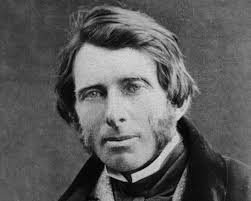
Ruskin was an English polymath - a writer, lecturer, art historian, art critic, draughtsman and philanthropist of the Victorian era. He wrote on subjects as varied as art, architecture, political economy, education, museology, geology, botany, ornithology, literature, history, and myth…. In all of his writing, he emphasized the connections between nature, art and society.... Today, his ideas and concerns are widely recognized as having anticipated interest in environmentalism, sustainability, ethical consumerism, and craft.
Introductory Comments
Few critics have staked so much on a single painter. Ruskin was only 24 when he published the first volume of Modern Painters (1843), a book written largely to defend J. M. W. Turner. The critics had been merciless. Turner's late canvases were mocked as incoherent blurs, and one reviewer's jibe, "soapsuds and whitewash," stung the painter enough that he reportedly repeated it for years. But where the critics saw smears, Ruskin saw truth. Turner's blazing skies and dissolving seas looked careless, he argued, only to people who had never really watched a cloud. And since nature was, for the young Ruskin, God's own handiwork, the painter who rendered it truly became something like a prophet with a palette.
Later readers have enlisted this partnership in the case against industrialism. Ruskin did eventually become one of the fiercest critics of smoke-choked Victorian England. But Turner makes an awkward recruit. His Rain, Steam and Speed sends a locomotive hurtling out of the mist straight at the viewer, and it reads less as a warning than a thrill. Another matter the two seemed to disagree on was sex - a fact underscored by Ruskin's marriage to Effie Gray, later annulled for non-consummation. As a Victorian, Ruskin preferred to keep this natural imperative tightly laced. So one can imagine his dismay when, sorting the many drawings Turner left to the nation, he came upon a cache of frankly erotic sketches. Turner, it seems, liked his nature served sans corset.
Some of Ruskin's Key Positions
Nature, art, and society are intimately connected. How people see the natural world, what they value in art, and how they treat one another belong to the same moral picture.
Consider art first. Great art requires truth to nature, grounded in close observation and brought to life by imagination and feeling. J. M. W. Turner’s stormy paintings exemplify this union. Their power comes from capturing both the behavior of light, clouds, and water and the awe and exhilaration that storms can awaken. The artist must have an attentive eye as well as a responsive soul.
Nature, in turn, deserves more than scientific scrutiny alone. Its beauty and grandeur can enlarge human sympathies and awaken a sense of spiritual significance. Scientific understanding enriches this encounter, but does not exhaust it. The Alps have something to offer the geologist and something to offer the soul; knowing how mountains rise need not prevent the spirits from rising with them.
A flourishing society must therefore cultivate beauty, care for nature, and respect the dignity of labor. Its economy should be judged by the quality of the lives it sustains. Accordingly, we must condemn the division of labor when it reduces workers to repetitive tasks that deny them opportunities to think, imagine, and create. A healthy economy puts people over products.
Place in the History of Ideas
Ruskin's Place in History of Ideas
Proust: Ruskin's special gift was the feeling for beauty, in nature as in art. It was in Beauty that his nature led him to seek reality, and his entirely religious life received from it an entirely aesthetic use. But this Beauty to which he thus happened to dedicate his life was not conceived by him as an object of enjoyment made to charm, but as a reality infinitely more important than life, for which he would have given his own life. From this, as you will see, the whole aesthetic system of Ruskin follows.
George Eliot: The truth of infinite value that he teaches is realism - the doctrine that all truth and beauty are to be attained by a humble and faithful study of nature, and not by substituting vague forms, bred by imagination on the mists of feeling, in place of definite, substantial reality. The thorough acceptance of this doctrine would remold our life; and he who teaches its application to any one department of human activity with such power as Mr Ruskin's, is a prophet for his generation.
Thomas Carlyle: There is nothing going on among us as notable to me as these fierce lightning-bolts Ruskin is copiously and desperately pouring into the black world of anarchy all around him. No other man in England that I meet has in him the divine rage against iniquity, falsity and baseness that Ruskin has, and that every man ought to have.
Random Thoughts on Ruskin
Stand long enough before a Gothic cathedral and you may notice something odd. No two gargoyles are quite alike, the stone leaves are carved with more gusto than precision, and here and there a saint's nose wanders slightly off true. A tidy mind sees mistakes. Ruskin saw freedom. Those irregularities, he argued in "The Nature of Gothic" (1853), were the fingerprints of workers who had been allowed to think. The factory of his own day demanded the opposite: flawless repetition, with one man's entire intelligence spent on the point of a pin and another's on its head. "You must either make a tool of the creature, or a man of him," Ruskin wrote. You cannot do both. From Turner he had learned that great work comes from reverent attention to the world. Gothic taught him that such work need not belong to painters alone. Both beauty and social justice flowed from one conviction: we are made to see beauty, to work creatively, and to live in harmony with nature.
Still, it's worth remembering who is talking. Ruskin had a habit of treating the ugly as though it were also the wicked, as if his own shudder were evidence of sin. In The Stones of Venice he read the city's turn to Renaissance architecture as moral decay: pride and unbelief, set in cut stone. Which leaves an awkward question: when Ruskin tells us the factory corrupts the soul, is he reporting a moral fact or recoiling from an ugly sight? For Ruskin, perhaps, there was no difference - and that perhaps was both his genius and his blind spot.
Ruskin influenced: Belloc, H., Bloom, Burne-Jones, Chesterton, Collingwood, Eliot, T.S., Gandhi, Gropius, W., Hill, Octavia, Hobson, J.A., Le Corbusier, Morris, W., Proust, Read, Herbert, Tolstoy, Wilde, Wright, F.L.
Similar and opposing positions
Thinkers with similar positions:
Bosanquet (Special insight is often needed to appreciate the beauty of art.)
Croce (More than even science or metaphysics, art edifies & enriches us.)
Fuller (As rational creatures, women have a right to a good education.)
Galbraith (Govt. should play an assertive role in improving general welfare.)
Goethe (The true artist strives after a higher truth, not a mere naturalness.)
Marx (The modern industrial worker is alienated from his own work.)
Morris (Being exposed to beauty is vital to everyone's general well-being.)
Schiller (Beauty is both an aesthetic experience and a moral condition.)
Shaw (Most importantly, we all should promote economic and social justice.)
Thinkers with opposing positions:
Collingwood (Works of art are essentially expressions of emotion.)
Langer (Our emotional responses are what make great art resonate within us.)
Nietzsche (We need the illusions of art to cope with the truth about this world.)
Nozick (No laws should limit people's consensual acts in economic matters.)
Pater (Revealing beauty, not moral or social truth, is how art justifies itself.)
Schopenhauer (Art exists in a realm free of the forces at work on & within us.)
Smith, Adam (Govt. must be very careful when interfering with the economy.)
What others said about Ruskin
Tolstoy: [Ruskin is] one of the most remarkable men not only of England and of our generation, but of all countries and times.
John A. Parks: Art [should be] both an aesthetic and a religious quest freed from the dominance of centuries of European painting. This was the magic brew that Ruskin had concocted and that American artists found... intoxicating.
Virginia Woolf: ... in the restless play of his mind upon one subject after another, there is something, we scarcely know how to define it, of the wealthy and cultivated amateur, full of fire and generosity and brilliance, who would give all he possesses of wealth and brilliance to be taken seriously, but who is fated to remain forever an outsider.
Carlyle: I have read your paper [an attack on the dumanizing effects of the current economy] with exhilaration.... [S]uch a thing flung suddenly into half a million dull British heads... will do a great deal of good.
Kenneth Clark: [Ruskin's views] cannot be made to form a logical system, and perhaps owe to this fact a part of their value.
J. M. W. Turner: [John Ruskin] knows a great deal more about my pictures than I do; he puts things into my head, and points out meanings in them that I never intended.
Gandhi: ... the one [book] that brought about an instantaneous and practical transformation in my life was "Unto This Last."... I believe that I discovered some of my deepest convictions reflected in this great book of Ruskin, and that is why it so captured me and made me transform my life. A poet is one who can call forth the good latent in the human breast.
Collingwood: The combination of shrewd common sense and romantic sentiment; the oscillation between levity and dignity...; the restlessness, the fervor, the impestuosity, - all these are... highly developed in Ruskin.
Schools: Utopian Socialism
Main interests: Architecture, Art and Aesthetics, Beauty, Botany, Commerce, Community, Economics, Happiness, Industrialism, Labor, Literary criticism, Literary theory, Literature, Metaphors, Mineralogy, Politics, Property, Social Criticism, Social Philosophy, Sublime Nature