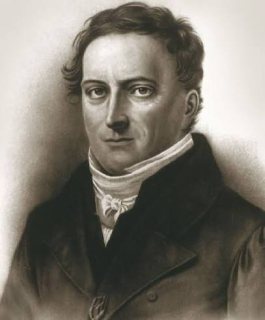
Johann Herbart (1776 - 1841)
Open Herbart's interactive page (graphs of influences, similar and opposing positions, and quotes)
Background
Johann Friedrich Herbart
Born: May 4, 1776 in Oldenburg, Germany
Died: August 14, 1841 (aged 65) in Göttingen,
Germany
Alma mater: University of Jena
School: German Idealism, Post-Kantianism
Main Interests: Logic, metaphysics, aesthetics,
epistemology, ethics, psychology, mathematics
Notable ideas: Pluralistic realism, Pedagogy as
an academic discipline
Influences: Immanuel Kant, Johann Gottlieb
Fichte, Parmenides, Christian Wolff
Influenced: Friedrich Eduard Beneke, Hermann
Lotze, Wilhelm Windelband, Immanuel
Hermann Fichte, Edmund Husserl, Antonio
Labriola, Moritz Wilhelm Drobisch, Gustav
Hartenstein, Hermann von Helmholtz, Paul
Natorp, Wilhelm Maximilian Wundt, Freud
From Wikipedia
Herbart was a German philosopher, psychologist and founder of pedagogy as an academic disci- pline. Herbart is now remembered amongst the post-Kantian philosophers mostly as making the greatest contrast to Hegel - in particular in rela- tion to aesthetics. His educational philosophy is known as Herbartianism…. Herbart's pedagogy emphasized the connection between individual development and the resulting societal contribu- tion…. [O]nly by becoming productive citizens could people fulfill their true purpose.
Introductory Comments
In 1797, at twenty-one, Herbart left the University of Jena without taking a degree and went to Switzerland as private tutor to the three sons of a Bernese magistrate. He had spent his student years under Fichte's spell and steeped in Kant, and he was already beginning to squirm. What the tutoring gave him was better than a system: three actual boys, of different ages and temperaments, who had to be taught something. Like every teacher before and since, he ran into trouble with attention, motivation, and comprehension. Unlike most, he wrote it up. Every few months he sent the boys' father a report on how the work was going and why - the first sketches of what would become the discipline called pedagogy.
From his hands-on experience as a tutor, Herbart concluded that student comprehension is largely a matter of apperception - the assimilation of new facts and ideas with facts and ideas already acquired. A teacher who merely scatters facts across a class, like a sower broadcasting seed, has done the easier half of the job. She must also show how each new item lodges in or expands upon what her students already know. Learning, on this view, is connecting dots. So the sequence and form of what she presents matter enormously. Information must be given in an order that is in sync with her students' growing capacities. If her students are to find the elephant hidden in the dots, she must first make sure her students are ready to find it.
Some of Herbart's Key Positions
Kant was wrong to posit innate categories of understanding built into the mind from birth. Locke was nearer the mark: the newborn mind is empty, waiting on experience. But the emptiness runs deeper than Locke supposed. There are no faculties either - no separate powers of intellect, feeling, and will standing ready to be exercised.
Kant was also wrong about the status of things-in-themselves. He had declared them permanently unknowable, our perceptions being irredeemably subjective. But since perception normally arises from genuine interaction with external reality, things-in-themselves are not sealed off from us at all. What we call knowledge is built up as the mind compares, combines, and reworks its perceptions into ever more complex ideas.
This building-up process, called apperception, continually absorbs new perceptions into the stock of ideas already on hand. It should also be the linchpin of our educational theory. A good teacher must always ask how a new lesson connects to and enlarges what a student already knows; teaching that ignores this fit will simply fail to take root.
But education must do more than accumulate knowledge. Its highest purpose is the formation of moral character. By cultivating broad and varied interests, clear judgment, and disciplined self-control, education prepares students not merely to know the world, but to act responsibly within it.
Place in the History of Ideas
Herbart's Place in History of Ideas
Kevin Knight: Herbart's main interest in philoso- phy... is the problem of Education - its object, its method, its possibilities. Education is in fact both the starting point and the goal of all his philosophical inquiries. The end of education is, he holds, determined by ethics. It is the forma- tion of noble, cultivated, moral character.... Ideal character is to be attained by "many-sided interest." The full development of the individ- ual, the realization of all his capabilities, should be then the constant aim of the process of education.
Alan Kim: In psychology and pedagogy, [Her- bart's] influence was [great and] lasting.... Though his mathematization of the mind proved a dead end, it encouraged early experi- mentalists like Fechner to apply mathematics to the psyche. His interpretation of space had an important influence on Helmholtz’s empirical theory of vision, and on Natorp’s “logicization” of Kantian spatio-temporal intuition. Herbart’s arguments against psychological faculties were taken over by Wundt, and his notions of the limen and the “subconscious” were fundamen- tal to Freud’s psychoanalytic theory. In philoso- phy, Herbart anticipated key ideas of Phenome- nology, such as Brentano’s conception of men- tal phenomena, and his ideas of representation- al force, the limen, and reproduction all find positive endorsement and development in Husserl’s Phenomenology.
Random Thoughts on Herbart
Herbart put ethics inside aesthetics, and he meant it structurally, not as a metaphor. Both domains issue judgments of approval - immediate verdicts that arrive unbidden. Strike a sour chord and nobody deliberates; the wince precedes the analysis. Moral judgment, Herbart held, works the same way, and its objects are not acts per se but "relations of will," just as music judges intervals rather than single tones. Five such relations win our unconditional approval: inner freedom (the agreement of a will with its own better judgment), perfection (a will concentrated rather than scattered), benevolence (a will bent toward another's good), right (the settlement that keeps two wills from grinding against each other), and retribution (the requiting of a deed with its equal). Conceive any one of them clearly and the verdict comes immediately and on its own.
The appeal is easy to see: no dry Kantian formalism, no reliance on revelation, and no dissolving into mere emotion. The trouble is that aesthetic judgments can be vague and contested, which makes clear rules hard to come by. Herbart's answer: retribution is measured against the deed, so that the response to an immoral act is itself immediate and unbidden. Still, the awkward question survives. Do those five relations point to the necessary structures of willing, let alone to moral judgment? Or are they the moral ear of a north German Protestant around 1808, mistaking its own tuning for the music of the spheres?
Influences
Herbart was influenced by: Fichte, Kant, Leibniz, Locke, Parmenides, Wolff
Herbart influenced: Beneke, F.E., Drobisch, M.W., Fichte, I.H., Freud, Hartenstein, G., Helmholtz, Husserl, Labriola, A., Lotze, Natorp, Paul, Windelband, Wundt
Similar and opposing positions
Thinkers with similar positions:
- Dewey (Education should be an active, engaged, and "hands-on" process.)
- Freud (Much of our behavior springs from unconscious motives and beliefs.)
- Gassendi (There is nothing in the mind which has not first been in the senses.)
- Iamblichus (The key to understanding the workings of nature is mathematics.)
- Locke (Education is more than memorization. Children must learn to reason.)
- Locke (Knowledge is empirical and springs from observing the actual world.)
- Montaigne (A liberal education develops a capacity to think deeply & broadly)
- Piaget (To function well, democracy requires an engaged & educated citizenry.)
- Seneca (The best way to establish virtue is through a liberal education.)
Thinkers with opposing positions:
- Brentano (There is no such thing as an unconscious mental act.)
- Hegel (There is a “rational” inevitability at work in the course of history.)
- Kant (Humans are born with certain innate ideas already in their mind.)
- Luther (Given God's sovereignty & our own sinfulness, there is no free will.)
- Proudhon (As we seek justice in equality, so society seeks order in anarchy.)
- Skinner (Behavior is a matter of stimuli & responses, not psyche or inner states.)
- Spinoza (Nothing is good or bad independent of human desires and beliefs.)
What others said about Herbart
- Edwin Boring: Leibniz foreshadowed the entire doctrine of the unconscious, but Herbart actually began it.
- Gustav Jahoda: Unlike Kant, Herbart believed that there can be a psychological science along the lines of Newtonian physics: "The lawfulness of the human mind [Geist] is exactly the same as that of the starry sky."
- Alan Blyth: He believed that every child is born with a unique potential, his Individuality, but that this potential remained unfulfilled until it was analysed and transformed by education in accordance with what he regarded as the accumulated values of civilisation.
- Kathleen Cruikshank: Integrated curriculum, elementary school history teaching, and constructivist learning theory are part of the contemporary legacy of Herbartianism.
- Benjamin Wolman: [Herbart] barely saw the world outside his study and the classrooms [making] his world the world of books and only books.
- Alan Kim: If virtue is the realization of human freedom, then the goal of Herbartian education is to make the child capable of living virtuously, viz., by forming the pupil’s character.
- David E. Leary: Even though Herbart himself denied the possibility of an experimental psychology, and despite the fact that his own psychology (as a branch of applied metaphysics) was largely conjectural, his example inspired subsequent scholars to work toward a quantitative, experimental discipline of psychology.
- Karl Vossler: One cannot lean on the psychology of Herbart without getting his metaphysics as part of the bargain. What lies at the threshold of the empirical sciences as pure metaphysics cannot be dismissed.
Schools: Post-Kantian Philosophy
Main interests: Art and Aesthetics, Epistemology, Ethics, Logic, Mathematics, Metaphysics, Psychology
Herbart's answers to philosophical questions
Art and Aesthetics
Aesthetics concerns values. It does not deal directly with reality, but rather with our judgments of reality.
Education
"Learning must serve the purpose of creating interest. Learning is transient, but interest must be lifelong."
Mathematics is essential to a good education, since learning mathematics sharpens perception and fosters logical thinking.
Educators should not wait for students to show interest. Rather, "learning must serve the purpose of creating interest."
The aim of education is in large part moral: Education should help develop ethical behavior and personal character.
Epistemology
Without a careful, logical study of experience, advancement in knowledge would be impossible.
"The world is a world of things-in-themselves [and] the things-in-themselves are perceivable."
Though experience consists of internal phenomena, it at the same time points directly to the existence of an outside world.
Space, time, matter and motion are not real things. Rather, they are appearances that make reality comprehensible.
We understand the world through rational concepts. These concepts develop over time and build upon one another.
Metaphysics
Monism is impossible: reality can't be reduced to a single ground. Pluralistic experience points to a pluralistic world.
Mind
The power of dialectics: "Concepts become forces when they resist one another."
Psychology
As very young children, we develop an internal metaphysics that distinguishes self from other, appearance from reality.
Science
Mental processes should be understood and modeled mathematically. This will make psychology a more scientific discipline.