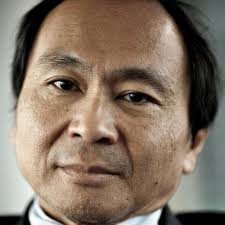
Francis Fukuyama (1952)
Open Fukuyama's interactive page (graphs of influences, similar and opposing positions, and quotes)
Background
Francis Fukuyama
Born: October 27, 1952 in Chicago,
Illinois, U.S.
Alma mater: Cornell University (BA, 1974),
Harvard University (PhD, 1981)
Main Interests: Developing nations, Governance,
International political economy, Nation-building
and democratization, Strategic and security
issues
Influences: Aristotle, Karl Marx, Sigmund Freud,
Charles Darwin, Friedrich Nietzsche, C. S. Lewis,
Allan Bloom, Hegel, Samuel P. Huntington,
Alexandre Kojève, Harvey Mansfield, Leo
Strauss, Seymour Martin Lipset
From Wikipedia
Fukuyama is known for his book The End of History and the Last Man, which argues that the world- wide spread of liberal democracies and free-mar- ket capitalism of the West and its lifestyle may signal the end point of humanity's sociocultural evolution and political struggle and become the final form of human government, an assessment met with criticisms. In his subsequent book Trust: Social Virtues and Creation of Prosperity, he modi- fied his earlier position to acknowledge that cul- ture cannot be cleanly separated from economics.
Introductory Comments
Fukuyama argues that a healthy liberal democ-racy rests on three pillars: a strong central gov- ernment staffed by a professional bureaucracy, a rule of law that binds even those who rule, and genuine accountability to citizens, usually through elections. The order in which these arrive - and the balance struck among them - varies from nation to nation, but skip any one of them and the whole structure wobbles. A state without competent government collapses into chaos and corruption; a state without the rule of law breeds tyrants; and a state without free elections leaves its citizens unable to fix what's broken or decide what matters.
History is littered with cautionary tales. Post-Soviet Russia held elections but lacked impartial law and a clean bureaucracy, and so account-ability curdled into oligarchy and strongman rule. Many post-colonial states inherited the trappings of government without the profes-sional institutions to run them, and good inten- tions drowned in patronage. Even ancient em- pires that mastered administration often had no mechanism to remove a bad ruler short of a palace coup or a peasant revolt - an early and bloody form of "term limits." The lesson is stub- bornly consistent: democracy is a delicate bal- ancing act among power, restraint, and con- sent. Think of the three elements of a liberal de- mocracy as the three legs of a stool: remove any one of them, and you're on the floor.
Some of Fukuyama's Key Positions
The question is not "Does history have an end" - at least not in the time-related sense of the word "end." Certainly major events will continue to occur as long as we don't blow up our species in a grand nuclear fireworks. No, the question is "Does history reveal an end?" That is, does history seem to be working toward a final goal or an ideal order?
The answer, at least regarding political institutions, seems to be - surprisingly - yes. And the goal here is the modern liberal democratic state. This is no accident, for liberal democracy - despite its serious imperfections and vulnerability to decay - has no superior ideological rival and offers the broadest, most durable basis for legitimacy, in part because it best satisfies the human desire for recognition.
The modern democratic state has three components: a strong central government with a professional bureaucracy; a rule of law binding even on the rulers; and some accountability to citizens, usually through elections. The order in which these develop, and the balance struck among them, varies - but all three are essential. Without strong, professional government, the state is prone to chaos and corruption. Without the rule of law, leaders are prone to tyranny. And without free and fair elections, citizens cannot correct political problems or set priorities.
Place in the History of Ideas
Fukuyama's Place in History of Ideas
Niccolo Soldo: Like so many others, the temptation to dunk on Francis Fukuyama for his triumphalist End of History and the Last Man is simply too great for me to avoid. The idea that liberal democracy would become the default ruling paradigm globally due to the collapse of its systemic rival, communism, is now, in hindsight, such a ridiculous assertion that anyone asserting it sincerely way back in the 1990s can only be viewed as having been intoxicated while doing so. This is a testament to the impermanence of international relations, statecraft, and the human condition.
Blake Smith: Nearly all of his readers missed his much more subtle point, re-elaborated in that reply, The End of History and the Last Man, and still again in "Reflections on The End of History, Five Years Later" that the prospect of liberal democracy overtaking all alternative forms of government cannot be an object of rational certainty but only of "hope." This hope is inseparable from Fukuyama’s fear that if the world does not imagine history to have a "progressive character" trending toward the spread of their own political values, then their adherence to liberal democracy - and thus the regime itself - will be fatally undermined. Without this hope in history, the United States will come to the same end as the Soviet Union. Fukuyama… seems to have taken it upon him- self to give grounds to this... necessary "hope."
Random Thoughts on Fukuyama
Fukuyama places special emphasis on the rule of law because it establishes the principle that government itself is subject to higher rules. To explain how rule of law evolved, he contrasts the histories of China and the West: China uni- fied under a powerful centralized state more than 2000 years ago, under the Qin and Han dy- nasties, long before any organized religion could establish itself as a rival power. The re- sult, Fukuyama argues, is that China never de- veloped a concept of law as something standing above the state. Even today, law in China re- mains whatever the Communist Party says it is.
In the West, the story unfolded differently. For centuries, Church and State were genuine rivals for power across Europe, each checking and oc- casionally humiliating the other. Pope Gregory VII and Emperor Henry IV spent years in one of history's most consequential quarrels over who had the authority to appoint bishops - a dis- pute that looks petty until you realize it quietly established the revolutionary idea that even rulers must answer to a higher law. By the time European nation-states consolidated their pow- er in the 16th and 17th centuries, their citizens had been marinating for generations in the as- sumption that some laws transcend human authority. And herein lies the delicious irony: Without those priests wagging their fingers at kings, we in the West might never have imag-ined governments could be bound by law at all.
Influences
Fukuyama was influenced by: Aristotle, Bloom, Allan, Darwin, Freud, Hegel, Huntington, S., Kojève, Lewis, C.S., Lipset, S. M., Mansfield, H., Marx, Nietzsche, Strauss
Similar and opposing positions
Thinkers with similar positions:
- Agamben (In going beyond the law, the "state of exception" breeds violence.)
- Darwin (Our moral instincts are innate and evolved with our social instincts.)
- Galbraith (Govt. should play an assertive role in improving general welfare.)
- Montesquieu (Government excesses can be avoided thru' checks & balances.)
- Orwell (The abuse of language in political discourse undermines democracy.)
- Piaget (To function well, democracy requires an engaged & educated citizenry.)
- Saint-Simon (Ideally advancement in society should be based on merit alone.)
- Spencer (History shows that, like reason & science, societies progress over time.)
- Vico (Society relies on narratives that give coherence and meaning to life.)
Thinkers with opposing positions:
- Adorno (Civilization does not inevitably lead to progress in morality and justice.)
- Carlyle (The history of the world is but the biography of great men.)
- Gentile (The state is the source of all authority and the object of all loyalty.)
- Hobbes (The sovereign is not bound by any higher laws: He makes the laws.)
- Rothbard (We should avoid all forms of intervention in affairs of other nations.)
- Rothbard (All services provided by govt. should be given to the private sector.)
- Schmitt (In "exceptional" situations the ruler must be above the law.)
What others said about Fukuyama
- Geoffrey Wheatcroft: Fukuyama is one of the former hawks - "a recovering neoconservative," as Pfaff calls him….
- Sarah Churchwell: Liberal academics like Francis Fukuyama… have recently chided progressives for championing causes like Black Lives Matter and transgender rights, thus provoking a "whitelash" among the "left-behind" Trump voters.
- Paul Sagar: Rarely read but often denigrated, ["The End of History"] might be the most maligned, unfairly dismissed and misunderstood book of the post-war era. Which is unfortunate for at least one reason: Fukuyama might have done a better job of predicting the political turmoil that engulfed Western democracies in 2016 [from Brexit to Trump…] than anybody else.
- Theodore Beale: Francis Fukuyama, the only predictor whose track record is worse than Scott "I did NOT see that coming" Adams, is convinced that history is still in the process of ending, it just didn’t end when he said it did.
- Paul Sagar: Fukuyama predicted that [egalitarian] resentment would eventually need a political outlet - and when it came, it would be explosive.
- Paul Berman: Francis Fukuyama could write his self-assured "The End of History" … because, from his American perspective, the collapse of communism plainly demonstrated that liberal democracy was history’s ultimate end.
- Blake Smith: He scolds both conservatives and progressives in the United States for their growing distrust of the "democratic process" [of] shaping of opinion through discourse. Republicans aligned with… Trump [doubt] that those opposed to their agenda [are] real Americans. The left, meanwhile, has promoted... a divisive… politics [emphasizing] group identities.
- Nigel Warburton: In essence, big-H history was, for Fukuyama, an understanding of human development as a logical progression…, a grand-narrative of progress, in which each step forward sees the world... a more rational place.
Schools: Historicism, Liberalism
Main interests: Artificial Intelligence, Bioethics, Civil Rights, Democracy, Economics, Government, History, History of Ideas, Ideology, Law, Political Philosophy, Political Theory, Politics, Power, Progress, Public Administration, Revolution, War, Wealth, Welfare State
Fukuyama's answers to philosophical questions
Economics
"Neoclassical economics [uses a] model of rational self-interested human behavior [that's] correct about 80% of the time."
"Free markets... promote long-term growth, but they are not self-regulating, particularly [as regards to] financial institutions."
"At this juncture, it seems to me that certain things Karl Marx said are turning out to be true." But he was generally wrong.
History
Does history seem to be working towards some sort of ideal order? The answer yes, at least in regards to political institutions.
The ideal order history seems to be working towards, in its slow & at times backsliding way, is the modern democratic state.
My "Marxist" take on history: "democracy is a result of a broad modernization process that happens in every country."
"Neoconservatives believed that history can be pushed along with the right application of power and will." I now have doubts.
Law
We need consitutional law to lay out governmental powers, including the power to make laws that lay out public programs.
"The courts, instead of being constraints on government, have become... instruments for the expansion of government."
Political Philosophy
We imperfect humans will probably never come up with a better political solution than liberal democracy and rule of law.
Despite its imperfections, the modern democratic state is the most just, stable, and accepted form of government possible.
"Transnational rule of law is... more in line with a 'post-historical' world than American's [emphasis on] national sovereignty."
The modern democratic state has three components: a strong central government, a rule of law, and free and fair elections.
Liberal deomocracy under rule of law is probably the best political structure for protecting the rights & interests of citizens.
Liberal democracies should, at least to some extent, guarantee the welfare of its citizens.
Society
By undermining our belief in truth & the possibility of progress, postmodern philosophy threatens our sense of community.
"[O]ver time life in a liberal society comes to be taken for granted and its sense of shared community seems thin."
"The Left’s identity politics poses a threat to free speech and to the kind of rational discourse needed to sustain a democracy."
Good government leads to a good economy: "[P]oor countries are poor... because they lack effective political institutions."