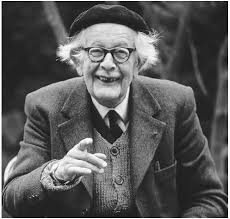
Jean Piaget (1896 - 1980)
Open Piaget's interactive page (graphs of influences, similar and opposing positions, and quotes)
Background
Jean Piaget
Born: 9 August 1896 in Neuchâtel, Switzerland
Died: 16 September 1980 (aged 84) in Geneva,
Switzerland
Alma mater: University of Neuchâtel
Main interests: Developmental psychology,
epistemology, morality, logic
Influences: Immanuel Kant, Henri Bergson,
Pierre Janet, James Mark Baldwin, Alfred Binet,
Konrad Lorenz, Claude Lévi-Strauss, Felix Klein,
Sabina Spielrein, Ernst Mach, Théodore Simon,
C. H. Waddington
Influenced: Bärbel Inhelder, Jerome Bruner,
Kenneth Kaye, Lawrence Kohlberg, Robert
Kegan, Howard Gardner, Thomas Kuhn,
Seymour Papert, Lev Vygotsky, Noam Chomsky,
Jürgen Habermas, David Ausubel, Alan Kay,
Andreas Demetriou, Roberto Refinetti, Mario
Christian Meyer, Robert Sternberg
From Wikipedia
Piaget was a Swiss psychologist known for his work on child development. Piaget's theory of cognitive development and epistemological view are together called "genetic epistemology." Piaget placed great importance on the education of children. As the Director of the International Bureau of Education, he declared in 1934 that "only education is capable of saving our societies from possible collapse, whether violent, or gradual." His theory of child development is studied in pre-service education programs.
Introductory Comments
"Genetic epistemology," Piaget's name for his life's work, sounds like something done in a laboratory. In fact the "genetic" has nothing to do with genes and everything to do with genesis. The question was how knowledge comes into being. Piaget's answer was that children build it, one revision at a time. A child makes sense of the world through mental schemas. When those schemas meet something they can't handle, the child has to rebuild them. The mind climbs from the grab-and-taste days of infancy, through the age of make-believe, to the heights of abstract reasoning, and it climbs the same stairs in the same order everywhere. Learning, on this view, is less like pouring water into a cup than like reshaping the cup itself.
Not everyone was convinced. The Soviet psychologist Lev Vygotsky agreed that children are active learners. But he thought Piaget had made learning too solitary. For Vygotsky, much of what a child comes to think begins between people, in conversation, guidance, and shared activity, before it moves inside the head. Piaget heard a preschooler's chatter during play as egocentric talk destined to fade. Vygotsky heard social speech on its way to becoming thought. If he was right, development depends heavily on a child's culture: its language, its tools, its teachers. Piaget gave us the staircase; Vygotsky reminded us that the stairs are built from local materials, to local designs, by local people.
Some of Piaget's Key Positions
Children are not small adults. They think differently, and the differences follow a pattern. Nor do they absorb knowledge passively. They construct it, testing ideas against experience like little scientists.
This construction passes through four stages, always in the same order, though at varying ages. Infants know the world through action and learn that hidden objects still exist. Young children use language freely but think egocentrically and trust appearances: water poured into a taller glass seems to become “more.” Around age seven, children reason logically about concrete things and grasp that a quantity survives a change of shape. Adolescents finally reason abstractly about the possible as well as the actual.
Throughout, experience is sorted into schemas, mental frameworks for making sense of things. New experiences either fit existing schemas or force them to change, and the push to balance the two drives development. Moral understanding develops too, as rules once seen as adult decrees become agreements among equals.
For education, the lesson is clear. Children learn by doing, not by being told. Teaching should unsettle their present thinking without overwhelming it. A concept memorized before the child can build it is words without understanding. To understand is to construct.
Place in the History of Ideas
Piaget's Place in History of Ideas
Saul Mcleod: Jean Piaget’s theory of cognitive development suggests that intelligence changes as children grow. A child’s cognitive develop- ment is not just about acquiring knowledge, the child has to develop or construct a mental model of the world. Cognitive development occurs through the interaction of innate capac- ities (nature) and environmental events (nur- ture), and children pass through a series of stages: Sensorimotor stage: birth to 2 years, Preoperational stage: 2 to 7 years, Concrete operational stage: 7 to 11 years, Formal opera- tional stage: ages 12 and up. The sequence of the stages is universal across cultures and follows the same invariant (unchanging) order.
C.J. Brainerd and V.F. Reyna: In the course of a long and hugely prolific career, he contributed important scholarly work to fields as diverse as the philosophy of science, linguistics, education, sociology, and evolutionary biology. Above all, however, he was the developmental psycholo- gist of the 20th century. For two decades, from the early 1960s to the early 1980s, Piagetian theory and Piaget's research findings domi- nated developmental psychology worldwide, much as Freud's ideas had dominated abnormal psychology a generation before. Almost single-handedly, he shifted the focus of developmen- tal research away from its traditional concerns with social and emotional development and toward cognitive development.
Random Thoughts on Piaget
Watch a group of children playing marbles, and you are watching moral philosophy in the making. That, at least, was Piaget's wager. Around 1930 he crouched down with Swiss boys and asked them about the rules of their game. Where do the rules come from? Can they be changed? The answers sorted neatly by age. Younger children treated the rules as sacred, handed down by fathers, elders, or God himself, and then played however they pleased. Older children held that rules were simply agreements among players, open to change by a vote, and then followed them scrupulously. Thinking about rules and keeping them, it seems, are separate skills. A child may reason beautifully about sharing while clutching all the toys.
What, then, moves morality forward? Cognitive growth matters: fairness means little until a child can imagine the world from someone else's point of view. But for Piaget, the decisive factor was the company children keep. Relations with adults are lopsided. A rule obeyed because someone bigger said so remains someone else's rule. But among equals, no one can pull rank. Children must argue and negotiate, and sometimes lose, and to keep the game going they must compromise. Out of that bargaining grows a "morality of cooperation," built on mutual respect rather than obedience. "Logic is a morality of thought," Piaget wrote, "just as morality is a logic of action." And so one quarrel over marbles may do more for a child's sense of justice than a thousand sermons from on high.
Influences
Piaget was influenced by: Baldwin, J.M., Bergson, Binet, Alfred, Janet, Kant, Klein, Felix, Levi-Strauss, Lorenz, Konrad, Mach, Ernst, Simon, T., Spielrein, S., Waddington
Piaget influenced: Ausubel, D., Bruner, Jerome, Chomsky, Demetriou, A., Gardner, H., Habermas, Inhelder, B., Kaye, Kenneth, Kegan, Robert, Kohlberg, L., Kuhn, Papert, S., Refinetti, R., Vygotsky, Lev
Similar and opposing positions
Thinkers with similar positions:
- Adorno (Rationality does not inevitably lead to progress in morality and justice.)
- Dewey (To function well, democracy requires an engaged & educated citizenry)
- Habermas (Reason plays a constructive role in moral, political & social systems.)
- Mill (Logic is not an autonomous discipline, but a branch of psychology.)
- Montaigne (Education should be an active, engaged & "hands-on" process.)
- Newman (A liberal education develops a capacity to think deeply and broadly.)
- Rousseau (The aim of education is not to socialize, but to liberate the man within)
Thinkers with opposing positions:
- Gassendi (Understanding relies on our senses, not on our deductive reasoning.)
- Hamann (Language does not spring from reason. Reason springs from language.)
- Husserl (Logic is an autonomous discipline, not a branch of psychology.)
- Leibniz (Humans are born with certain innate ideas already in their mind.)
- MacIntyre (Rationality is inevitably linked to cultural traditions.)
- Mead (The mind and self emerge from the social process of communication.)
- Pinker (Language develops more from specialized instincts than from reason.)
- Sextus Empiri. (Demonstrative reasoning doesn't lead to true knowledge.)
- Skinner (Behavior is a matter of stimuli & responses, not psyche or inner states.)
What others said about Piaget
- Serhat Kurt: Sigmund Freud and B.F. Skinner may have more name recognition, but Piaget’s contribution to the world is possibly more wide-reaching.
- Paul Main: Piaget did not want to measure how well children can spell, count, [etc.]. He was more intrigued to find out how the fundamental concepts such as the very idea of time, number, justice, quantity and so on emerged.
- Marvin Minsky: At one time, many philosophers held that faultless "laws of thought" were somehow inherent, a priori, in the very nature of mind…. This belief was... shaken in the past century… when Freud and Piaget started to reveal the tortuous ways in which our minds actually develop.
- Serhat Kurt: … Piaget believed that humans create their own understanding of the world. In theological terms, he was a psychological constructivist, believing that learning is caused by the blend of... assimilation & accommodation.
- Paul Main: His research interests included child development, logic, mathematics, linguistics, social sciences and education.
- Brian Duignan: Piaget saw the child as constantly creating and re-creating his own model of reality, achieving mental growth by integrating simpler concepts into higher-level concepts at each stage.
- Wilson, E.O.: Piaget, who was originally trained as a biologist, views intellectual development as an interaction of an inherited genetic program with the environment. It is no coincidence that he calls this conception "genetic epistemology," in effect the study of the hereditary unfolding of understanding.
- Kendra Cherry: Piaget believed that children take an active role in the learning process, acting much like little scientists as they perform experiments, make observations, and learn about the world.
Schools: Innatism, Rationalism, Structuralism
Main interests: Childhood, Communication, Epistemology, Logic, Mind, Perception, Personal Identity, Psychology, Science, Semantics, Semiotics
Piaget's answers to philosophical questions
Education
"The principle goal of education... should be creating men and women who… creative, inventive and… critical…."
"Only education is capable of saving our societies from possible collapse, whether violent, or gradual."
"… in order for a child to understand something, he must construct it himself, he must re-invent it."
"Each time one prematurely teaches a child something he could have discovered himself, that child is kept from inventing it."
Nurture creativity: "[E]ducation means making creators…. You have to make inventors, innovators, not conformists."
"What is desired is that the teacher ceased being a lecturer…. His role should rather be that of a mentor stimulating initiative."
"The goal of education is not to increase... knowledge but to create the possibilities for a child to invent and discover...."
Epistemology
Experience may be, by definition, subjective, but it is also how we reach objectivity: "Experience precedes understanding."
The child has various mental schemas to help her navigate her world, but the schemas change as she ages & her world shifts.
"Logic is the mirror of thought, and not vice versa." That's why grasping our thought processes is key to grasping logic.
Ethics
Moral insights occur in various stages as the child ages and her observations of the world increase and improve.
Language
Language is not based on logic, but vice versa: "Logic and mathematics are nothing but specialized linguistic structures."
Law
"How much more precious is a little humanity than all the rules in the world."
Mind
"The essential functions of the mind consist in understanding & in inventing…, in building up structures by structuring reality."
"The self thus becomes aware of itself, at least in its practical action, and discovers itself as a cause among other causes…."
"Intelligence is what you use when you don't know what to do: when neither innateness nor learning has perpared you…."
"What we see changes what we know. What we know changes what we see." And both affect what we do.
Psychology
Mental growth: Psychology needs "to explain how the transition is made from a lower level of knowledge to a [higher] level."
Educators should respects the child's current limitations (or nature) while also encouraging (or nurturing) her development.
"[T]here is no sort of boundary between the living and the mental or between the biological and the psychological."
Science
"This means that no single logic is strong enough to support the total construction of human knowledge."
"Scientific knowledge is in perpetual evolution; it finds itself changed from one day to the next."