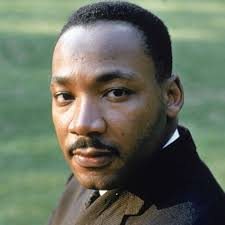
King was an American Baptist minister and activist, one of the most prominent leaders in the civil rights movement from 1955 until his assassination in 1968. An African American church leader and the son of early civil rights activist..., King advanced civil rights for people of color in the United States through nonviolence and civil disobedience. Inspired by his Christian beliefs and the nonviolent activism of Mahatma Gandhi, he led targeted, nonviolent resistance against Jim Crow laws and other forms of discrimination.
Introductory Comments
For King, nonviolent protest was not a polite request to be considered - and ignored - at leisure. He drew a sharp line between passive peacefulness - which he sometimes called "stag- nant passivity" - and the active, muscular discipline of nonviolent resistance. Boycotts, marches, sit-ins, and the willing filling of jails were designed to create what he called "con-structive tension": a moral pressure that drags hidden injustice into daylight, where a com-munity can no longer pretend not to see it. Polite requests made people comfortable; King intended to make them very uncomfortable.
In creating this productive discomfort, King in- sisted that the civil rights struggle be guided by two principles at once: justice and love. Love without justice, he warned, becomes sentimen- tal - a soft glow that warms the oppressor while the oppressed go cold. But justice alone, with- out love, hardens into vengeance, trading one tyranny for another. Both justice and love are needed, and combined in what King meant by agape: a stubborn goodwill that seeks the re- demption of the opponent even while disman- tling his injustice. Power without love is reckless and abusive; love without power is anemic and sentimental. But combining the two is harder than it sounds: it is relatively easy to love your friends or to fight your enemies, but to love your enemies while fighting them - that is the needle King was always trying to thread.
Some of King's Key Positions
The teachings of Jesus and the themes of the gospels should inspire active social engagement. To "love your neighbor as yourself" and "do to others what you want them to do to you" is to refuse injustice wherever it appears - and to confront it directly, though without violence of fist, tongue, or spirit. Love and justice belong together: love without justice is sentimental, and justice without love is brutal.
Jesus also taught, "if anyone slaps you on the right cheek, turn to him the other also." This is not passivity but a refusal of the logic of retaliation - no slap for a slap, no eye for an eye. One answers attack with firm, disciplined resistance, grounded in agape: a redemptive goodwill that sees opponents not as enemies but as misguided children of God, brothers and sisters yet to be won over. The aim is not to defeat them but to awaken their conscience.
Nonviolent resistance, as Gandhi showed, is also a powerful method against social and political injustice. Through boycotts, marches, and the willing acceptance of suffering, its practitioners "can be voices of reason, sanity, and under- standing amid the voices of violence [and] hatred," setting a mood of peace from which a system of peace may be built. Following the example of Jesus, such resistance is impatient with injustice yet patient with persons - and thus protests unjust laws openly and lovingly.
Place in the History of Ideas
King's Place in History of Ideas
Elisa Graf: The Reverend Dr Martin Luther King, Jr. is often remembered as the most visible spokesperson and leader for American civil rights, passionately defending the human rights of black Americans and effectively battling to end to racial segregation. Under his leadership the civil rights movement burgeoned into a powerful force for change and influenced the development of many movements for social progress to come. But Dr. King's crusade for social and economic justice was also a global cause; he became a world figure championing human rights movements on many continents, promoting an end to war and expressing the need for what he called, "a worldwide fellowship that lifts neighborly concern beyond one's tribe, race, class and nation."
Barack Obama: It is precisely because Dr. King was a man of flesh and blood and not a figure of stone that he inspires us so. His life, his story, tells us that change can come if you don't give up. He would not give up, no matter how long it took, because in the smallest hamlets and the darkest slums, he had witnessed the highest reaches of the human spirit; because in those moments when the struggle seemed most hopeless, he had seen men and women and children conquer their fear.... And that is why we honor this man - because he had faith in us. And that is why he belongs on this Mall, because he saw what we might become.
Random Thoughts on King
King's theology was shaped by several major thinkers. From Rauschenbusch he inherited the Social Gospel - the conviction that Christianity must address structural sin and not merely personal salvation. From Tillich he drew a so- phisticated philosophical theology that ground-ed faith in the very "ground of being," giving his religious commitments intellectual depth and resilience. And from Niebuhr, he absorbed a sober realism about human nature and the stubbornness of sin - a corrective to any naïve optimism about how quickly hearts and institu- tions change. These were not dusty academic influences; they were the bones of his thinking.
As to Jesus, King saw the humble Galilean as the embodiment of the two principles at work in nonviolent protests: love and justice. Jesus was both befriended outcasts and overturned tables, and then walked deliberately toward the cross - an "extremist for love," as King put it in the Birmingham jail. From Jesus, King drew his theology of unearned suffering as redemp- tive, and his willingness to break unjust laws openly, lovingly, and with full acceptance of the penalty. Civil disobedience, for King, was not lawlessness but a higher obedience: when human statutes collide with the law of God, conscience must answer to the higher court. And to turn the other cheek was, for King, as it was for Jesus, not surrender, but rather the most defiant thing a free soul could do.
King influenced: Abernathy, R., Hooks, B. L., Jackson, J., Johnson, L., Lewis, John, Obama, B., West, Cornel, Young, Andrew
Similar and opposing positions
Thinkers with similar positions:
Buber (People must never be seen as mere means to our personal ends.)
Croce (Civilization requires the continual vigilance against barbarism.)
Erasmus (The Christian scripture teaches us the transformative power of love.)
Jesus (Love means to love that which is unlovable, else it is no virtue at all.)
Niebuhr (Social injustice is an inherently religious problem for Christians.)
Plantinga (Man isn't sufficient unto himself. We need God’s Word & guidance.)
Thoreau (Citizens have a duty to peacefully protest governmental injustice.)
Tillich (Humanism today has too much faith in man & all too little faith in God.)
Thinkers with opposing positions:
Barth (God is personal, but personal in an incomprehensible way.)
Evola (Mixing with inferior non-European races leads to cultural decline.)
Fanon (Like colonization itself, decolonization is inherently a violent process.)
Fichte (The living moral order is itself God. There is no other God.)
Hitchens (The idea of a God is a totalitarian belief that impedes freedom.)
Niebuhr (Utopianism is always out of place in our sinful and imperfect world.)
Paine (Nature or creation is the Bible of the Deist. We need no other Bible.)
Tillich (God isn't personal. God is a pure absolute devoid of consciousness & life.)
What others said about King
Elisa Graf: [King] promoted Gandhi's view of non-violent peaceful protest as the only effective agent of real change [and] with love as its foundation.
Nelson Mandela: Let the strivings of us all, prove Martin Luther King Jr. to have been correct, when he said that humanity can no longer be tragically bound to the starless midnight of racism and war.
Malcolm X: … Martin Luther King is just a 20th century or modern Uncle Tom, or a religious Uncle Tom, who is doing the same thing today, to keep Negroes defenseless in the face of an attack, that Uncle Tom did on the plantation to keep those Negroes defenseless in the face of the attacks of the Klan in that day.
Elisa Graf: King also recognized the distinct relationship between what he called the three evils: racism, poverty, and war. He referred to them as the violence of the flesh and the violence of the spirit….
Ralph Abernathy: Martin... held to the fact that an eye for an eye and a tooth for a tooth would end up with a blind society and a toothless generation.
Obama: [We remember how Dr. King] gave mighty voice to the quiet hopes of millions; how he offered a salvation path for oppressed and oppressors alike. His words [possessed] a power and prophecy unmatched in our time.
Stokely Carmichael: Dr. King's policy was, if you are nonviolent, if you suffer, your opponent will see your suffering and will be moved to change his heart. That's very good. He only made one fallacious assumption. In order for nonviolence to work, your opponent must have a conscience. The United States has none.
Sri Chinmoy: He was a lover: a lover not only of his race but a lover of all mankind. His heart was so broad, so great, so magnanimous, and this gave him a most sincere feeling of absolute oneness with everyone.
Schools: Christian Theology, Communitarianism, Internationalism, Personalism, Social Liberalism, Virtue Ethics
Main interests: Civil Rights, Community, Equality, Eschatology, Faith, Freedom, Justice, Labor, Politics, Punishment, Racism, Religion, Social Criticism, Virtue, War