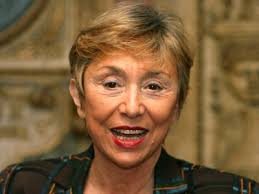
Kristeva is a Bulgarian-French philosopher, literary critic, semiotician, psychoanalyst, feminist, and, most recently, novelist, who has lived in France since the mid-1960s…. Her sizeable body of work includes books and essays which address inter- textuality, the semiotic, and abjection, in the fields of linguistics, literary theory and criticism, psycho- analysis, biography and autobiography, political and cultural analysis, art and art history. She is prominent in structuralist and poststructuralist thought.
Introductory Comments
For Kristeva, language has two elements. The semiotic is the older, wilder one - the rhythms, intonations, babbles, and bodily drives that ripple through speech before meaning gets its hands on them. The symbolic, by contrast, is language wearing a tie: grammar, syntax, refer- ence, the orderly system that lets us file taxes and write op-eds. Where the semiotic surges, the symbolic structures; where the semiotic sings, the symbolic spells. Think of the semiotic as the music and the symbolic as the lyrics - both are language, but they serve different functions: one is the rigid skeleton of a sen-tence, the other is the warm, rhythmic blood pumping through its veins.
For Kristeva, the child’s entry into language involves a gradual shaping of this raw, rhythmic semiotic flow into the rule-bound symbolic order. As infants, we dwell largely in tones, cries, and bodily rhythms; as we acquire lan- guage, these become disciplined into words and sentences under social norms. Yet the earlier layer is never erased. It continues to surface in slips of the tongue, poetic invention, emotional emphasis, and even in the peculiar music of everyday speech. The adult speaker is thus not a clean rational machine but a negotiated space where impulse and structure coexist - grammar riding atop a restless undercurrent. Put sharply: we never outgrow the murmur beneath mean- ing; we just learn to speak over it.
Some of Kristeva's Key Positions
Signification has two parts: The first part is the semiotic, which is related to the infantile pre-Oedipal stage of life. This pre-linguistic modality the chora - a mobile, rhythmic space of drives and instinctual energies, associated with the phonetic aspect of language rather than its semantic aspect. Being focused on sound and its evocative resonance, the semiotic is also associated with the musical, the poetic, the rhythmic, and the "feminine."
Once the child has entered the Mirror Stage (when infants recognize themselves in the mirror), he or she approaches the thetic phase -the threshold at which the symbolic part of signification becomes possible. This is the shared cultural realm of symbols, be they in language, art, or any other medium. In contrast to the semiotic, the symbolic is associated with law, structure, and the "masculine."
The transition from the semiotic to the symbolic is neither sudden nor total, particularly for females - who continue to identify with their mothers to some extent. However, any general claim regarding males and females must be tempered by the recognition that there are as many different kinds of sexualities as there are people. This is why we need a "third generation" feminism - one that moves beyond the opposition between equality and difference toward an exploration of multiple, singular identities.
Place in the History of Ideas
Kristeva's Place in History of Ideas
Kelly Oliver: Kristeva’s theories synthesized elements from such dissimilar thinkers as the French psychoanalyst Jacques Lacan, the French philosopher Michel Foucault, and the Russian literary theorist Mikhail Bakhtin. Two distinct trends characterize her writings: an early struc- turalist-semiotic phase and a later psychoana- lytic-feminist phase. During the latter period Kristeva created a new study she called “sema- nalysis,” a combination of the psychoanalysis of Sigmund Freud and the semiology, or semiotics (the study of signs), of the Swiss linguist Ferdin- and de Saussure and the American philosopher Charles Sanders Peirce. Her most important contribution to the philosophy of language was her distinction between the semiotic and the symbolic aspects of language. The semiotic, which is manifested in rhythm and tone, is associated with the maternal body. The symbolic, on the other hand, ... is associated with referential meaning.
Ingrid Schreiber: Today, Kristeva remains an influential public intellectual and polymath, having written over 30 books on diverse subjects in philosophy, linguistics, critical theory, art, psychoanalysis, and international relations. Much of her work transcends disciplinary boundaries, driven instead by a fascination with the key interdisciplinary themes of language, subjectivity, affect, semiotics, and power.
Random Thoughts on Kristeva
Kristeva's distinction between the semiotic and the symbolic (see Introductory Comments) has not gone unscathed. As a description of infant development, modern developmental linguis- tics confirms that pre-linguistic infants are in- deed attuned to rhythm, intonation, and affec- tive patterning before they acquire words - so she is onto something real. But the clean narra- tive of rupture and loss sits uneasily with re- search showing language acquisition to be grad-ual, social, and variable across cultures; the Lacanian drama of separation feels more like myth than mechanism. The semiotic/symbolic distinction also risks romanticizing pre-verbal experience as some lost Eden of pure feeling - which is, let us say, a generous reading of what toddlers are actually up to.
For literary and cultural studies, however, the framework earns its keep. Kristeva's concept of the semiotic gives critics tools to discuss what texts do beyond what they say: the disruptive rhythms of modernist poetry, the transgressive excess of Céline or Artaud, the bodily, maternal undertow in writing that resists symbolic con- tainment. It also opens productive space for feminist analysis of how the dominant symbolic order marginalizes voices coded as feminine, excessive, or irrational. The risk, as with much psychoanalytic theory, is that the framework is so elastic or indeterminate that it can reveal more about the observer than the observed.
Condorcet (Patriarchal norms that oppress & marginalize women must end.)
Fuller (Women have a right to a good education and meaningful employment.)
Merleau-Ponty (Mind & body unite in a consciousness that is itself embodied.)
Nussbaum (The claim that gender is just a cultural construct is not plausible.)
Peirce (Since all thought takes time, all thought is in signs or sign processes.)
Schleiermacher (Reading involves a discourse between the interpreter & text.)
Sidgwick (As equally rational, girls and boys should be educated in same way.)
Stanton (The personal is political. Laws must consider the plight of women.)
Thinkers with opposing positions:
Augustine (Soul and body are distinct substances and soul is superior to body.)
Bradley (Reality is ideal, whole and one. There are no real separate things.)
Butler, Judith (Gender is the cultural interpretation of sexuality.)
Descartes (We are fundamentally thinking beings. Our being rests in thought.)
Evola (Women are by nature completely subordinate to men & must remain so.)
Freud (Penis envy explains much about the psychology of girls and women.)
Irigaray (Perceived sexual differences are due more to culture than biology.)
Philo (God, not man, is the source of all meaning and purpose in life.)
What others said about Kristeva
Kelly Oliver: Kristeva's writing is an intersection between philosophy, psychoanalysis, linguistics, and cultural and literary theory.
Ingrid Schreiber: [S]he is widely credited - along with Hélène Cixous and Luce Irigaray - with reconfiguring psychoanalysis from its patriarchal, conservative origins into a liberal, gender-critical language for critiquing hegemony.
Barthes: Julia Kristeva changes the place of things: she always destroys the last prejudice, the one you thought you could be reassured by, could take pride in; what she displaces is the already-said, the déja-dit, i.e., the instance of the signified, i.e., stupidity; what she subverts is authority -the authority of monologic science, of filiation.
Kelly Oliver: Kristeva attempted to bring the "speaking body" back into linguistics and philosophy. She proposed that bodily drives are discharged in language and that the structure of language is already operating in the body.
Ingrid Schreiber: In her theory, any hatred of Otherness becomes redirected hatred of the self.
Jeanne Willette: [In response to Kristeva, Judith] Butler called for a greater emphasis on the "materiality" of the female body, rather than allowing the woman to vanish into the theoretical materiality of language.
Roman Jakobson: Both readers and listeners, whether agreeing or in stubborn disagreement with Julia Kristeva, feel indeed attracted to her contagious voice and to her genuine gift of questioning generally adopted "axioms," and her contrary gift of releasing various "damned questions" from their traditional question marks.
Emma Brodeur: I wonder, too, if Kristeva’s psychoanalysis is a secular form of religion, in particular, of the Christian/humanistic tradition out of which she develops her thought.
Main interests: Alienation, Art and Aesthetics, Autobiography, Communication, Community, Cultural Criticism, Desire, Equality, Eroticism, Health, History, Language, Literary criticism, Literary theory, Literature, Love, Metaphilosophy, Metaphors, Personal Identity, Political Activism, Politics, Psychoanalysis, Psychology, Religion, Semiotics, Sexuality, Social Criticism, Social Theory, Time, Wisdom