Margaret Fuller (1810 - 1850)
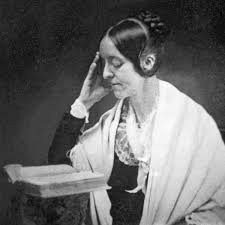
Open Fuller's interactive page (graphs of influences, similar and opposing positions, and quotes)
Background
Margaret Fuller
Born: May 23, 1810 in Cambridgeport,
Massachusetts, U.S.
Died: July 19, 1850 (aged 40) off Fire Island, New
York, U.S.
School: Transcendentalism, feminism
Main interests: Journalism, woman's rights,
social reform, politics, abolition, education
Influences: Emerson, Swedenborg, Timothy
Fuller, Jr., Rousseau, Byron, Madame de Staël,
Harriet Martineau, Bronson Alcott, Elizabeth
Peabody, William Ellery Channing, William
Henry Channing, Sarah and Angelina Grimke,
Nathaniel Hawthorne, Adam Mickiewicz,
Goethe, Orestes Brownson, Fourier
Influenced: Elizabeth Cady Stanton, Susan B.
Anthony, Emerson, Horace Greeley, Helen
Campbell, Grace Greenwood, Ida B. Wells,
Louisa May Alcott, Whitman, Matilda J. Gage
From Wikipedia
Fuller was an American journalist, editor, critic, translator, and women's rights advocate associated with the American transcendentalism movement. She was the first American female war correspondent and full-time book reviewer in journalism. Her book Woman in the Nineteenth Century is considered the first major feminist work in the United States…. She also encouraged many other reforms in society, including prison reform and the emancipation of slaves in the United States.
Introductory Comments
In April 1847, during Holy Week, Margaret Fuller went to hear vespers at St. Peter's and lost her party in the crowd. A young Roman noticed her looking stranded and offered to help her find them. He did not succeed, so he walked her home instead. She was 36, the New-York Tribune's correspondent in Italy and the first woman any American paper had sent abroad to do that job. He was Giovanni Angelo Ossoli, roughly ten years younger, a marquis of an old family and no money. She had read Goethe in German and been Emerson's editor. He had read very little. What they had in common was Italy: its independence, and its claim to be a republic.
Fuller had spent her life being described as formidable, which in the 1840s was rarely a compliment for a woman. In Ossoli she found someone her intellect did not alarm. A son, Angelo, was born in September 1848 in the hill town of Rieti, where she had gone to hide the pregnancy. Whether she and Ossoli ever married remains unknown. Domestic happiness, when it came, came braided with secrecy, poverty, and separation. Then the melodrama: French troops crushed the Roman Republic in July 1849 and the three of them sailed for America in the spring of 1850, on a merchant ship - without its captain, who had just died at sea of smallpox. On July 19, in a hurricane, the inexperienced mate put the ship onto a sandbar a few hundred yards off Fire Island. All three drowned within sight of shore.
Some of Fuller's Positions
Every soul is owed the chance at self-culture - the unfolding of its own powers - an obligation owed to God before any husband, father, or legislature. Grant a woman a real education and she will not stay content inside the boundaries drawn for her.
Nor should women be confined to the occupations deemed suitably feminine, teaching chief among them. Let them be sea captains, if they will.
Having an occupation also means that women will no longer need to be dependent on their husbands. Women too often - from fear of poverty or from their own sense of weakness - marry out of desperation and pretend to respect men who deserve little respect.
And as to sexual differences, no man is wholly masculine, no woman purely feminine. The two temperaments - the self-possessed and the intuitive - mix in everyone. What woman needs is not to rule as a woman but to grow as a nature and live unimpeded as a soul.
Besides the plight of women, other social problems need to be addressed: homelessness and abject poverty, the inhumane prison system, the unjust way we have treated Native Americans, and of course "this cancer of slavery." No human should be held in bondage: not by a master, not by a husband, not by stereotypes that cramp a life before it can take its shape.
Place in the History of Ideas
Fuller's Place in History of Ideas
Joseph Jay Deiss: Margaret Fuller still probably holds more firsts than any other American woman who ever lived. As editor of the transcendentalist Dial, she was the first woman editor of an important intellectual magazine. She was the first woman to write a book about the West and such experiences as sleeping in a barroom, shooting rapids in an Indian canoe, and witnessing maltreatment of the red man by the white man. She was the first woman to break the taboo against the female sex in the Harvard College Library. As columnist for Horace Greeley's New York Tribune, she was the first U.S. woman journalist and and the first professional literary critic of either sex in the United States.
Charles T. Congdon: In American literature she will remain a remarkable biographic phenomenon, while the tragic death of this Lycidas of women, a most painful personal story of shipwreck, was intensified by so many melancholy incidents that whoever, long years hence, may read them, will wonder how the gods could have been so pitiless, and why the life of new happiness and larger intellectual achievement which was before her should so suddenly have ended upon that savage and inhospitable shore.
Edgar Allan Poe: Humanity is divided into Men, Women, and Margaret Fuller.
Random Thoughts on Fuller
Every generation enjoys catching an ancestor in the act of being modern, and Fuller makes the temptation nearly irresistible. A full century before researchers began prying "gender" loose from "sex" in the 1950s and '60s, she had written that male and female are two sides of a single radical dualism, "perpetually passing into one another," and that "there is no wholly masculine man, no purely feminine woman."
But the honest reader has to resist a little. Fuller was not describing identity, and the vocabulary she would need for that had not been invented. Her sources were Goethe, Swedenborg, and the venerable idea of the androgynous soul, and her claim was a metaphysical one: the qualities the age had parceled out by sex - intuition and self-possession - are in fact distributed unevenly through every individual.
That argument had a private source. Margaret grew up knowing she did not fit the mold, and her contemporaries kept saying so - usually about her conversation, which could flatten a room. The quip that trails her, "humanity is divided into men, women, and Margaret Fuller," has long been pinned on Poe, though nobody has produced the page. Whoever said it meant to needle her. Read from here it lands as something closer to a compliment: the categories on offer were too small, and everyone could see it, including the people making jokes.
Influences
Fuller was influenced by: Alcott, B., Brownson, O., Byron, Channing, W.E., Channing, W.H., de Stael, Emerson, Fourier, Fuller, T. Jr., Goethe, Grimke, Sarah, Hawthorne, Martineau, H., Peabody, E., Rousseau, Swedenborg
Fuller influenced: Alcott, L.M., Anthony, S.B., Campbell, H., Emerson, Gage, M.J., Greeley, H., Greenwood, G., Stanton, Wells, Ida B., Whitman
Similar and opposing positions
Thinkers with similar positions:
- Condorcet (Patriarchal norms that oppress and marginalize women must end.)
- de Beauvoir (Politics includes household relationships between the sexes.)
- Dewey (To function well, democracy requires an engaged & educated citizenry.)
- Emerson (Besides being beautiful, Nature is also a moral & spiritual guide.)
- Humboldt, W. (A vibrant, liberal democracy requires universal public education)
- Lacan (Male and female sexual identities are largely based on fictions.)
- Rousseau (Education is crucial to the emancipation of all individuals.)
- Sidgwick (As equally rational, girls and boys should be educated in same way.)
- Stanton (The personal is political. Laws must consider the plight of women.)
- Wollstonecraft (As rational beings, women must have same rights as men.)
Thinkers with opposing positions:
- Arendt (Politics doesn't include household relationships between the sexes.)
- Bentham (Talk of natural rights is mere rhetoric - just "nonsense upon stilts.")
- Evola (Women are by nature completely subordinate to men & must remain so.)
- Evola (Liberal democracy represents an ignoble trend towards mediocrity.)
- Fichte (Active citizenship and civic freedom should be withheld from women.)
- Kristeva (Cultures come into being by excluding the maternal & the feminine.)
What others said about Fuller
- Susan B. Anthony: [Fuller] possessed more influence on the thought of American women than any woman previous to her time.
- John Matteson: To imagine that Fuller could conduct herself as she did and never run afoul of gender prejudice is fanciful. To suppose that such biases were alone responsible for her troubles is equally so.
- Megan Marshall: As Margaret would later write, Europe had come to seem "my America," an unsettled territory where liberty was at hand, while the New World she had left behind had grown "stupid with the lust of gain, soiled by crime in its willing perpetuation of slavery, shamed by an unjust war," the imperialist conflict with Mexico over… Texas.
- Emerson: She was an active, inspiring companion and correspondent, and all the art, the thought, the nobleness in New England seemed at that moment related to her and she to it. She was everywhere a welcome guest.
- Matilda Joslyn Gage: [Fuller] was the precursor of the Women's Rights agitation.
- Edgar Allan Poe: ["Woman in the Nineteenth Century" is] a book which few women in the country could have written, and no woman in the country would have published, with the exception of Miss Fuller.
- Sophia Hawthorne: The impression [her book] left was disagreeable. I did not like the tone of it - and did not agree with her at all about the change in woman's outward circumstances.... Neither do I believe in such a character of man as she gives. It is altogether too ignoble.... I think Margaret speaks of many things that should not be spoken of.
- Emerson: I remember that she made me laugh more than I liked; for I [had], at that time,... tasted the sweets of solitude and stoicism, and I found something profane in the hours of amusing gossip into which she drew me...
Schools: Feminism, Transcendentalism
Main interests: Abolition of slavery, Education, Equality, Immortality, Journalism, Love, Political Activism, Politics, Social Criticism
Fuller's answers to philosophical questions
Art and Aesthetics
"Art can only be truly art by presenting an adequate outward symbol of some fact in the interior life."
"The critic is beneath the maker, but is his needed friend….. Next to invention is the power of interpreting invention…."
"
Economics
Work is important for everyone, including women, but it's not everything: "Men for the sake of getting a living forget to live."
Ethics
"Man can never come up to his ideal standard. It is the nature of the immortal spirit to raise that standard higher & higher…."
"Two persons love in one another the future good which they aid one another to unfold."
Language
"Essays... are epistles addressed to the public, through which the mind of the recluse relieves itself of its impressions."
Law
"Let no one dare aid in punishing another as criminal who is not willing to suffer the penalty due to his own offenses."
Metaphysics
"Time flows on steadily, whether [man] regards it or not, yet unless he keep time there is no music in that flow."
Mind
"But the intellect, cold, is ever more masculine than feminine; warmed by emotion, it rushes towards mother earth…."
Nature
"Nature seems to have poured forth her riches so without calculation, merely to mark the fullness of her joy."
Psychology
"No man can be absolutely true to himself, eschewing cant, compromise, servile imitation... without becoming original."
Religion and Theology
"Let this day's performance of the meanest duty be thy religion…. [P]ick up [a] pebble..., and from it learn the all."
"I wish woman to live, first for God's sake. Then she will not make an imperfect man for her god and thus sink to idolatry."
"[L]et us be completely natural, before we trouble ourselves with the supernatural…. There is marvel... enough in that for me."
Sex and Gender
Women see things differently: "The especial genius of women I believe to be... intuitive in function, spiritual in tendency."
"There is no wholly masculine man, no purely feminine woman…. Nature provides exceptions to every rule."
"Marriage is the natural means of forming a sphere, of taking root on the earth: it requires strength to do this…."
Women must be given all the rights & opportunities of men, including the opportunity to pursue any job that interest them.
Education is key to an independent and meaningful life - particularly for women, who suffer from many social biases.
Society
"Man is not made for society, but society is made for man. No institution can be good which does not tend to improve [us]."