Elizabeth Stanton (1815 - 1902)
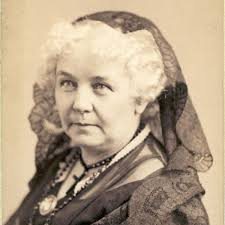
Open Stanton's interactive page (graphs of influences, similar and opposing positions, and quotes)
Background
Elizabeth Cady Stanton
Born: November 12, 1815 in Johnstown, New
York, U.S.
Died: October 26, 1902 (aged 86) in New York
City, New York, U.S.
Spouse: Henry Brewster Stanton (m. 1840)
Main interests: Women's rights, abolition of
slavery, religion, law, Temperance movement
Influences: Mary Wollstonecraft, Frederick
Douglass, Sarah Moore Grimké, William Lloyd
Garrison, Theodore Parker, Charles Grandison
Finney, Henry Brewster Stanton, Louisa May
Alcott, Ralph Waldo Emerson, Gerrit Smith,
Susan B. Anthony, Lucretia Mott, Margaret
Fuller, John Stuart Mill, Harriet Taylor Mill
Influenced: Henry Brewster Stanton, Susan B.
Anthony, Matilda Joslyn Gage, Harriot Stanton
Blatch
From Wikipedia
Stanton was an American writer and activist who was a leader of the women's rights movement in the U.S. during the mid- to late-19th century. She was the main force behind the 1848 Seneca Falls Convention, the first convention to be called for the sole purpose of discussing women's rights, and was the primary author of its Declaration of Sentiments. Her demand for women's right to vote generated [controversy] but quickly became a central tenet of the women's movement. She was also active in [the abolitionist movement].
Introductory Comments
Stanton insisted that personal, domestic matters were political ones, because she believed women's legal powerlessness fed directly into their private suffering. She had seen too many women trapped in abusive marriages with no way out - unable to divorce drunken or violent husbands, unable to control their own property or earnings, legally bound even to submit to unwanted sexual advances. The vote, she reasoned, would mean little if women lacked the power to rewrite the laws governing their most intimate lives.
Other suffrage leaders, notably Lucy Stone, thought this approach would backfire. Talk of divorce, domestic violence, and sexual autonomy, they feared, would confirm male anxieties that women's suffrage threatened the family itself and would brand the whole movement as scandalous—alienating the moderate men and cautious women whose support the cause needed. Many also worried that such talk would distract from the immediate goal of winning the vote.
The dispute concerned how much a movement should demand at once, which injustices could wait, and who would bear the cost of waiting. It boiled down to a familiar tension: propriety and gradual change, or audacity and sweeping transformation? Stanton's critics answered, in effect, that the perfect should not be the enemy of the good. Stanton answered back that justice delayed is justice denied.
Some of Stanton's Positions
Women are entitled to the same rights and opportunities as men, including the freedom to pursue their interests and enter the occupations of their choice. Education is essential to individual development, and women must have equal access to every level of it.
Women must also have the vote. As citizens subject to the law, they deserve an equal voice in making it. Without political power, they remain dependent on men to protect interests that men have too often ignored or overridden.
Drunkenness exposes wives and children to violence, neglect, and poverty. Temperance reform must therefore protect families as well as discourage drinking. Women must also have the right to divorce habitually drunken husbands rather than remain legally bound to men who endanger their well-being.
Marriage must not deprive a woman of control over her property and earnings. Married women must be able to own and manage property in their own right, including what they bring into marriage and what they subsequently earn or inherit. Economic independence is essential to protecting themselves and their children from an irresponsible husband.
Each person finally faces life alone. This "solitude of self" is the deepest grounds for women's rights.
Place in the History of Ideas
Stanton's Place in History of Ideas
Dorothy Rogers: Along with Susan B. Anthony, Stanton fueled the movement for women’s suffrage. She advocated for change in both the public and private lives of women - regarding property rights, equal education, employment opportunity, more liberal divorce provisions, and child custody rights. By addressing such a wide range of women’s issues, she laid down the foundation for the three main branches of feminism that are in existence today: liberal feminism, which focuses on women’s similarities to men and emphasizes equality; cultural feminism, which celebrates women’s differences from men and aims for gender equity; and dominance feminism, which focuses on male power/female submission and aims to overturn all forms of gender hierarchy.
Margaret S Marsh: Mainstream feminist leaders (with the exception of the aging Elizabeth Cady Stanton and the younger Charlotte Perkins Gilman) muted the earlier criticism of sexual and familial relationships in favor of concentra- tion on legal and political issues. Whether they shifted their emphasis because of ideological considerations or as a tactical move was in one sense irrelevant; in the eyes of both its own rank-and-file and the larger society the movement as a whole became less radical, less threatening, and hence less likely to effect fundamental changes. The anarchist-feminists refused to accept this solution to the dilemma.
Random Thoughts on Stanton
Few alliances in American reform began more promisingly. Stanton and Frederick Douglass met in the antislavery circles of the 1840s. She was a judge's daughter who had learned early how little the law allowed a woman. He had escaped slavery and made himself one of the most celebrated speakers in the country. Each knew what it was to be denied rights by statute. The motto of Douglass's newspaper, the North Star, had the clause "right is of no sex." When Stanton and four other women called the Seneca Falls Convention in 1848, her resolution demanding the vote was too radical for many of her own allies. Douglass's speech helped carry it by a narrow margin.
After the Civil War, the alliance cracked. The proposed 15th Amendment barred denial of the vote on grounds of race but said nothing about sex. Douglass embraced the abolitionist view that "this hour belongs to the negro." Black men in the South faced terror and needed the ballot now; women, he argued, were not being hunted down and hanged for their politics. Stanton refused to wait. In pressing her case she reached for the prejudices of her class, setting educated white women against "ignorant" freedmen and immigrants. The quarrel split the suffrage movement in 1869, and it remains the least defensible chapter of her career. Yet the friendship outlasted the feud. Their bitter argument had never been about whether everyone should come through the door - only about who went first.
Influences
Stanton was influenced by: Alcott, L.M., Anthony, S.B., Douglass, F., Emerson, Finney, C.G., Fuller, Garrison, W.L., Grimke, Sarah, Mill, Mill, Harriet T., Mott, L., Parker, T., Smith, Gerrit, Stanton, H.B., Wollstonecraft
Stanton influenced: Anthony, S.B., Blatch, H.S., Gage, M.J., Stanton, H.B.
Similar and opposing positions
Thinkers with similar positions:
- de Beauvoir (Politics includes household relationships between the sexes.)
- Fuller (The personal is political. Laws must consider the plight of women.)
- Fuller (Women have a right to a good education and meaningful employment.)
- George, Henry (As rational beings women must be given same rights as men.)
- Harris (One can be moral without having any religious beliefs.)
- Holbach (Religion is an impediment to the moral advancement of humanity.)
- Kristeva (Cultures come into being by excluding the maternal & the feminine.)
- Sidgwick (As equally rational, girls and boys should be educated in same way.)
Thinkers with opposing positions:
- Arendt (Politics doesn't include household relationships between the sexes.)
- Bentham (Talk of natural rights is mere rhetoric - just "nonsense upon stilts.")
- Evola (Women are by nature completely subordinate to men & must remain so.)
- Fichte (Active citizenship and civic freedom should be withheld from women.)
- Fichte (Active citizenship and civic freedom should be withheld from women.)
- Freud (Penis envy explains much about the psychology of girls and women.)
- Lacan (Male and female sexual identities are largely based on fictions.)
- Muir (In studying nature we are also directly studying the handiwork of God.)
What others said about Stanton
- Gena Hymowech: Cady Stanton argued that the Bible taught "the subjection and degradation of woman" and that equality demanded a revision of its lessons.
- Peggy Solic: Elizabeth Cady Stanton was willing to criticize some of the most deeply held beliefs of her time and insisted on questioning what most deemed "natural" and therefore unchangeable.
- Dorothy Rogers: Although she was theoretically minded, Stanton had no interest in living the life of an intellectual, removed from the hubbub of social and political life. In fact, her feminist theory grew out of the real-life problems women faced in her age and was developed to solve them.... Stanton, then, could be termed an applied philosopher....
- Jone Johnson Lewis: [Besides her efforts in the] woman suffrage struggle, she was also active and effective in winning property rights for married women, equal guardianship of children, and liberalized divorce laws.
- Maria M. das Neves: Stanton opposed ratification of the [Fifteenth] Amendment if [voting rights] only applied to men.
- Dorothy Rogers: At the heart of her ideals and advocacy lies a blurring of the distinction between the "public" world of law and politics, and the "private" world of home and family.…
- Lori D. Ginzberg: She also descended to some rather ugly racist rhetoric along the lines of, "We educated, virtuous white women are more worthy of the vote" [than are black men].... She talked about how much worse black men would be as voters than the white women about whom she was concerned, and she was really quite dismissive of black women's claims.
- Susan B. Anthony: [On Stanton's death:] It seems impossible that voice is stilled which I have loved to hear for fifty years. Always I have felt I must have [her] opinion of things before I knew where I stood myself. I am all at sea.
Schools: Feminism
Main interests: Abolition of slavery, Civil Rights, Equality, Freedom, Justice, Labor, Law, Political Activism, Racism, Religion, Social Criticism
Stanton's answers to philosophical questions
Ethics
"Love is the vital essence that pervades and permeates… the graduating circles of all thought and action."
History
"The history of the past is but one long struggle upward to equality."
Law
"It is folly to make [intolerable laws]. To make laws that man can not and will not obey, serves to bring all law into contempt."
Political Philosophy
Democracy means respect for the dignity and worth of each individual - no matter their race, no matter their sex.
A government in a true democracy must be based on the voice of all the people. Therfore, women must be given the vote.
Psychology
Value your uniqueness: "Nature never repeats herself, and the possibilities of one human soul will never be found in another."
"The happiest people [take] no concern about their own souls…, but [do] their uttermost to mitigate the miseries of others."
Religion and Theology
"The new religion will [not talk of God, but] teach the dignity of human nature and its infinite possibilities for development."
“The happiest people... [have] no concern about their own souls, but [do] their uttermost to mitigate the miseries of others.”
"The memory of my own suffering has prevented me from [spreading] the superstition of the Christian religion."
"I found [in science and reason] that peace and comfort I could never find in the Bible and the church."
"Holy texts" are not holy: "Bibles, prayer-books, catechisms, & encyclical letters are all emanations from the brains of man."
Sex and Gender
Society & religion are the problem: "Our religion, laws, customs, are all founded on the belief that woman was made for man."
Women need not obey their husband nor submit to all their sexual demands. Women have command over their childbearing.
Women, like men, should be encouraged to pursue a broad range of interests and whatever occupation they desire.
"[To give] woman all the opportunities for higher education… is [to give her ownership] of her own individual life...."
To have some financial independence, a wife must have control of property she had before her marriage or acquired during it.