Lewis, C.I. (1883 - 1964)
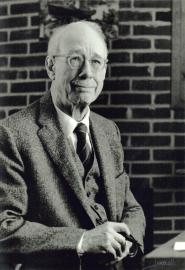
Open Lewis, C.I.'s interactive page (graphs of influences, similar and opposing positions, and quotes)
Background
Clarence Irving Lewis (C. I. Lewis)
Born: April 12, 1883 in Stoneham, Massachusetts,
United States
Died: February 3, 1964 (aged 80) in Menlo Park,
California, United States
Alma mater: Harvard University
Schools: Pragmatism, Analytic
Main interests: Epistemology, logic, ethics,
aesthetics
Notable ideas: Conceptual pragmatism, modal
logic, qualia
Influences: Josiah Royce, Ralph Barton Perry,
William James, David Hume, Immanuel Kant,
Charles Sanders Peirce
Influenced: Nelson Goodman, Willard Van
Orman Quine, Roderick Chisholm, Roderick
Firth, W. K. Frankena, Robert Paul Wolff,
Donald Davidson, Saul Kripke, Walter A.
Shewhart, W. Edwards Deming
From Wikipedia
C. I. Lewis was an American academic philosopher and the founder of conceptual pragmatism. First a noted logician, he later branched into epistemol- ogy, and during the last 20 years of his life, he wrote much on ethics. The New York Times memorialized him as "a leading authority on symbolic logic and on the philosophic concepts of knowledge and value." He was the first to coin the term "Qualia" as it is used today in philosophy, linguistics, and cognitive sciences.
Introductory Comments
Philosophers have long been tempted to picture the knower as a spectator - a mind seated quietly in the dark while experience plays across the screen. The picture is tidy, but it has one large flaw: spectators never have to do anything. Real knowers do. They must decide whether the ice will hold, whether the dog will bite, whether those clouds mean rain. C. I. Lewis built his theory of knowledge around that plain fact. Knowledge, he argued, exists for the sake of action. A theory that forgets this describes someone who never has to get out of the chair.
From there Lewis forged an unusual alliance between Kant and American pragmatism. With Kant, he held that the mind meets experience armed with concepts it did not find there. With the pragmatists, he held that those concepts are tools, kept because they work rather than because they mirror some fixed structure in the nature of things. The result, his "pragmatic conception of the a priori," has a whiff of paradox about it. It describes truths no experience can overturn, which we may nonetheless abandon when a better scheme comes along. Even logic, on this view, is less a set of eternal laws than a system we adopt, and could in principle revise, because it serves us. When the logical positivists reached America in the 1930s, they found much in Lewis to agree with. Where they parted ways was over value. Lewis insisted that judgments of value are as much a matter of knowledge as anything in science.
Some of C. I. Lewis's Key Positions
Knowledge has two ingredients: the given, which is raw sensory experience the mind neither creates nor alters, and the concepts that interpret it. Knowledge arises only where they meet.
The a priori is real but not fixed. A priori principles, including those of logic, are true by definition and cannot be refuted by experience. Yet they are chosen, and they can be replaced by more useful ones.
Empirical knowledge is predictive: to call an object real is to say that certain actions would yield certain experiences. No finite set of tests exhausts these predictions, so such knowledge is only probable. But if anything is to be probable, something must be certain, and that something is immediate experience.
Linguistic meaning is the web of definitions linking terms. Sense meaning is the imagined test in experience by which one recognizes what a term applies to. Empirical knowledge rests on sense meaning.
Judgments of value are a form of empirical knowledge. Like any prediction, they are true or false and confirmable by experience; they do not merely express feelings. Questions of right and wrong, however, are not reducible to questions of value. They answer to imperatives of rationality and consistency.
Place in the History of Ideas
C. I. Lewis's Place in History of Ideas
Eric Dayton: Lewis’s philosophy as a whole reveals a systematic unity in which logic, epistemology, value theory and ethics all take their place as forms of rational conduct in its broadest sense of self-directed agency. In his first major work, Mind and the World Order..., Lewis put forward a position he called "conceptualistic pragmatism" according to which empirical knowledge depends upon a sensuous "given," the constructive activity of a mind and a set of a priori concepts which the agent brings to, and thereby interprets, the given. These concepts are the product of the agent’s social heritage and cognitive interests, so they are not a priori in the sense of being given absolutely: they are pragmatically a priori. They admit of alternatives and the choice among them rests on pragmatic consid- erations pertaining to cognitive success.
Bruce Hunter: Value and disvalue are modes or aspects of experience to which desire and aversion are "addressed." Lewis denies that "pleasure" is adequate to the wide variety of what is found directly good in experience, and thus thinks it inadequate as a synonym for "good." ... Lewis directly found goodness... to be as natural a quality or property of certain experiences as any other qualia directly apprehended in experience.... What is ultimately good for Lewis is the quality of a life found good in the living of it.
Random Thoughts on C. I. Lewis
For centuries, philosophers treated the mind as a mirror - an image Rorty would later make famous. A good mind, like a good mirror, would reflect the world as it is, adding nothing and leaving nothing out. Descartes wanted the reflection guaranteed with mathematical certainty. Locke was more modest. He thought some of our ideas resemble their causes and others do not, and he cheerfully allowed that the candle of human understanding shines "bright enough for all our purposes." Those purposes, though, stayed mostly offstage.
Lewis brought them to center stage. Knowledge, he argued, is no copy of anything. The mind brings concepts to experience, choosing them much as a carpenter chooses tools: for what they let us do. As Lewis put it, concepts translate data into "instruments of prediction and control." A good concept lets us anticipate what comes next, sort the flood of experience into order, and act with some hope of success.
Think of the difference as one between two questions about a map. The mirror theorist asks whether the map faithfully reproduces the territory. Lewis asks whether it gets us where we need to go. But there is a catch, and Lewis knew it. To get us where we need to go, a map may choose the scale and the projection, and may include aids to help us get from point A to point B, but it must not change where the river runs. Lewis gave the mind its tools without giving it the last word.
Influences
Lewis, C.I. was influenced by: Hume, James, Kant, Peirce, Perry, Ralph B., Royce
Lewis, C.I. influenced: Chisholm, R., Davidson, Deming, W.E., Firth, R., Frankena, Goodman, Kripke, Quine, Shewhart, Wolff, R.P.
Similar and opposing positions
Thinkers with similar positions:
- Bolzano (Logic must remain free from any psychological admixture.)
- Dennett (Knowledge & evaluation are essentially animal adaptive responses.)
- Foot (Moral judgments have a biological basis and are entrenched in our nature.)
- Hare (Moral statements do not objectively describe, but rationally prescribe.)
- James (Cognition connects present experience with possible eventualities.)
- Mead (Our knowledge of the world is largely shaped by pragmatic concerns.)
- Moore (Though in part intuitive, moral judgments can be objectively true.)
- Peirce (We perceive the singular with the senses & the universal thru intellect)
- Schlick (Outside logic & math, the truth of statements must rest on evidence.)
Thinkers with opposing positions:
- Carnap (Metaphysics should play no role in responsible human discourse.)
- Carnap (Meaning of a sentence is equivalent to stating its truth conditions.)
- Hamann (I trust the power of passion and symbol over abstraction and logic.)
- Mill (Logic is not an autonomous discipline, but a branch of psychology.)
- Russell (Language is ultimately dependent upon a layer of atomic facts.)
- Russell (Language that is not verifiable is not true or untrue but meaningless.)
- Schlick (A statement that cannot be falsified by evidence is meaningless.)
What others said about Lewis, C.I.
- Eric Dayton: Lewis was entirely opposed to the positivist conception of value statements as devoid of cognitive content, as merely expressive.
- Ayer: For Lewis there are no synthetic a priori propositions. The propositions of pure mathematics are analytic, and it is a contingent question whether they are applicable to matters of empirical fact.
- Bruce Hunter: Lewis was also a key figure in the rise of analytic philosophy in the United States, both through the development and influence of his own writings and through his influence, direct and indirect, on graduate students at Harvard, including some of the leading analytic philosophers of the last half of the 20th century.
- Eric Dayton: For Lewis knowledge does not copy anything but concerns the relation between this experience and other possible experiences of which this experience is a sign.
- Bruce Hunter: [Lewis believed the] felt goodness of experience is what is intrinsically good or valuable for its own sake.
- Ayer: Lewis several times refers to the emotive theory of ethics in terms of pious horror, but it does not seem to me that the differences between it and his own position run very deep.
- Eric Dayton: The rapid abandonment of experiential analysis in favor of physicalism by the major positivists and their rejection of value as lacking cognitive significance both struck [Lewis] as particularly unfortunate. Indeed his own deepening conversation with the pragmatic tradition led him in the opposite direction.
- W. T. Parry: [Lewis] is the principal founder of the modern symbolic treatment of modal logic and theory of entailment.... He [also] heightened the awareness of the interrelations between logic, epistemology, and value theory....
Schools: Analytic Philosophy, Empiricism, Pragmatism
Main interests: Art and Aesthetics, Epistemology, Ethics, Logic
Lewis, C.I.'s answers to philosophical questions
Art and Aesthetics
"The aesthetic attitude is one of disinterested interest in the presented, attentiveness to the given in its own right...."
Epistemology
"If the mind does not shape or condition what is given to it how could valid knowledge be possible?"
"Knowing begins and ends in experience; but it does not end in the experience in which it begins."
"The only knowledge a priori is purely analytic; all empirical knowledge is probable only."
Analytic statements are necessarily true since they are true by definition. However, such truths are of limited value.
"If the truth should be… disillusioning, it would still not be a merit to substitute for it [something] more comforting…."
Ethics
"No rule of action is right except one which is right in all instances, and therefore right for everyone."
Despite what the positivists say, values represent real knowledge in that they guide towards our needs and potentialities.