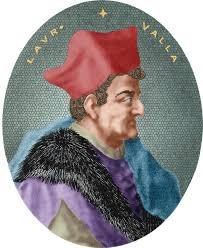
Lorenzo Valla (c. 1407 - 1457)
Open Valla's interactive page (graphs of influences, similar and opposing positions, and quotes)
Background
Lorenzo Valla
Born: c. 1407 in Rome
Died: 1457 in Rome
Main Interests: Language, literature, philology,
rhetoric, Greek philosophy, education, religion,
theology
Influences: Aristotle, Epicurus, Nicholas of Cusa,
Bessarion, Cicero, Quintilian, Vittorino da Feltre,
Giovanni Aurispa, Poggio Bracciolini
Influenced: Erasmus, Luther, Robert Bellarmine,
Angelo Poliziano
School: Humanism
Main interests: Language, literature, philology,
philology, rhetoric, Greek philosophy,
education, religion, theology
From Wikipedia
Lorenzo Valla was an Italian Renaissance human- ist, rhetorician, educator and scholar. He is best known for his historical-critical textual analysis that proved that the Donation of Constantine was a forgery, therefore attacking and undermining the presumption of temporal power claimed by the papacy. Lorenzo is sometimes seen as a pre- cursor of the Reformation…. [In older biographies] he appears as quarrelsome, combining humanistic elegance with critical wit... and an opponent of the temporal power of the Catholic Church.
Introductory Comments
God bless cantankerous curmudgeons, for they stirreth things up. And God bless Lorenzo Valla, who was so cantankerous that he not only landed before the Inquisition but also found time to attack Medieval Scholasticism, berate the much-beloved Aristotle for his airless logic, praise the then-condemned Epicureans, condemn the then-esteemed Stoics, scold Livy for the inaccuracies in his histories, denounce St. Jerome for his rendering of the Bible (the sacred Vulgate), fault Boethius for leaning on Plato, and rebuke Aquinas for leaning on Aristotle. Then, to stretch his neck as far as humanly possible, he made war on the papacy itself by exposing the Donation of Constantine - the document that supposedly granted the Pope supreme earthly authority - as a forgery. And this tally leaves out the countless brawls he picked with his fellow scholars.
One contemporary claimed Valla wrote simply to annoy people: a kind of court jester who relished putting down anyone, living or dead, who was widely admired, and who delighted, whenever he could, in savaging what others held most precious. Is there a role for professional malcontents like Valla? Surely. Naysayers stirreth things up. And the pot of ideas must be stirred, as witches do with their cauldron, else the weightiest notions may sink to the bottom, forever unseen and untasted. Socrates, Diogenes, Machiavelli, Luther, Galileo, Spinoza, Hume, Rousseau, Darwin, Nietzsche: God bless those who stirreth thing up.
Some of Valla's Key Positions
Philosophy needs to "re-plough" the infertile ground of Scholasticism. For too long its practitioners have lost themselves and their readers in tangled logic, meaningless distinctions, and verbal sloppiness. This absurd system must go.
The way to make philosophy fertile again is to replace pedantic nonsense with plain common sense, expressed in ordinary language: "Let us conduct ourselves more simply and more in line with natural sense and common usage. Philosophy and dialectic... ought not to depart from the most customary manner of speaking." Many Scholastic distinctions should simply be banished - matter from form, essence from existence, particular things from universals, and the rest.
We should also think harder about language itself. The study of words aids both human discourse and thought, for words are the very tools of discourse and thought. Grasping how language develops historically matters too, since a text's meaning cannot be fully understood apart from the context in which it was written.
Such philological analysis can even expose certain documents as outright frauds. The most important example here is the Donation of Constantine, which was supposedly a 4th-century decree of emperor Constantine granting the papacy vast worldly power. But a careful analysis of its language reveals what it really is: an 8th-century fake.
Place in the History of Ideas
Valla's Place in History of Ideas
Neal W. Gilbert: Lorenzo Valla, the Italian humanist, is best known as the man who exposed the Donation of Constantine and thus undermined a leading argument for papal sovereignty in the secular realm. This fact and the reputation for hedonism derived from his youthful work De Voluptate (On pleasure) have conspired to invest Valla with an air of disre- pute that he probably does not deserve. In particular, this reputation does not do justice to Valla's efforts on behalf of a return to the spirit of the Gospel or to his respect for Paul and the early Greek and Latin Church Fathers, in which he clearly anticipates later develop- ments. Nor does it recognize his passion for historical truth and for the defense of plain speaking against what he regarded as meta- physical obscurity and verbalizing.
John Herman Randall Jr.: Lorenzo Valla, skeptical and ironic critic of tradition, was the first to attack the Aristotelian method formal- ly.... [He argued that] scholastic logic is mere sophistry, for Schoolman use such barbarous and complicated Latin. Logic must be made a rational science through a simplification of its language.... Above all we must get rid of its empty abstract terms and return to the concrete, to things. Since thought is a practical activity leading to expression, the science of thought must be the science of language, a branch of the more inclusive rhetoric.
Random Thoughts on Valla
Valla was in some ways the first linguistic philosopher - the first to wield the analysis of language as both a tool for understanding and a battering ram against misunderstanding. Like the "ordinary language" philosophers of the twentieth century, Valla held that when we drift from the plain, commonsense meaning of words, we soon get tangled in our own jargon. This, he argued, was precisely why Medieval Scholasticism had lost touch with reality: its endless logic-chopping and hair-splitting bred a technical vocabulary so specialized and abstract that it no longer clarified thought - it smothered it.
The Schoolmen of the past could of course fire back. Such a reverence for ordinary language, they might say, betrays either an inability or an unwillingness to grapple with genuinely hard problems. The deeper one digs into philosophical questions, they could argue, the more one is forced to draw distinctions that ordinary speech never bothered to make; and to refuse ever to leave everyday language is simply to refuse to think beyond the everyday. So the quarrel between Valla and the Scholastics - like the later one between "ordinary language" and analytic philosophers - comes down to the question: does the looseness and flexibility of ordinary language capture reality better than any rigidly precise, specialized language ever could? Or, if you will: Is the world precise, and our words lazy; or is the world messy, and our precision a pretense?
Influences
Valla was influenced by: Aristotle, Aurispa, Bessarion, Bracciolini, Bruni, Cicero, Epicurus, Jerome, Nicholas of C., Quintilian, Vittorino
Valla influenced: Bellarmine, Erasmus, Luther, Poliziano
Similar and opposing positions
Thinkers with similar positions:
- Carnap (Many philosophical questions abuse language and are meaningless.)
- Dilthey (Understanding texts requires understanding historical worldviews.)
- Epicurus (Contentment is gained thru moderation and living a measured life.)
- Erasmus (The Catholic Church should be reformed, not overthrown or destroyed.)
- Hamann (Language does not spring from reason. Reason springs from language.)
- Herder (Language helps shape the unique thinking & feelings of a people.)
- Wittgenstein (Ordinary language analysis can dissolve all metaphysical issues.)
Thinkers with opposing positions:
- Albertus Mag. (Aristotle's philosophy is compatible with Christian beliefs.)
- Aquinas (Philosophy & revelation are different means of reaching same truth.)
- Boethius (Logic is an important discipline and tool when doing philosophy.)
- Derrida (It's fruitless to ground meaning on links betweeen text and the world.)
- Holbach (Religion is an impediment to the moral advancement of humanity.)
- Lacan (To survive one must be taken in by signs and be the dupe of language.)
- Pinker (The structure of a language does not affect its speakers' worldview.)
- Savonarola (Church officials should play a role in the administration of the state.)
- Skinner (Free will is not possible in our deterministic world.)
What others said about Valla
- John Herman Randall Jr.: [Valla defended our] seeking pleasure. I ndeed, what is Christianity itself but a sublimated form of hedonism?
- Erasmus: [Valla] refuted the stupidities of the barbarians [and] restored Italy to her ancient splendor of eloquence [and] forced even the learned to express themselves henceforth with more circumspection.
- Copleston: The Aristotelian logic, in Valla's opinion, is sophistry, depending largely on linguistic barbarism.... Many of the terms employed in the Aristotelian logic... do not express insight into the concrete characteristics of things, but are artificial constructions.... A reform of speech is needed, and logic must be recognized as subordinate to "rhetoric."
- Neal W. Gilbert: Valla was perhaps the most versatile of the humanists; he initiated a series of attacks upon Scholastic logic, theology, and law, in addition to his contributions to historical and textual criticism.
- Robert Bellarmine: [Lorenzo Valla was] Luther's precursor.
- Randall: [Valla] sympathizes with the Epicurean who places the highest good in tranquil pleasure [and] declares that the prostitute is better than the nun in that she makes men happy while the nun lives in shameful and futile celibacy....
- Cassirer: Valla's basic thesis states that Christianity is not inimical to Epicureanism, for it is itself nothing but a more elevated and "sublimated" Epicureanism. Is the bliss that Christianity promises its followers anything but the highest and most complete form of pleasure?
- Russell: Lorenzo Valla, an Epicurean,... who ridiculed the style of the Vulgate..., was made apostolic secretary. This policy of encouraging humanism rather than piety or orthdoxy continued until the sack of Rome in 1527.
Schools: Christian Theology, Hermeneutics, Humanism
Main interests: Education, Language, Literature, Philology, Religion, Rhetoric, Theology
Valla's answers to philosophical questions
Ethics
Despite what the Platonists and Stoics say, virtue is not and end in itself. A good deed is one that leads to good results.
Once you have achieved a virtuous life, you may in good conscious live a life of prudent pleasure - both on earth & in heaven.
Bodily pleasures, if moderately pursued, need not be sacrificed for the sake of stoic resignation or prudish abstinence.
History
History shows us why the world is the way it is and why we are the way we are. "Without history one remains always a child."
Language
The study of words can serve as an aid both in discourse and in thought itself. After all, words are the tools of discourse.
Philosophy
Logic, as seen in Aristotle and many of his followers, is often based on linguistic barbarisms and outright sophistry.
Religion and Theology
Since God's will is known to no man, we can't know whether it limits human freedom. Free will is a matter of faith.
Philology is crucial to understanding scripture - particularly a deep and extensive knowledge of Latin and Greek.