Girolamo Savonarola (1452 - 1498)
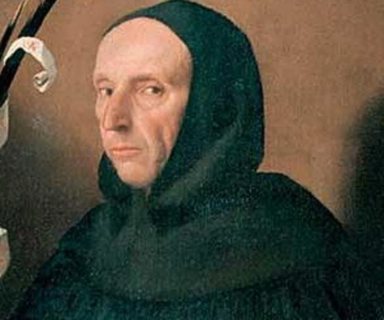
Open Savonarola's interactive page (graphs of influences, similar and opposing positions, and quotes)
Background
Savonarola
Born: September 21 1452 in Ferrara, Duchy of
Ferrara in the Holy Roman Empire
Died: May 23 ,1498 (aged 45) in Florence,
Republic of Florence
Main Interests: Religion, politics, political
philosophy, morality, poetry
Influences: Aristotle, Aquinas, Petrarch, Jan Hus
Influenced: Luther, Henry VIII, Calvin, Joseph
Schnitzer, Luigi Sturzo, Philip Neri, Machiavelli,
Pius X, Giovanni Pico della Mirandola
From Wikipedia
Savonarola was an ascetic Dominican friar from Ferrara and a preacher active in Renaissance Florence. He became known for his prophecies of civic glory, his advocacy of the destruction of secular art and culture, and his calls for Christian renewal. He denounced clerical corruption, des- potic rule, and the exploitation of the poor…. Some Protestants, including Martin Luther himself, have regarded Savonarola as a vital precursor to the Protestant Reformation.
Introductory Comments
No good deed goes unpunished, as they say. In 1490 Lorenzo de' Medici - fabulously wealthy patron of the arts and de facto ruler of Florence - invited Savonarola back to the city to resume his sermons on simplicity. (Lorenzo was gravely ill by this point, so perhaps a little heavenly credit seemed a prudent investment.) Savonarola returned, and preach on simplicity he did, thundering against the corruption and opulence of the papacy. Oh, and one more thing: he also preached that Florence must throw off its tyrant - Lorenzo de' Medici himself.
Yet Lorenzo sought no revenge. On his deathbed in 1492 he is said to have summoned the very friar who had denounced him, hoping for absolution. Fancy that. After Lorenzo's death, Savonarola and his allies helped drive out his heir, Piero de' Medici. With Piero gone, Savonarola's followers built a republic dedicated to scrubbing Florence clean of its sinful Renaissance ways.
But when the city refused to join the league arrayed against Charles VIII of France, Pope Alexander VI laid the blame on Savonarola and, in time, excommunicated him. From there things went from bad to worse, and before long the friar found himself in the Piazza della Signoria - the very square that had staged his famous Bonfire of the Vanities - now hanged and given to the flames himself. Savonarola had set out to purify Florence by fire. In the end, Florence returned the favor.
Some of Savonarola's Key Positions
The strength of a state springs from the strict Christian devotion of its citizens. To the degree that its people commit themselves to rigorously moral lives, the state grows glorious, prosperous, and powerful. Should Florence heed this call, it will become the center of the Christian world, commanding both temporal and spiritual authority.
Such devotion demands far purer lives. Those who cannot conquer every desire of the flesh must at the very least renounce outright sin - adultery, sodomy, gambling, public drunkenness, ostentatious dress, and the rest of the seven deadly sins, along with blasphemy, lying, and the many lesser vices.
The Church must purify itself as well. Convents and monasteries must recover their original, rigorous discipline. Its leaders must forswear luxury and the showy display of wealth. Friars must stop lining their own pockets and return to serving society and spreading God's love.
Government has an essential part in securing these moral and institutional reforms. The best form, all things considered, is a republic, since it makes citizens feel fully invested in the common good. Yet republican participation must somehow be joined to a religiously guided leadership - one that supplies moral direction and guards Christian values.
Place in the History of Ideas
Savonarola's Place in History of Ideas
Quentin Skinner: [Savonarola] insisted that the proper roles of human life are not connected in the least with worldly advancement or display, but with the cultivation of Christian humility and godliness.... Nevertheless, it would be mis- leading to suggest, as Chabod and others have done, that Savonarola's "principle theme" was "one of revolt against the times".... On the con- trary, it is evident that even his special prophet- ic vision of [Florence's] future was closely con- nected with a number of well-entrenched Flor- entine myths.... It is a remarkable feature of [Savonarola's] argument that he is quite willing to endorse the comfortable assumption that Florence's great wealth should be taken as a sign of God's favor, and that her citizens may expect "an abundance of riches" as long as they follow God's commands.
Philip Schaff: Dizzy flights of fancy abounded in Savonarola's discourses and took the place of calm and logical exposition. On the evening be- fore he preached his last sermon in Advent, 1492, Savonarola beheld in the middle of the sky a hand holding a sword with the inscription, Behold the sword of the Lord will descend sud- denly and quickly upon the earth.... Suddenly the sword was turned toward the earth, the sky was darkened, swords, arrows and flames rained down. The heavens quaked with thunder and the world became a prey to famine and death.
Random Thoughts on Savonarola
Newton's third law states that "for every action there is an equal and opposite reaction." Though this is not as true in the history of ideas as it is in physics, it's true enough. Again and again, movements that celebrate human reason, freedom, or worldly achievement seem to provoke movements determined to put humans back in their place. The exuberance of Renaissance Florence met the stern Christianity of Savonarola and his Piagnoni; Enlightenment rationalism helped bring about the Great Awakenings; Protestant modernism provoked fundamentalism. Push hard enough in one direction, it seems, and history has a habit of pushing back.
Why the backlashes? Animals, after all, lodge no complaints about the animal-rights movement. Why have so many humans recoiled from humanism? For strikingly different reasons. Hobbes embraced authority as the only thing standing between us and a bloody war of all against all. Burke argued, more mildly, that respect for inherited hierarchies keeps the social order from unraveling. Dostoyevsky suspected we simply cannot bear the weight of freedom. Chesterton insisted we need grand narratives to live by. And Savonarola condemned humanism for the gravest reason of all: in exalting created man above God his Creator, it turned the whole moral universe upside down. Call it, if you like, humanism's third law: every celebration of humanity seems to summon its own equal and opposite sermon.
Influences
Savonarola was influenced by: Aquinas, Aristotle, Hus, Petrarch
Savonarola influenced: Calvin, Henry VIII, Luther, Machiavelli, Neri, Philip, Pico, Pius X, Schnitzer, J., Sturzo, Luigi
Similar and opposing positions
Thinkers with similar positions:
- Al-Ghazali (We must restrain our animal nature and develop our angelic spirit.)
- Chesterton (The carpe diem religion is not the religion of happy people.)
- Cicero (Republics require that citizens place public good over private gain.)
- Erasmus (The Catholic Church should be reformed, not overthrown or destroyed.)
- Luther (The Catholic Church has often been guilty of oppression & corruption.)
- Machiavelli (Religion is essential for keeping a republic in order.)
- Sorel (A moral revival of the country is needed to save it from decadence.)
Thinkers with opposing positions:
- Bataille (To be free means to be unrestrained by any chains of morality.)
- Bentham (Our ultimate motive is always to experience pleasure and avoid pain.)
- Epicurus (The gods do not punish the bad and reward the good.)
- Hooker (Religion is based on revelation, but also on reason and tradition.)
- Nietzsche (Christianity has a "slave morality" placing weakness over strength.)
- Sade (Bodliy pleasures should be vigorously pursued, not dismissed as sins.)
- Suarez (In metaphysics the individual remains the fundamental reality.)
- Tillich (Humanism today has too much faith in man & all too little faith in God.)
What others said about Savonarola
- Simon Montefiore: Savonarola's "Christian and religious republic" was an intolerant, sanctimonius and murderous reign of terror.
- Quentin Skinner: [Savonarola] was one of the most influential supporters of the restored Florentine republic, and one of most powerful spokesman in favour of city's traditional liberties.
- Machiavelli: If Moses... and Romulus had been unarmed, they could not have enforced their constitutions for long - as happened in our time to Fra Girolamo Savonarola, who was ruined with his new order [when] the multitude believed in him no longer, and he had no means of keeping steadfast those who believed or of making the unbelievers to believe.
- Ludwig Pastor: The terrorism exercised by Savonarola and his adherents grew daily more and more intolerable. The prophet declared that no one could be a good Christian who did not believe in him.
- Russell: Even in Italy, it is true, the Middle Ages did not die without a struggle; Savonarola and Leonardo were born in the same year.
- Ken Curtis: Giroloma Savonarola differed from Wycliffe, Hus, and Luther in that he never quarreled with the theology of the Roman Catholic Church. He was more of a moral reformer than a theologian.
- Philip Schaff: Savonarola was not merely the expounder of righteousness. He claimed to be a prophet revealing things which, to use his own words, "are beyond the scope of the knowledge which is natural to any creature." This element would have been a sign of weakness, if it had not been associated with a great personality, bent on noble ends.
- Anonymous: The best, and the worst, that can be said of the tempestuous friar is that he loved God so passionately that he had very little love left for man.
Schools: Christian Theology
Main interests: Ethics, Faith, Free/Unfree Will, Immortality, Poetry, Political Philosophy, Politics, Religion, Salvation
Savonarola's answers to philosophical questions
Art and Aesthetics
Sacred art is a useful tool for promoting religion, but secular art is worthless and at times quite dangerous.
Ethics
Love expresses one's spirituality: In loving their neighbors, Christians return the love God has bestowed upon them.
If one is not able to avoid all desires of the flesh, one must at least avoid adultery, sodomy and other sexual sins.
Metaphysics
"Do you wish to be free? Then above all things, love God, love your neighbor...; then you will have true liberty."
Political Philosophy
Too often governments rule despotically and exploit the poor. A Christian government should be Christian in its ways.
A republic is the best form of government, but it must be paired with priestly rule to ensure Christian values & norms.
If Florence is to become the world center of Christianity, a puritanical crusade is needed to uplift and purify the public.
A Christian government must do everything in its power to ensure that its citizens live up to strict, Christian morality.
Religion and Theology
Faith is the foundation of the church and the soul of the believer: "A life without faith is a life devoid of meaning."
Public exercises, such as processions, bonfires of the vanities & pious theatricals, help people lead more Christian lives.
Beware book reading and so-called reason, for they can lead to atheism. True religion springs from the simple & earnest heart.
Society
A general commitment to living rigorously Christian lives will lead to a more glorious, prosperous and powerful state.