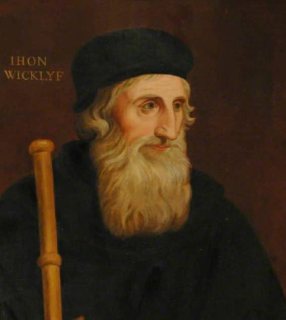
John Wycliffe (c. 1328 - 1384)
Open Wycliffe's interactive page (graphs of influences, similar and opposing positions, and quotes)
Background
John Wycliffe
Born: c. 1328 in Hipswell, Yorkshire, England
Died: December 31, 1384 in Lutterworth,
Leicestershire, England
Alma mater: Merton College, Oxford
Notable work: Wyclliffe's Bible
Main interests: Theology, religion
Influences: Roger Bacon, William of Ockham,
Robert Grosseteste, Thomas Bradwardine,
Richard Fitzralph, Augustine, Aristotle, Plotinus
Influenced: Jan Hus, Martin Luther, Henry VIII,
John Clavin, Huldrych Zwingli, William Tyndale,
Robert Alyngton, William Penbygull, Johannes
Sharpe, William Milverley, Roger Whelpdale,
John Tarteys, Paul of Venice
From Wikipedia
Wycliffe was an English scholastic philosopher, theologian, purported biblical translator, reform- er, Catholic priest, and a seminary professor at the University of Oxford. He became an influential dissident within the Catholic priesthood during the 14th century and is considered an important predecessor to Protestantism. Wycliffe questioned the privileged status of the clergy... and advocated radical poverty of the clergy….. Wycliffe's writings... greatly influenced the philosophy and teaching of the Czech reformer Jan Hus.
Introductory Comments
How did John Wycliffe - a scholar prized for his austerity, a man seemingly built for library carrels rather than court intrigue - end up entangled with the rich and powerful? His stature at Oxford made him a name worth knowing, but it was the content of his theology, not his reputation, that drew courtiers to his door. His attacks on clerical corruption and on the papacy's shaky claim to worldly power gave ambitious men exactly what they wanted: a respectable justification for stripping the Church of its power and its wealth.
The arrangement, in other words, was mutually convenient. The crown and nobility needed Wycliffe's theology to legitimize their designs on Church property; Wycliffe needed their protection from a Church eager to try him for heresy. Each side got something it could use, and so the ascetic scholar found himself, however awkwardly, at the elbow of power. And he was not alone. Other such men found themselves enmeshed in the this-worldly business of power politics - Jan Hus, Martin Luther, John Calvin all made common cause with mighty patrons.
And the great mass of ordinary people? At first, they hardly figured at all. But in time they proved the big winners. A weaker Church meant a stronger nation; a stronger nation meant, eventually, stronger institutions - assemblies, government offices - and with those institutions came, at last, the possibility of representation.
Some of Wycliffe's Key Positions
The current wealth, pomp, and worldliness of the Catholic Church undermine its role as spiritual guide. The clergy should renounce luxury, freeing themselves to attend to their flock's spiritual concerns. Monasteries' endowments should be stripped away: rather than nurseries of holiness, they have become breeding grounds for greed and idleness.
In tending to souls, clerics should concern themselves with the state of a person's faith rather than with external and merely physical things - pilgrimages, and the veneration of saints, the mechanical performance of the sacraments.
Scripture, not the rites and teachings of clerics, is the true source of our knowledge of God and of what He asks of us. The Bible should therefore be translated into the vernacular, so that everyone may read it directly.
The Church must likewise abandon its pretensions to temporal rule. This applies to the papacy itself, which has no scriptural warrant. Political power belongs rightly to the king and his officers.
Most important of all, we must not confuse the visible Catholic Church with the true but invisible church of the elect. God has predestined some to salvation and some to damnation, and the Church's grand displays only distract from this essential truth.
Place in the History of Ideas
Wycliffe's Place in History of Ideas
Alessandro Conti: John Wycliffe was one of the most important and authoritative thinkers of the Middle Ages. His activity is set in the very crucial period of late Scholasticism, when the new ideas and doctrines there propounded accelerated the transition to the modern way of thought. On the one hand, he led a move- ment of opposition to the medieval Church and to some of its dogmas and institutions, and was a forerunner of the Reformation; on the other, he was also the most prominent English philos- opher of the second half of the 14th century. His logical and ontological theories are, at the same time, the final result of the preceding realistic tradition of thought and the starting-point of the new forms of realism at the end of the Middle Ages....
Russell: Wycliffe is remarkable for the extreme slowness of his development. In 1372, when his age was fifty or more, he was still orthodox; it was only after this date, apparently, that he became heretical. He seems to have been driven into heresy entirely by the strength of his moral feelings - his sympathy with the poor, and his horror of rich worldly ecclesiastics. At first his attack on the papacy was only political and moral, not doctrinal; it was only gradually that he was driven into wider revolt.... He taught, further, that property is the result of sin; Christ and the Apostles had no property, and the clergy ought to have none.
Random Thoughts on Wycliffe
Though the history of ideas has a life of its own, that life can never be wholly divorced from the economic and social forces at work around it. The heretical current John Wycliffe rode is a good case in point. Improved agricultural techniques yielded surplus food in the late Middle Ages. Surplus food freed more people to specialize in trades other than farming. That specialization fed the rise of merchant guilds and trade fairs, which spurred commerce and urbanization, which in turn widened literacy and encouraged a more democratic cast of mind - and with all that came a keener hunger for a Bible one could actually read, and a hotter anger at the corruption of the papacy and the whole Roman Church.
So enter John Wycliffe: the man behind the first English Bible and a scourge of the Church's corruption. The little history sketched above needs far more fleshing out, of course, but it does lend some context to Wycliffe's heretical agenda - as it does to that of other so-called heretics, like Hus, Luther, and Calvin. Still, we should not mistake context for causality. The old question remains: is history shaped by the actions of remarkable men and women, or by impersonal economic and social forces? Wycliffe's own answer was neither. God alone calls the shots. Remarkable individuals are merely the bullets He fires. But this "neither" answer is still an answer - for whether the hand is God's or history's, the bullet does not choose its targets.
Influences
Wycliffe was influenced by: Aquinas, Aristotle, Augustine, Bacon, Roger, Bradwardine, Democritus, Fitzralph, R., Grosseteste, Ockham, Plato, Plotinus
Wycliffe influenced: Alyngton, R., Calvin, Henry VIII, Hus, Luther, Milverley, W., Paul of Venice, Penbygull, W., Sharpe, J., Tarteys, John, Tyndale, W., Van Til, C., Whelpdale, R., Zwingli
Similar and opposing positions
Thinkers with similar positions:
- Al-Ghazali (Though God's foreknowledge is perfect, free will is still possible.)
- Augustine (God is transcendent. He is above everything in nature.)
- Bacon, Roger (To protect yourself from heresy, turn to the word of God.)
- Calvin (Jesus Christ suffered crucifixion as an atonement for human sin.)
- Erasmus (True piety consists not in outward ceremonies but inward conversion)
- Hus (The Catholic Church has become materialistic, avaricious and corrupt.)
- Plantinga (Our free will is compatible with an omnipotent & omniscient God.)
- Plato (Universals or metaphysical Forms are more real than individual things.)
Thinkers with opposing positions:
- Abelard (Universals don't exist independent of concrete, individual things.)
- Aquinas (Universals are "embedded" in particular objects as their "whatness.")
- Luther (Given God's sovereignty & our own sinfulness, there is no free will.)
- Luther (Reason cannot aid faith. It is the greatest enemy that faith has.)
- More (The Catholic Church should be reformed, not overthrown or destroyed.)
- Ockham (Universals are just concepts. Only concrete individual things are real.)
- Savonarola (Church officials should play a role in the administration of the state.)
- Weil (Religious rituals can enhance our love of God and our devotion to God.)
What others said about Wycliffe
- Randall: [Wycliffe's] denunciation of the Pope [and] of the sins of the clergy, and his appeal to the Bible as an ultimate authority... paved the way for revolt.
- William Thorpe: [Wycliffe] was emaciated in body... and in conduct most innocent. Very many of the chief men of England conferred with him, loved him dearly, wrote down his sayings and followed his manner of life.
- John Stacey: [Wycliffe was a] promoter of the first complete translation of the Bible into English. He was one of the forerunners of the Protestant Reformation. The politico-ecclesiastical theories that he developed required the church to give up its worldly possessions, and in 1378 he began a systematic attack on the beliefs and practices of the church.
- Alessandro Conti: [Wycliffe believed] that all the goods of God should be in common, just as they were before the Fall. Private property was introduced as a result of sin.
- Merle d'Aubigne: This visitation of the Almighty [the Black Death] sounded like the trumpet of the judgment-day in the heart of Wycliffe.
- Philip Schaff: Wycliffe was spare, and probably never of robust health, but he was not an ascetic. In temper he was quick, in mind clear, in moral character unblemished. Towards his enemies he was sharp, but never coarse....
- Anthony Kenny: [Wycliffe was for communism.] On the one hand, someone who is in sin has no right to property. You can only possess something justly if you can use it justly.... On the other hand, if you are in a state of grace,... you inherit the whole realm of God. But if each Christian in grace is lord of all, he must share his lordship with all other Christians in grace.
- Russell: [Wycliffe] held that God's decrees are not arbitrary, as some maintained; the actual world is not one among possible worlds, but is the only possible world, since God is bound to choose what is best.
Schools: Christian Theology
Main interests: Immortality, Religion, Salvation, Spirituality, Theology
Wycliffe's answers to philosophical questions
Economics
Ideally all of God's goods should be held in common, as they were in Eden. Private property is the result of man's Fall.
Metaphysics
Universals precede all things and all events. They spring from God's mind and are essential to His creation of the world.
Philosophy
We should study logic so that we can better understand the human mind and, to some extent, the mind of God.
Political Philosophy
Kings must be obeyed even if they become tyrants. Since they are God’s vicars, only God can dispose them.
The Church should give up all its efforts and pretensions to temporal rule. Political power belongs only to the king.
Religion and Theology
Religion is primarily an inward matter of faith. Rites and rituals of the church focus too much on what is merely external.
The purity of one's faith and state of one's soul - not one's external acts and ritual behavior - compose spirituality.
God first created universals in his mind and then created the world according to these universals.
All things and events existed first in the mind of God, but God's mind is always in sync with the future free will of men.
"For whichever [place a man] goes to [after death], whether he like it well or ill, there he must dwell forevermore."
Grand rites and impressive rituals only distract us from what is most important: the state and future of one's soul.
The supposed miracle of transubstantiation is in fact a lie: bread & wine are not changed into the body & blood of Christ.
God has predestined some of us to be saved and some to be damned. Nothing we can do can change this fact.
"Trust wholly in Christ; rely altogether on His sufferings; [don't seek justification] in any other way than by His righteousness."
"Holy Scripture is the highest authority for every believer, the standard of faith and the foundation for reform."