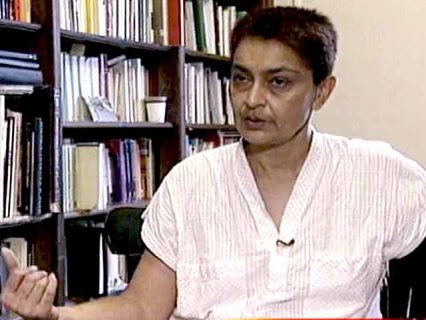
Influenced: Angana P. Chatterji, Judith Butler, R.
Radhakrishnan
From Wikipedia
Spivak is an Indian scholar, literary theorist, and feminist critic. She is… a founding member of the establishment's Institute for Comparative Literature and Society. Considered one of the most influential postcolonial intellectuals, Spivak is best known for her essay "Can the Subaltern Speak?" and her translation of and introduction to Jacques Derrida's De la grammatologie... Although associated with postcolonialism, Spivak confirmed her separation from the discipline in her book A Critique of Postcolonial Reason….
Introductory Comments
Following Derrida, Spivak treats texts as places where a society quietly confesses itself. Every text rests on what it refuses to say - the binaries it props up, the voices it excludes, the assump-tions it smuggles in as common sense. By read- ing against the grain, Spivak shows how the canonical works of Western philosophy, litera- ture, and economics naturalize the hierarchies of class, gender, and labor that organize mod- ern life. When Spivak reads Jane Eyre, for instance, she shows how Jane's triumphant selfhood is quietly purchased at the expense of Bertha Mason, the Creole woman locked in the attic. Deconstruction, then, becomes less a literary game than a way of catching power in the act of pretending to be neutral.
This same deconstructive lens can be turned on colonialism. The great texts of empire - legal documents, travel writing, administrative reports, even well-meaning humanitarian litera-ture - are riddled with assumptions about the inferiority, passivity, and voicelessness of the colonized. In Conrad’s Heart of Darkness, em- pire presents itself as order and civilization even as it disfigures the people it rules. Unpacking such assumptions does not merely reveal preju- dice; it exposes how language was used to make conquest seem natural, inevitable, and even virtuous. As Spivak might have it: the colonizer did not only take the land - he wrote the story that made the taking look like a gift.
Some of Spivak's Key Positions
Marxism, feminism, and deconstructionism complement one another in vital ways: Marxism critiques global economic injustice. But if one has neither voice nor standing - as is the case with subaltern women - then economic redistribution alone cannot heal the indignity of being culturally erased. Hence, Marxists and feminists must work together to address how capitalism and patriarchy deeply entwine.
In resistance, a tactic of "strategic essentialism" is sometimes deployed - a tactic that brings together, at least temporarily, powerless groups divided by race, ethnicity, class, or gender. Then, in mutual support for one another, these groups can more effectively defend their politi- cal and cultural interests, while remembering that no group is ever truly homogeneous.
To undermine oppressive structures, we must lay bare the power dynamics hidden within dominant cultural texts. This is where Derrida's deconstruction comes in: by showing how a text's logic inherently contradicts and sabotages itself, we can expose the cracks in colonial authority. Crucially, this exposure forces us to confront our own complicity in those very dynamics. A caveat, though: Moral condemnations here are insufficient. We must do the difficult work of tracing the historical narratives and economic forces that drive people to cruelity and injustice towards others.
Place in the History of Ideas
Spivak's Place in History of Ideas
Akriti Dhasmana: Gayatri Chakravorty Spivak is an influential critical theorist and researcher with interests mainly in 19th and 20th Century Literature, Marxism, Feminism Deconstruction, General French Theory, Globalization and Postcolonial Political Theory, and Critical Social Theory. Spivak is known for her work as a postcolonial critic…. Her most well known piece of work is "Can the subaltern Speak?" … Her work describes how Eurocentric narratives of the abolishment of the Sati practice actively deny voice to this subaltern community of women who were the colonial subjects. Anoth- er work by her titled "A Critique of Postcolonial Reason" makes similar arguments on how the colonial history and narratives exclude the subaltern experience and discussions.
Terry Eagleton: If colonial societies endure what Spivak calls "a series of interruptions, a repeat- ed tearing of time that cannot be sutured," much the same is true of her own overstuffed, excessively elliptical prose. She herself, unsur- prisingly, reads the book's broken-backed structure in just this way, as an iconoclastic departure from "accepted scholarly or critical practice." But the ellipses, the heavy-handed jargon, the cavalier assumption that you know what she means, or that if you don't she doesn't much care, are as much the overcodings of an academic coterie as a smack in the face for conventional scholarship.
Random Thoughts on Spivak
For Spivak, translation is never innocent. When- ever we render another culture into our own language - whether through scholarship, fiction, journalism, or human rights reports - we inevi- tably choose which voices to amplify, which idi- oms to flatten, and which silences to fill with our own assumptions. The translator's vocabu- lary, genre conventions, and political horizon do the choosing before she does. Worse, the very act of making the foreign legible to a Wes- tern audience often domesticates it, smoothing away precisely the textures and contradictions that made it foreign in the first place.
Yet the claim deserves scrutiny. Human imagi- nation has always crossed boundaries - Tolstoy gave us Anna Karenina, Flaubert gave us Emma Bovary. If a novelist can imaginatively inhabit people separated from her by gender, class, or centuries, why should cultural difference be an absolute barrier? Spivak is right, of course, that translation involves loss and the risk of distor- tion, but loss and the risk of distortion are the conditions of all understanding, not a unique pathology of cross-cultural encounter. On the other hand, Spivak’s warning is admirably cau- tious: we must never mistake our imaginative leaps into other cultures for total, flawless un- derstanding. Intellectual humility reminds us that we are still viewing these cultures through a rental car window - and assuming we own the landscape is exactly how colonial fiction begins.
Barthes (Human consciousness is constrained by culture & its "structures.")
Derrida (Western culture imposes implicit hierarchies on a text's meaning.)
Fanon (Colonization is an attack on the dignity & self-worth of the colonized.)
Gramsci (The bourgeoisie spreads its politics more thru culture than violence)
Gramsci (Overthrowing unjust regimes requires overthrowing their worldviews)
Herder (Different cultures should not be measured against one another.)
Murdoch (Literature can help us clarify and improve our moral perspective.)
Orwell (Colonialism is despotic, even when it pretends to be democractic.)
Said (Cultural stereotypes in literature can encourage political aggression.)
Thoreau (Citizens have a duty to peacefully protest governmental injustice.)
Thinkers with opposing positions:
Arendt (Only rights granted by the state matter, not "inalienable human rights.")
Bataille (Literature has no moral purpose. It's best when disrupting morals.)
Evola (Mixing with inferior non-European races leads to cultural decline.)
Fanon (Like colonization itself, decolonization is inherently a violent process.)
Freud (The social realm plays a minimal role in shaping human psychology.)
Tillich (Humanism today has too much faith in man & all too little faith in God.)
What others said about Spivak
Ramesh Tibile: She is widely acknowledged as the conscience of the metropolitian politics of identity.
Said: [Spivak] pioneered the study in literary theory of non-Western women and produced one of the earliest and most coherent accounts of that role available to us.
Arijit Sen: The words "academic" and "superstar" do not usually belong in the same sentence. But if an exception were to be made, then Gayatri Chakravorty Spivak - literary theorist, feminist critic, and one of the world's foremost postcolonial thinkers - would be the ideal candidate to exemplify both these nouns.
Stephen Howe: Spivak is so bewilderingly eclectic, so prone to juxtapose diverse notions without synthesis, that ascribing a coherent position to her on any question is extremely difficult.
Butler, Judith: [Spivak] gives us the political landscape of culture in its obscurity and proximity.
Ramesh Tibile: Breaking rules of the academy and trespassing disciplinary boundaries have been central to the intellectual projects of Gayatri Spivak, one of the leading literary theorist and cultural critic.
Bollinger: Not only does [Spivak's] world-renowned scholarship… range widely from critiques of post-colonial discourse to feminism, Marxism, and globalization; her lifelong search for fresh insights and understanding has transcended the traditional boundaries of discipline while retaining the fire for new knowledge that is the hallmark of a great intellect.
Michael Rosenthal: She certainly enjoys celebrity status in our profession. But I don't think I am alone sometimes in finding it difficult to understand what exactly she is saying.
Main interests: Alienation, Civil Rights, Colonialism, Cultural Criticism, Cultural Studies, Equality, Freedom, History, History of Ideas, Ideology, Literary criticism, Literary theory, Literature, Political Activism, Political Theory, Power, Psychoanalysis, Psychology, Racism, Rhetoric, Sexuality, Social Criticism